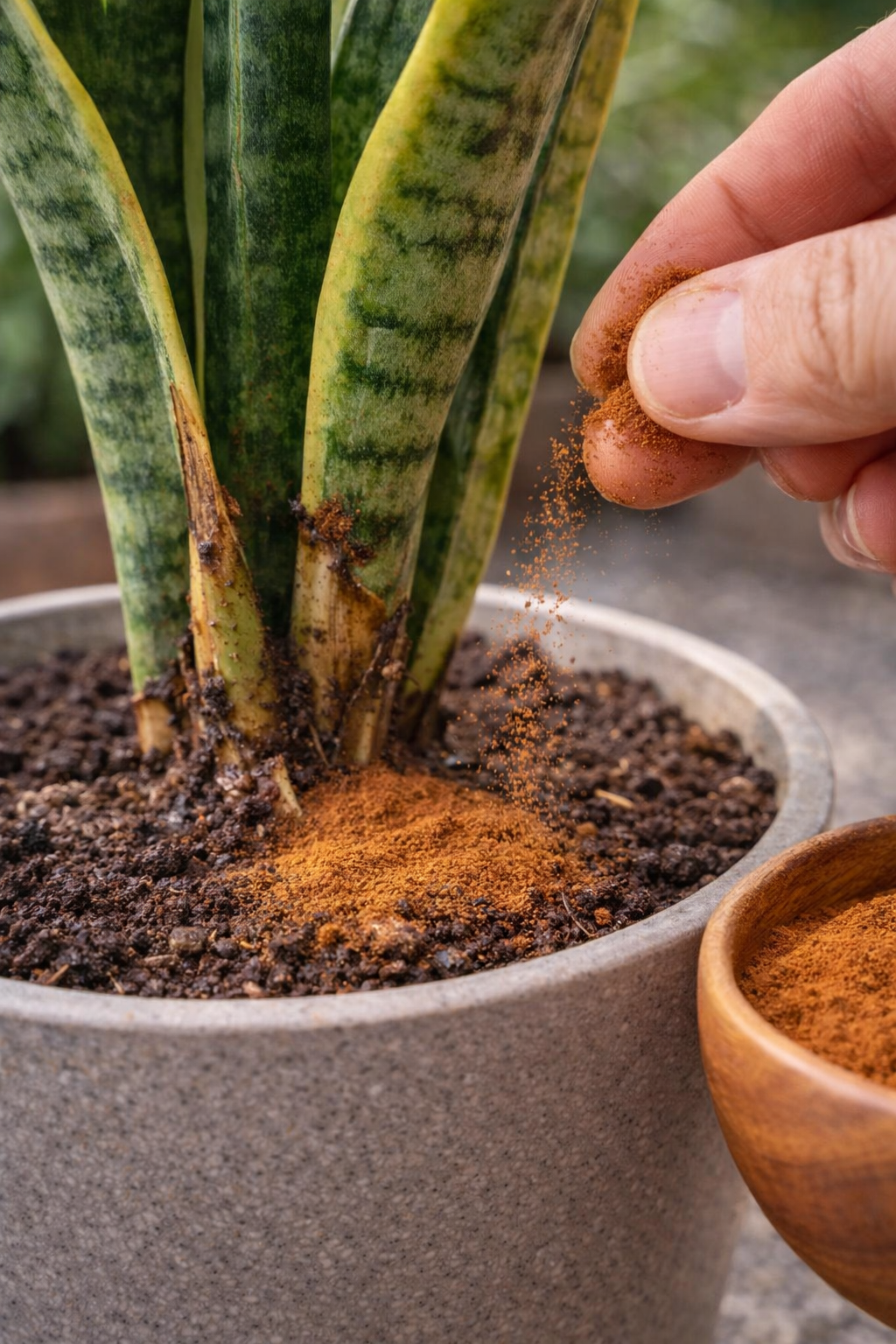
The Cinnamon Trick for Snake Plants: What It Really Does (And When It Works Fast)
Cinnamon is one of the most popular “viral plant hacks” online — especially for snake plants (Sansevieria / Dracaena trifasciata).
You’ll see people sprinkling cinnamon into the soil and claiming: ✅ faster growth
✅ no root rot
✅ no fungus
✅ pups popping up
But here’s the truth:
Cinnamon can help — but only in very specific situations.
And if you use it the wrong way, it can quietly make things worse.
In this guide, I’ll explain what cinnamon really does for snake plants, the fastest way to use it, when it actually works, and the mistakes that stop it from working.
(✅ FAQ included at the end.)
Why Cinnamon Became a “Snake Plant Miracle”
Cinnamon isn’t fertilizer.
It doesn’t give your plant nitrogen or nutrients.
What cinnamon DOES have is:
- natural antifungal properties
- mild antibacterial activity
- drying ability (it absorbs moisture on the surface)
That’s why it can be useful for snake plants — because most snake plant problems are caused by:
✅ too much water
✅ fungus + rot
✅ open wounds / cut leaves
✅ soggy soil near the crown
What Cinnamon Really Does for Snake Plants
1) Cinnamon helps dry out “danger zones” in the pot
Snake plants rot from the base first.
The crown area (where leaves come out of the soil) is the #1 risk zone.
Cinnamon helps by: ✅ drying the surface
✅ discouraging fungus around the crown
That’s why it sometimes looks like a miracle.
2) Cinnamon helps prevent fungus after cutting or repotting
This is the BEST use.
After:
- dividing the plant
- trimming rotten roots
- removing mushy leaves
- cutting a leaf for propagation
Cinnamon acts like a “plant bandage”:
✅ it protects the wound
✅ reduces the chance of rot spreading
✅ keeps fungus away while the cut dries
This is where cinnamon works FAST.
3) Cinnamon reduces mold growth on soil surface
If you see:
- white fuzz
- mushrooms
- sour smell from top soil
Cinnamon can help surface fungus.
But it won’t fix the real cause (too much water).
4) What cinnamon does NOT do
Let’s be clear so you don’t get fooled by TikTok:
🚫 Cinnamon does NOT fertilize snake plants
🚫 It does NOT replace good soil
🚫 It does NOT “heal” rotten roots
🚫 It does NOT make pups by itself
🚫 It does NOT fix overwatering damage
When Cinnamon Works Fast (Best Situations)
Here are the exact cases where cinnamon can show results quickly:
✅ Case 1: After removing soft/mushy leaves
If you removed a leaf and the base is wet: ➡️ sprinkle cinnamon on the wound.
Works fast because it dries + protects.
✅ Case 2: After trimming early root rot
If you removed brown mushy roots: ➡️ cinnamon can help the remaining roots resist fungus while drying.
✅ Case 3: After dividing snake plant pups
This is the #1 use by pros.
After division: ✅ dust cut rhizomes with cinnamon
✅ let them dry 12–24 hours
✅ then repot
This reduces rot dramatically.
✅ Case 4: Fungus gnats / mold signs on top soil
Cinnamon lightly sprinkled on top soil can slow fungus.
(But only if you also stop overwatering.)
The Best Way to Use Cinnamon on Snake Plants (Safe Method)
✅ What to use:
Use pure ground cinnamon (no sugar mixes).
Method A (Best): Wound Protection
This is the fastest-working method.
Steps
- Cut rotten leaf or roots
- Let the area air dry for 30–60 minutes
- Dust a thin layer of cinnamon directly on cut area
- Wait 12–24 hours before watering
✅ Best for:
- leaf removal
- root trimming
- division wounds
Method B: Soil Surface Protection
Only use this if soil is draining well.
Steps
- Sprinkle a pinch around crown area
- Do NOT mix deep into soil
- Repeat only once after 2–3 weeks if needed
✅ Best for:
- surface mold
- crown staying damp
The Biggest Cinnamon Mistakes (That Kill The Benefit)
❌ Mistake 1: Dumping too much cinnamon
Too much creates a thick “cake” layer.
That can:
- trap moisture
- block airflow
- worsen fungus
✅ Rule: thin dust only
❌ Mistake 2: Mixing cinnamon deep into wet soil
Cinnamon is organic.
In wet soil, it can:
- feed fungal activity
- cause bad smell
- create clumping
Cinnamon is for surface and wounds, not deep soil.
❌ Mistake 3: Using cinnamon instead of fixing overwatering
If the soil is wet for 5–7 days… you don’t need cinnamon.
You need: ✅ repotting
✅ drainage
✅ dry cycle
What If Your Snake Plant Is Already Rotting?
If your snake plant has:
- mushy base
- leaves falling out
- bad smell
Cinnamon alone won’t save it.
The real rescue plan:
✅ unpot
✅ cut rot
✅ let dry 24 hours
✅ repot into cactus/succulent mix
✅ wait 5–7 days before watering
Then you can use cinnamon only as a protective dust on wounds.
The “Secret” Combo: Cinnamon + Proper Soil
For a cinnamon trick to truly work, the soil must drain fast.
Best snake plant soil:
- 50% cactus mix
- 30% perlite/pumice
- 20% orchid bark or coarse sand
This creates oxygen space — the #1 thing snake plant roots need.
FAQ — Cinnamon for Snake Plants
1) Can cinnamon make snake plant pups grow faster?
Not directly. Pups come from: ✅ light
✅ warmth
✅ healthy roots
✅ correct watering cycle
Cinnamon only helps if rot/fungus was blocking growth.
2) How often can I add cinnamon to soil?
Only occasionally.
✅ Once every 3–4 weeks maximum
✅ Only a pinch
✅ Only on soil surface
3) Can cinnamon stop root rot?
It can slow fungus — but it cannot reverse rotted roots.
You must cut rot and repot.
4) Is cinnamon safe for indoor plants?
Yes, in small amounts.
But too much can cause:
- soil clumping
- moisture trapping
5) Can I use cinnamon after propagation?
Yes — it’s excellent.
Dust the cut end of the leaf, then let it dry/callus 2–3 days before planting.
6) Cinnamon vs hydrogen peroxide — which is better?
✅ Cinnamon = prevention & wound protection
✅ Peroxide = deeper rot cleanup (temporary oxygen boost)
Best approach: Use peroxide rinse if rot is present, then cinnamon as wound dust.
7) What’s the #1 sign cinnamon will actually help?
When the problem is: ✅ fungal
✅ surface mold
✅ fresh cut wounds
✅ early rot prevention
Not when the plant is already collapsing.
Final Takeaway
✅ Cinnamon works fast when used as:
- wound protection after cutting
- prevention after division
- mild surface fungus control
🚫 Cinnamon is NOT fertilizer
🚫 Cinnamon does NOT fix overwatering
🚫 Cinnamon does NOT heal rotten roots
If you use it in the right situation, it’s powerful.
If you use it wrong, it’s just powder in wet soil.