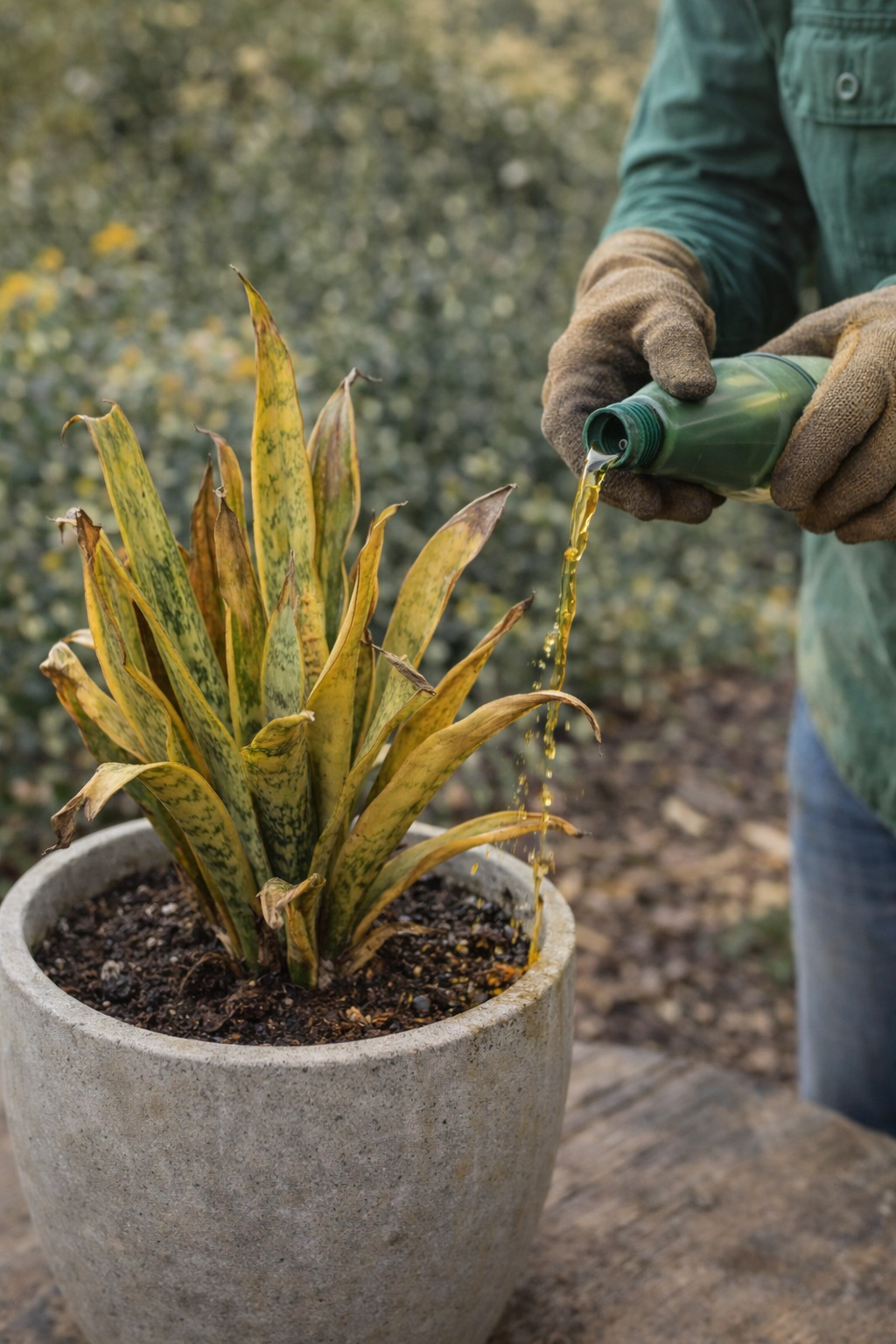
How to Revive a Sick Snake Plant (The Natural Fertilizer Rescue Method)
A sick snake plant can look scary fast.
Leaves turn yellow.
Tips dry out.
The plant starts leaning… and it feels like it’s “giving up.”
But here’s the truth:
✅ Most snake plants don’t die suddenly.
They decline slowly because of 2 main problems:
- roots are stressed (watering issues)
- soil has no oxygen (compact, wet, old mix)
That’s why this Natural Fertilizer Rescue Method works so well — because it fixes the root zone first, then feeds gently without burning.
In this guide you’ll learn:
✅ how to diagnose what’s wrong
✅ the safest “rescue reset” step-by-step
✅ the best natural fertilizer to revive roots
✅ what mistakes make it worse
✅ FAQ (6 Q + answers)
✅ final takeaway
First: Is Your Snake Plant Sick or Just Stressed?
Snake plants show similar symptoms for different causes.
✅ Signs of stress (usually easy to fix)
- yellow edges but leaves still firm
- slow growth
- dry brown tips
- wrinkled leaves after long dryness
❌ Signs of real sickness (root problem)
- leaves soft / mushy at base
- bad smell from soil
- black spots spreading
- plant falling over
- soil stays wet for many days
If your leaves are soft near the bottom, assume:
⚠️ root rot risk.
The Natural Fertilizer Rescue Method (Step-by-Step)
This method is made for indoor snake plants and is safe.
✅ What You Need
- clean scissors or knife
- paper towel
- fresh succulent/cactus soil
- perlite (important)
- worm castings (vermicompost)
- pot with drainage
- optional: cinnamon (only for cut areas)
Step 1: Stop Watering Immediately
If the plant is sick:
✅ don’t water again
until you check roots.
Watering a sick snake plant is the fastest way to rot it.
Step 2: Remove the Plant + Inspect Roots
Take the plant out gently.
Look at roots:
✅ Healthy roots
- white / pale yellow
- firm
- no smell
❌ Rotten roots
- black / brown
- slimy
- smell bad
- easily break
Step 3: The Rescue Cut (If Needed)
If you see rot:
✅ cut off all mushy roots
✅ cut off mushy base tissue
You must remove everything soft.
Then:
✅ sprinkle tiny cinnamon only on cut areas
✅ let it dry 2–4 hours (air-dry)
Step 4: The “Oxygen Soil Reset” (Most Important Part)
This is where most people fail.
A snake plant cannot recover if soil has no air.
✅ Best Rescue Soil Mix
Use:
✅ 50% cactus/succulent soil
✅ 30% perlite
✅ 20% orchid bark / coco chips
This mix dries correctly and gives roots oxygen.
Step 5: Repot Correctly
✅ choose a pot only slightly bigger than roots
✅ drainage holes required
Then repot.
Do NOT pack the soil tight.
Snake plants hate compact soil.
The Natural Fertilizer Rescue Method (The Gentle Feeding)
Now after the reset, we feed.
But not like normal fertilizer.
We feed like “recovery support.”
✅ The Best Natural Fertilizer for Recovery
1) Worm Castings (Vermicompost) — safest rescue booster
Why it works:
✅ improves soil microbes
✅ boosts root recovery
✅ very low burn risk
✅ helps leaf strength return
Exactly How to Use It (Spoon Method)
Use this after repotting:
✅ 1 teaspoon worm castings
✅ place in 3 small holes around plant
✅ cover with dry soil
That’s it.
When to Apply
✅ wait 7–10 days after repotting
(so roots settle)
How Often
✅ once every 4–6 weeks
during recovery
Stop feeding when:
✅ leaves start firming up
✅ color improves
✅ plant stands stronger
The Watering Rescue Rule (Critical)
After repotting sick snake plant:
✅ wait 7–10 days before first watering
After that:
✅ water only when soil is fully dry
Usually:
- every 2–4 weeks indoors
- less in winter
Light + Temperature (The Recovery Speed Boosters)
✅ Light
Put it in:
✅ bright indirect light near window
Avoid:
❌ dark corners (slow recovery)
✅ Warmth
Best:
✅ 20–30°C
Cold slows roots.
Mistakes That Kill Recovery (Avoid These)
❌ using strong fertilizer after repot
❌ watering right away
❌ keeping soil wet
❌ using huge pot
❌ using heavy garden soil
❌ spraying leaves with random mixtures
❌ leaving rot inside (it spreads)
FAQ — Reviving a Sick Snake Plant (6 Questions)
1) Can natural fertilizer save a dying snake plant?
Yes, but only after fixing roots + soil oxygen first. Fertilizer alone won’t save rot.
2) What is the best natural fertilizer for snake plants?
✅ worm castings
Safest option indoors with the lowest burn risk.
3) How do I know if my snake plant has root rot?
Soft base, bad smell, black mushy roots, leaves falling over.
4) Should I cut yellow leaves?
If leaves are fully yellow and soft → yes, remove.
If yellow but firm → keep (plant can still use it).
5) When will it recover?
Usually:
✅ 2–6 weeks to look better
✅ 2–3 months for strong new growth
6) Can I use coffee grounds or banana peel fertilizer?
Not for rescue ❌
They increase fungus gnats + rot risk. Use only safe gentle fertilizer.
Final Takeaway
To revive a sick snake plant, don’t “feed it more.”
Do this instead:
✅ remove plant + inspect roots
✅ cut rot + dry the base
✅ repot in airy succulent soil mix (oxygen reset)
✅ wait before watering
✅ use 1 teaspoon worm castings as the natural fertilizer rescue method
✅ bright indirect light + warmth
This is the safest indoor recovery method that helps the roots rebuild — and once roots recover, the whole plant comes back strong.