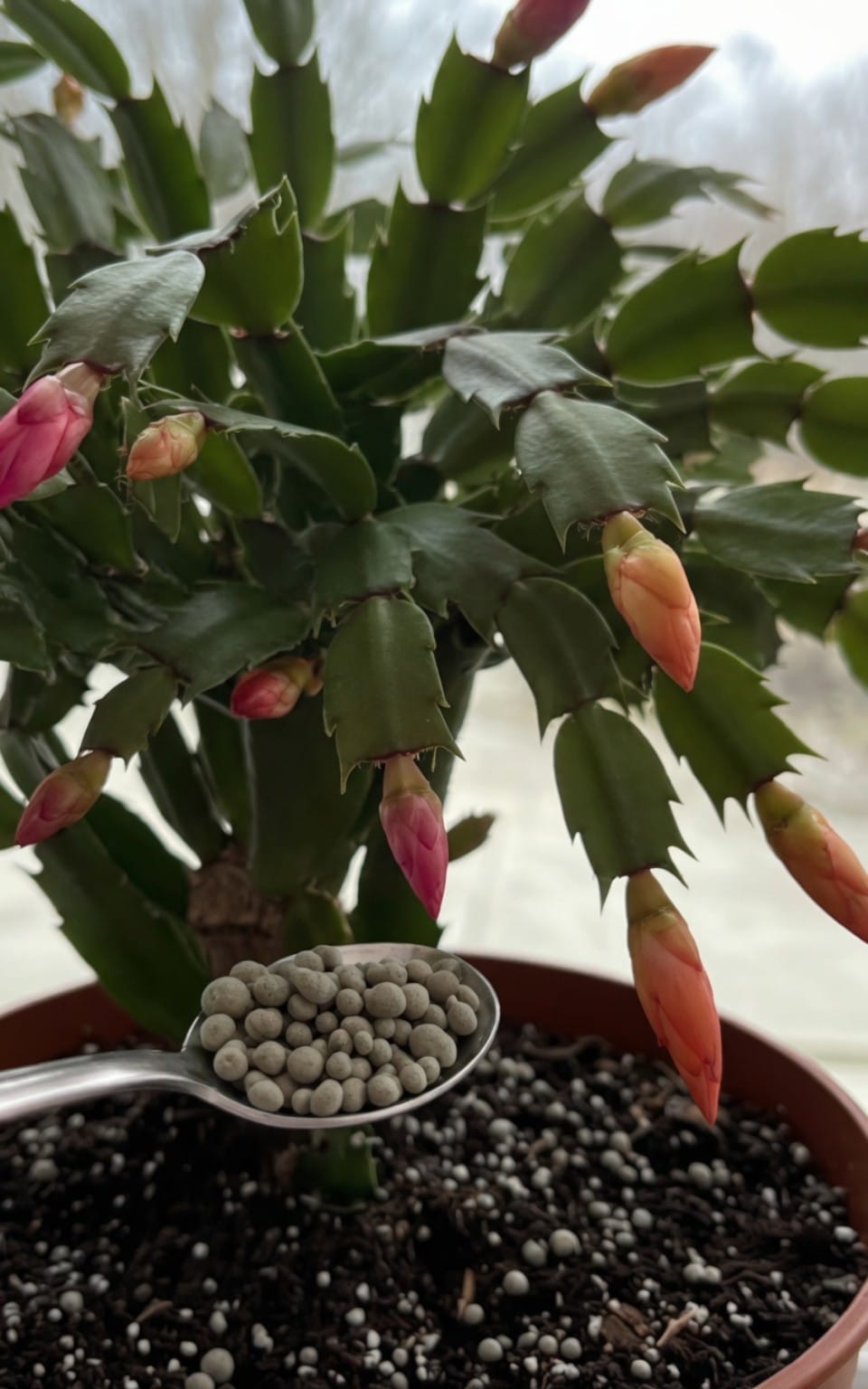
A holiday cactus in bud has a very special kind of beauty. It does not need giant leaves or a dramatic pot to stand out. Once the buds begin forming at the tips of the segments, the whole plant starts looking alive in a new way. It feels festive, elegant, and full of promise. That is exactly why videos and images like this get so much attention. A plant covered in pink buds already looks exciting, and when someone brings in a spoon full of gray pellets, it immediately creates the feeling that there must be a small secret behind the heavy bud set.
From the image and video, this looks like a holiday cactus, most likely a Thanksgiving cactus or a closely related Christmas cactus type from the Schlumbergera group. The segments appear pointed rather than rounded, which often suggests Thanksgiving cactus. The gray balls on the spoon look like granular fertilizer pellets or slow-release feeding granules, not a kitchen ingredient. That matters, because a blooming holiday cactus can benefit from a light, balanced feeding routine at the right time, but it still depends much more on light, roots, watering, and seasonal stability than on any one pellet product.
That is why smart plant owners ask better questions than most. They do not only ask what the pellets are. They ask whether the plant is already healthy enough to use them well. They ask whether the roots are active, whether the potting mix drains properly, whether the plant is in bright indirect light, and whether the buds are being protected from stress. Those are the real questions that decide whether the buds will keep developing and open into a beautiful display.
A plant like this is not only a houseplant. It becomes part of the room’s mood. Budded and blooming holiday cactus brings color, softness, and warmth into windowsills, tables, and shelves. So understanding what really supports it matters for both plant care and decor.
What the Gray Pellets Likely Represent
The gray pellets look like some kind of:
- slow-release fertilizer
- granular plant food
- controlled-release nutrient pellets
- top-dressing feed meant to dissolve gradually with watering
This kind of product is usually designed to release nutrients over time instead of all at once. That can make sense for a healthy plant in active growth or budding season. But it is important to understand that pellets are only support. They are not the foundation of success.
A holiday cactus becomes beautiful because of:
- healthy roots
- good light
- suitable potting mix
- balanced watering
- stable conditions during bud formation
- light feeding when needed, not excessive feeding
That is the system. The pellets may help that system, but they do not replace it.
Why a Budded Holiday Cactus Looks So Impressive Indoors
One of the reasons these plants are so loved is that they create anticipation before the flowers even open. The buds themselves are decorative. They add movement and color to the plant, and once there are many of them, the whole cactus starts looking richer and more exciting.
A heavily budded holiday cactus can make a room feel:
- more cheerful
- more seasonal
- more styled
- more alive
- more elegant without trying too hard
That is why people are so protective of the buds once they appear. Bud drop feels disappointing because the visual promise is already there.
Why Root Health Matters More Than Pellets
A plant can only use nutrients properly if the root system is healthy. If the roots are stressed, compacted, or damaged, feeding becomes much less effective and sometimes more risky. Healthy roots help the plant:
- absorb moisture evenly
- support stronger bud development
- keep segments firmer and greener
- hold blooms better once they open
- recover more easily after the flowering cycle ends
That is why experienced growers think below the soil line first.
Why Holiday Cactus Needs the Right Kind of Soil
Holiday cactus is not a desert cactus in the strictest indoor-care sense. It usually performs best in a mix that drains well but still offers some moisture balance. Heavy wet soil can create stress, but an overly harsh dry mix can also make the plant less happy over time.
A better holiday cactus mix usually supports:
- airflow around the roots
- moderate moisture retention
- decent drainage
- low compaction
- easier root health over time
If the potting mix is poor, pellets will not solve the deeper issue. The plant may still struggle even if nutrients are added.
Why Light Quietly Controls the Bloom Display
Many people think flowering is mostly about fertilizer, but with holiday cactus, light plays a huge role. Bright indirect light helps the plant build stronger energy reserves, which supports healthier segments and better bud development.
Good light helps:
- strengthen the plant before bloom season
- support more reliable bud formation
- improve the final bloom display
- keep the plant looking fuller and healthier overall
A holiday cactus in poor light may stay alive, but it often performs below its potential.
Why Stability Matters Once Buds Form
This is one of the most important truths about budded holiday cactus. Once the buds appear, the plant usually wants calm, stable conditions. Too much change can lead to dropped buds, slowed development, or a weaker overall show.
Stress during bud formation can come from:
- sudden temperature shifts
- moving the plant too often
- inconsistent watering
- low light
- root stress
- overfeeding or salt buildup
That is why a dramatic-looking spoonful of pellets may attract attention, but the real secret is often simple stability.
Why Too Much Fertilizer Can Backfire
Holiday cactus can benefit from light feeding, especially during active growing periods, but too much fertilizer is one of the easiest ways to create problems instead of beauty. Overfeeding can contribute to:
- root stress
- salt buildup
- brown segment edges
- weaker plant balance
- reduced bud quality if the plant becomes stressed
That is why the smartest growers feed moderately. A plant with many buds does not necessarily need more product. It needs the right environment to finish the job.
When Gray Pellets May Actually Make Sense
Pellet feeding may make sense when:
- the plant is already healthy
- the roots are stable
- the potting mix drains well
- the amount used is appropriate
- the plant is in active growth or a supported budding phase
- the grower knows the product and uses it carefully
In that kind of setup, the pellets can be part of a smart routine. They are not the whole reason the plant looks good, but they may support it.
When the Pellets Become the Wrong Focus
The pellets become the wrong focus when:
- the plant is already stressed
- the soil is dense and staying wet
- the buds are dropping because of instability
- the plant is in poor light
- the owner is feeding instead of correcting the real conditions
In those cases, the true solution is better care, not more product.
Why Bud Count Depends on More Than Fertility
A plant like this often gets admired because it is loaded with buds. But that kind of bud count usually reflects a broader pattern of care, not a single feeding moment. High bud count often comes from:
- good light over time
- healthier mature growth
- proper seasonal rhythm
- root comfort
- lower stress
- patient care
The pellets may be one detail, but not the whole story.
Table: What Smart Homeowners Check Before Adding Gray Pellets to a Holiday Cactus
| Factor | What to Check | Why It Matters |
|---|---|---|
| Root health | Are the roots active and healthy? | Healthy roots can actually use the feed |
| Potting mix | Is the soil airy and not compacted? | Dense soil weakens blooming performance |
| Light | Is the plant in bright indirect light? | Better light supports more buds |
| Watering | Is moisture balanced and stable? | Stress here can cause bud drop |
| Product amount | Is the pellet use moderate? | Too much can create salt stress |
| Plant stage | Is the plant actively growing or budding? | Timing matters for feed usefulness |
| Stability | Is the plant being kept calm and consistent? | Budded plants dislike abrupt change |
Why a Healthy Budded Holiday Cactus Improves Decor So Much
A holiday cactus in bud already feels like decor, even before it blooms. It brings color and movement into a room without taking up much space. That is why it works so well on:
- windowsills
- side tables
- shelves
- kitchen corners
- cozy seasonal displays
A strong plant like this can make a room feel:
- more inviting
- more alive
- more cheerful
- more carefully maintained
- more visually warm
That is why people love them so much.
Frequently Asked Questions
Is this a Christmas cactus or Thanksgiving cactus?
It looks more like a Thanksgiving cactus because the segment edges appear more pointed, but the care principles are very similar for both.
Are those gray pellets fertilizer?
They appear to be some kind of fertilizer pellets or slow-release granules from the visual context.
Do holiday cacti need fertilizer to bloom?
They can benefit from light balanced feeding, but blooming depends much more on light, root health, watering balance, and seasonal stability.
Can too much fertilizer hurt a holiday cactus?
Yes. Overfeeding can stress the roots and reduce the plant’s overall quality.
Why are my buds dropping before opening?
Bud drop often comes from stress such as sudden movement, inconsistent watering, poor light, root issues, or temperature swings rather than simply a lack of fertilizer.