A Christmas Cactus overflowing with bright pink flowers can transform a simple window into one of the most beautiful displays in an indoor garden. Its cascading green stems, delicate flower buds, and colorful blossoms make it a favorite for holiday decorating, modern living rooms, and elegant indoor plant collections.
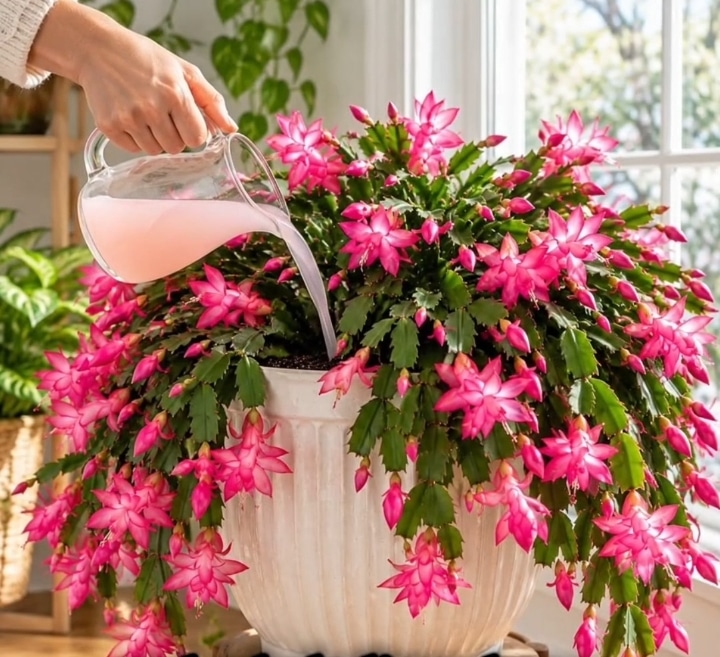
The image shows a large, mature holiday cactus growing in a decorative white ceramic planter beside a bright window. Dozens of pink flowers and developing buds hang from the plant’s segmented green stems. A hand pours a pale pink liquid from a clear glass pitcher directly toward the potting medium.
The scene raises an interesting gardening question: can pink liquid fertilizer encourage Christmas Cactus to produce more flowers, or does successful blooming depend on something more important?
Although a suitable liquid fertilizer can support healthy plant growth, the pink liquid cannot be identified from its appearance alone. It might be diluted commercial plant food, a colored watering solution, or another mixture.
The image also does not establish that the liquid caused the impressive flower display.
The plant appears to be a holiday cactus from the Schlumbergera group, most likely a Thanksgiving Cactus or a related cultivated hybrid. Its pointed stem segments are more characteristic of Thanksgiving Cactus than the rounded segments commonly associated with true Christmas Cactus.
Both types share many similar care requirements, including bright indirect light, an airy potting medium, careful watering, and suitable seasonal conditions for flower bud development.
This guide explains how to evaluate pink liquid treatments, choose suitable flowering houseplant fertilizers, compare premium indoor potting mixes, protect cactus roots, select LED grow lights, prevent bud drop, and maintain beautiful pink flowers in a decorative indoor planter.
Quick Answer: Can Pink Liquid Make Christmas Cactus Bloom More?
A properly formulated liquid houseplant fertilizer can support healthy Christmas Cactus growth when nutrients are needed.
However, an unidentified pink liquid should not be applied simply because it appears in a gardening video or image.
The most important factors for successful flowering include:
- Bright indirect light during active growth
- Suitable seasonal nighttime darkness
- Moderately cool conditions during bud initiation
- Healthy roots and well-draining potting soil
- Consistent moisture without waterlogging
- Balanced fertilizer when needed
- Protection from sudden temperature changes
- Good airflow
- A container with drainage holes
- Avoiding excessive feeding during flowering
A healthy holiday cactus can produce abundant flowers without unusual homemade treatments.
What Plant Is Shown in the Image?
The plant appears to be a holiday cactus belonging to the genus Schlumbergera.
Its flattened green segments have noticeable pointed projections along their edges.
This characteristic is commonly associated with Thanksgiving Cactus, Schlumbergera truncata, and related hybrids.
True Christmas Cactus hybrids generally have more rounded segment edges.
The plant’s pink flowers emerge from the ends of mature segments and hang gracefully around the container.
Because the exact cultivar cannot be confirmed from the image alone, the most reliable identification is a flowering holiday cactus.
Why Holiday Cactus Is Different From Desert Cactus
Holiday cacti originate from tropical forest environments rather than arid deserts.
They often grow among trees and organic material where their roots receive moisture and airflow.
Their roots are adapted to loose, well-aerated growing conditions.
They do not thrive in permanently saturated soil.
Unlike many desert cacti, holiday cacti generally prefer bright filtered light instead of prolonged exposure to intense direct sunlight.
Understanding the Pink Liquid in the Image
Pink-colored liquids are sometimes featured in gardening demonstrations as flowering boosters.
However, color does not reveal nutrient composition.
A liquid’s safety depends on its ingredients, concentration, and intended use.
Commercial Liquid Fertilizer
Some commercial fertilizers contain dyes or naturally colored ingredients.
A suitable fertilizer may provide nitrogen, phosphorus, potassium, and micronutrients.
When applied according to the label, it can support healthy plant growth.
Organic Liquid Fertilizer
Organic liquid products may contain nutrients derived from plant or animal sources.
Their nutrient composition and release characteristics vary.
Choose formulations suitable for indoor container plants.
Colored Water
A pink-colored liquid may simply contain dye.
Color does not establish fertilizer effectiveness.
Homemade Kitchen Mixtures
Some homemade treatments contain fruit juice, sugar, or other kitchen ingredients.
Their nutrient composition is usually unpredictable.
Sugary liquids are not suitable substitutes for balanced fertilizer and may encourage unwanted microbial growth in the potting medium.
Unknown Pink Liquid
If the ingredients are unknown, do not apply it.
Identify the product and follow reliable application instructions.
Why Christmas Cactus Produces So Many Pink Flowers
A mature holiday cactus can produce a spectacular flower display when its seasonal requirements are met.
Flower initiation depends strongly on darkness and temperature.
Seasonal Nighttime Darkness
Holiday cacti are short-day flowering plants.
They respond to long, uninterrupted nights during the bud-setting period.
Approximately 12–14 hours of uninterrupted darkness each night for several weeks can encourage bud formation, although requirements vary by cultivar and temperature.
Artificial lighting during the dark period may interfere with flowering.
Moderately Cool Temperatures
Cooler conditions can support flower bud initiation.
Temperatures around 55–65°F (13–18°C) are often useful during the preparation period.
Avoid freezing temperatures and abrupt environmental changes.
Healthy Mature Growth
A mature plant with numerous healthy stem segments has more potential flowering sites than a small cutting.
Balanced Nutrition
Fertilizer can support growth when nutrients are needed.
However, extra phosphorus or potassium does not automatically produce more flowers when the plant already has sufficient nutrients.
Consistent Watering
Severe dehydration or prolonged waterlogging can stress the plant.
Stable moisture management is especially important after buds appear.
Best Liquid Fertilizer for Christmas Cactus
Several fertilizer types are marketed for flowering houseplants.
The best option depends on the plant’s nutrient requirements and growing conditions.
Balanced Liquid Houseplant Fertilizer
A balanced liquid fertilizer is often a practical choice.
It can be measured and applied during watering.
Follow the manufacturer’s recommended dilution.
Flowering Plant Fertilizer
Some products are formulated specifically for flowering ornamentals.
These may contain different nutrient ratios.
A high-phosphorus fertilizer does not automatically produce more flowers when phosphorus is already sufficient.
Organic Liquid Fertilizer
Organic products may provide nutrients from alternative sources.
Their composition varies.
Choose products labeled for indoor container plants.
Controlled-Release Fertilizer
Controlled-release granules provide nutrients gradually.
They can reduce the frequency of feeding.
However, excessive application can still damage roots.
Fertilizer Comparison Table
| Fertilizer type | Main advantage | Main consideration | Best use |
|---|---|---|---|
| Balanced liquid fertilizer | Easy to measure | Correct dilution required | Active growth |
| Flowering plant fertilizer | Designed for flowering ornamentals | Extra phosphorus may be unnecessary | Suitable nutrient needs |
| Organic liquid fertilizer | Alternative nutrient sources | Composition varies | Indoor container plants |
| Controlled-release granules | Extended feeding | Avoid overapplication | Established plants |
| Homemade pink liquid | No established advantage | Unknown composition | Not recommended |
For most holiday cacti, a suitable balanced houseplant fertilizer is sufficient when feeding is necessary.
How to Apply Liquid Fertilizer Safely
Liquid fertilizer should be used carefully to protect roots and delicate flowers.
Step 1: Identify the Product
Check the fertilizer label.
Confirm that it is suitable for ornamental houseplants.
Step 2: Prepare the Correct Dilution
Follow the manufacturer’s instructions.
Do not assume that stronger fertilizer produces more flowers.
Step 3: Inspect Soil Moisture
Avoid applying concentrated fertilizer to severely dry roots.
Follow the product’s watering instructions.
Step 4: Apply to the Growing Medium
Pour the prepared fertilizer solution onto the potting medium rather than directly onto the flowers.
Step 5: Allow Excess Water to Drain
Use a container with drainage holes.
Empty accumulated water from the saucer.
Step 6: Monitor Plant Response
Watch for unusual stem discoloration, wilting, or signs of nutrient stress.
Step 7: Adjust During Slow Growth
Reduce feeding when the plant is not actively growing.
Avoid heavy fertilizer applications during the bud-setting period.
When Should You Fertilize Christmas Cactus?
Fertilizer requirements depend on the plant’s growth stage, potting mix, and environmental conditions.
During Spring Growth
New segments may begin developing after flowering.
This can be an appropriate period for feeding when nutrients are needed.
During Summer
Continue suitable feeding during active growth according to the product label.
During Fall Bud Preparation
Focus on suitable darkness and temperature conditions.
Do not assume that additional fertilizer will trigger flowers.
During Flowering
Heavy feeding is generally unnecessary.
Maintain stable growing conditions.
After Flowering
Allow the plant to return gradually to its normal growth routine.
Resume feeding when active growth begins.
Best Potting Soil for Christmas Cactus: Premium Indoor Mixes Compared
Holiday cacti require an airy growing medium that retains moderate moisture while allowing excess water to drain.
Dense soil can reduce oxygen around the roots and increase the risk of rot.
A suitable potting mix should provide:
- Good aeration
- Moderate moisture retention
- Reliable drainage
- Suitable organic material
- Structural stability
- Healthy root-zone conditions
Quality Indoor Potting Mix
A well-formulated indoor potting mix provides a useful foundation.
However, some products retain too much moisture when used alone.
Perlite
Perlite improves aeration and reduces compaction.
It is useful for container plants sensitive to waterlogging.
Fine Orchid Bark
Fine orchid bark contributes structure and airflow.
It can be particularly useful for tropical forest cacti.
Coco Coir
Coco coir retains moisture and contributes to the physical structure of the medium.
Excessive amounts may increase moisture retention.
A Practical Holiday Cactus Potting Mix
A useful starting mixture is:
- 2 parts quality indoor potting mix
- 1 part perlite
- 1 part fine orchid bark
Adjust the mixture according to the container and watering habits.
Potting Mix Comparison
| Material | Drainage | Moisture retention | Main purpose |
|---|---|---|---|
| Indoor potting mix | Variable | Moderate to high | Organic foundation |
| Perlite | High | Low | Aeration |
| Fine orchid bark | High | Low to moderate | Structure |
| Coco coir | Moderate | Moderate to high | Moisture retention |
| Dense garden soil | Often poor in containers | Variable | Generally unsuitable |
Premium potting soil is useful when its composition matches the plant’s needs.
Choosing the Right Pot for Christmas Cactus
The image shows a mature holiday cactus growing in a large white decorative ceramic planter.
Its cascading stems and pink flowers create a striking ornamental display.
However, the container must provide adequate drainage.
Premium Ceramic Planters
Ceramic planters offer attractive finishes and colors.
They can complement flowering holiday cacti in modern interiors.
Choose a container with drainage holes.
Terracotta Pots
Unglazed terracotta allows moisture to evaporate through the pot walls.
This can help the growing medium dry more quickly.
However, it may require more frequent watering.
Plastic Nursery Pots
Plastic pots are lightweight and practical.
They retain moisture longer than unglazed terracotta.
Decorative Outer Containers
A nursery pot can be placed inside a decorative ceramic container.
Remove the inner pot for watering and allow it to drain before returning it.
Planter Comparison
| Planter type | Main advantage | Main concern |
|---|---|---|
| Ceramic | Decorative appearance | Drainage must be checked |
| Terracotta | Porous and breathable | Faster drying |
| Plastic | Lightweight and affordable | Retains moisture longer |
| Self-watering planter | Convenient moisture management | Requires careful monitoring |
| Glass without drainage | Attractive appearance | Higher waterlogging risk |
For holiday cacti, drainage is more important than the price of the planter.
How to Water Christmas Cactus Without Causing Root Rot
Holiday cacti generally prefer moderate moisture during active growth.
However, they do not tolerate permanently saturated soil.
During Active Growth
Check the upper portion of the potting mix.
When it begins to dry, water thoroughly enough for excess water to drain.
During Bud Formation
Maintain relatively consistent moisture.
Avoid severe drying.
During Flowering
Continue careful watering.
Sudden shifts between extremely dry and saturated conditions can stress the plant.
During Cool Weather
Water use may decrease.
Adjust according to growth and soil moisture.
Signs of Overwatering
- Persistently wet soil
- Soft or mushy segments
- Root deterioration
- Unpleasant odor
- Sudden collapse
Signs of Underwatering
- Wrinkled segments
- Reduced firmness
- Very dry growing medium
- Slower growth
- Bud drop during severe stress
Because root damage can also cause wrinkling, inspect the growing medium before increasing watering.
Preventing Root Rot in Christmas Cactus
Root rot can develop when roots remain in excessively wet, poorly aerated conditions.
Use a Well-Draining Mix
Choose a loose potting medium that allows oxygen to reach the roots.
Avoid Oversized Pots
An excessively large container may retain more wet soil than the roots can use.
Water Carefully
Do not keep the growing medium permanently saturated.
Inspect the Roots
If the plant collapses or shows signs of severe decline, inspect the roots carefully.
Remove Damaged Material
Use clean tools when removing severely damaged tissue.
Repot healthy remaining material when appropriate.
Best LED Grow Lights for Christmas Cactus
A suitable LED grow light can support healthy holiday cactus growth when natural daylight is insufficient.
However, artificial lighting must be managed carefully during the flowering preparation period.
When Grow Lights Are Useful
Supplemental lighting may help plants growing in:
- North-facing rooms
- Home offices with limited daylight
- Indoor plant shelves
- Apartments with small windows
- Rooms with weak winter sunlight
What to Look for in an LED Grow Light
Useful features include:
- Adjustable brightness
- Suitable coverage area
- Manufacturer-provided light output information
- Timer controls
- Adjustable mounting height
- Low heat generation
- Energy-efficient operation
Protect the Dark Period
During bud initiation, avoid leaving grow lights on late into the night.
A timer can help maintain a consistent lighting schedule while preserving uninterrupted darkness.
Grow Light Comparison
| Lighting option | Main advantage | Main limitation |
|---|---|---|
| Bright indirect window light | Natural and inexpensive | Depends on window exposure |
| Basic LED grow light | Supports growth in dim rooms | Requires correct positioning |
| Adjustable LED grow light | Greater intensity control | Higher initial cost |
| Timer-controlled lighting | Consistent daily schedule | Must preserve darkness |
| Strong direct sunlight | High light intensity | Can scorch segments |
A holiday cactus growing well near a bright window may not require supplemental lighting.
Why Christmas Cactus Buds Fall Off
Premature bud drop can occur when the plant experiences environmental stress.
Sudden Temperature Changes
Avoid moving the plant between environments with dramatically different temperatures.
Inconsistent Watering
Severe drying or excessive moisture can stress developing buds.
Insufficient Light
Poor light may limit the plant’s overall energy supply.
Excess Fertilizer
High soluble salt concentrations can damage roots.
Abrupt Relocation
Moving a budding plant into substantially different conditions can contribute to bud drop.
Keep the environment reasonably stable.
How to Encourage Fuller Christmas Cactus Growth
A mature holiday cactus can develop many healthy segments and numerous flowering sites.
Provide Adequate Light
Bright indirect light supports healthy growth.
Maintain Healthy Roots
Use an airy potting mix and avoid waterlogging.
Fertilize Appropriately
Feed during active growth when needed.
Prune After Flowering
Selective pruning after flowering can encourage branching.
Remove one or two terminal segments from suitable stems by gently separating them at their joints.
Propagate Healthy Cuttings
Healthy stem segments can be rooted to create additional plants.
Once established, several cuttings can be planted together in an appropriately sized container for a fuller display.
Propagating Christmas Cactus From Stem Cuttings
Holiday cacti can be propagated from healthy stem segments.
Step 1: Select Healthy Segments
Choose a healthy stem section with approximately two to four connected segments.
Step 2: Separate at a Joint
Gently twist the cutting at a natural joint.
Step 3: Allow the Cut End to Dry
Place the cutting in a clean, shaded location with good airflow for a short period.
Step 4: Prepare an Airy Potting Mix
Use a loose growing medium with appropriate drainage.
Step 5: Plant Shallowly
Insert the basal portion into the potting mix.
Avoid burying several segments deeply.
Step 6: Maintain Gentle Moisture
Keep the medium lightly moist without saturation.
Step 7: Wait for Root Establishment
Roots may begin developing within several weeks under suitable conditions.
Avoid repeatedly disturbing the cutting.
Christmas Cactus Blooming Timeline
| Stage | Typical development | Care priority |
|---|---|---|
| Active growth | New stem segments develop | Light, moisture, and appropriate nutrition |
| Pre-bloom preparation | Plant responds to seasonal cues | Darkness and cool conditions |
| Bud initiation | Small buds appear | Stable environment |
| Bud development | Buds enlarge and develop color | Consistent moisture |
| Flowering | Mature flowers open | Avoid stress |
| Post-flowering | Plant returns toward vegetative growth | Gradual routine maintenance |
Flowering time varies by cultivar, climate, and indoor conditions.
Common Christmas Cactus Problems and Solutions
| Problem | Possible cause | Practical solution |
|---|---|---|
| No flowers | Inadequate darkness or unsuitable temperature | Improve seasonal conditions |
| Bud drop | Watering or environmental stress | Stabilize care |
| Wrinkled segments | Dehydration or root problems | Inspect soil and roots |
| Soft stems | Excess moisture or rot | Improve drainage |
| Slow growth | Limited light or root stress | Review growing conditions |
| Pale segments | Nutrient or environmental stress | Evaluate overall care |
| Surface mold | Persistent moisture and poor airflow | Improve ventilation |
| Brown tips | Environmental or watering stress | Check conditions |
Pest Control for Indoor Christmas Cactus
Holiday cacti can occasionally develop pest problems.
Common pests include mealybugs, scale insects, and fungus gnats.
Mealybugs
Mealybugs may appear as white cotton-like clusters around segment joints.
Scale Insects
Scale insects can appear as small attached bumps on stems.
Fungus Gnats
Fungus gnats are often associated with persistently damp organic potting media.
Choosing Pest Control Products
Use products specifically labeled for the target pest and suitable ornamental plants.
Insecticidal soap or horticultural oil may be appropriate for certain pests when used according to the label.
Avoid applying unidentified homemade mixtures directly onto flowers or sensitive tissue.
Christmas Cactus in Modern Living Room Decor
A mature holiday cactus covered in pink flowers can become a striking feature in a modern home.
Its cascading growth works particularly well in elevated planters, plant stands, and decorative shelves.
Living Room Window Displays
Place the plant near a bright window with filtered light.
A white ceramic planter can complement natural wood furniture, stone surfaces, and neutral interiors.
Luxury Entryway Plant Styling
A flowering holiday cactus can create an attractive seasonal display in a bright entryway.
Avoid locations exposed to cold drafts or inadequate light.
Home Office Plant Decor
Compact specimens can work well on desks, shelves, and side tables.
Choose a location with suitable light and stable temperatures.
Covered Patio Displays
During appropriate weather, holiday cacti can grow outdoors in protected shade.
Avoid frost, intense direct sunlight, and prolonged heavy rain.
Decorative Color Combinations
Pink-flowering holiday cacti pair well with:
- White ceramic planters
- Natural wood furniture
- Beige and cream interiors
- Light stone surfaces
- Dark green botanical arrangements
- Minimalist decorative shelves
The best decorative placement should also support healthy growing conditions.
Premium Indoor Plant Equipment: What Is Worth Buying?
Not every holiday cactus requires expensive gardening equipment.
The most useful purchases solve specific growing problems.
Quality Potting Soil
A suitable, well-draining potting mix can improve root conditions.
However, a premium brand is not automatically superior.
Moisture Monitoring Tools
A moisture meter may help some gardeners assess watering needs.
Readings should be checked against the actual condition of the growing medium because inexpensive meters can be unreliable.
LED Grow Lights
Supplemental lighting is useful when natural daylight is insufficient.
Choose an appropriately sized fixture rather than automatically buying the most powerful model.
Decorative Ceramic Planters
A well-designed ceramic planter can improve the appearance of a room.
Drainage remains essential.
Plant Stands and Shelving
A sturdy plant stand can elevate cascading holiday cactus stems and make the flowers more visible.
Choose stable furniture suitable for the weight of the plant and container.
Advanced Christmas Cactus Care Schedule
| Care factor | Recommended approach |
|---|---|
| Light | Bright indirect light |
| Soil | Airy, well-draining potting mix |
| Watering | Moderate moisture without waterlogging |
| Fertilizer | Appropriate feeding during active growth |
| Bloom initiation | Long nights and suitable cool temperatures |
| Container | Pot with drainage holes |
| Repotting | When necessary, preferably outside active flowering |
| Propagation | Healthy stem cuttings |
| Outdoor placement | Protected shade in suitable weather |
| Decorative use | Ceramic planters, shelves, plant stands |
Frequently Asked Questions
Can Pink Liquid Make Christmas Cactus Bloom Faster?
Not necessarily.
A suitable fertilizer may support healthy growth when nutrients are needed, but unidentified pink liquid cannot be assumed to increase flowering.
What Is the Pink Liquid in the Image?
Its composition cannot be determined from appearance alone.
It could be fertilizer, colored water, or another mixture.
Should Liquid Fertilizer Be Poured Over Christmas Cactus Flowers?
Products intended for soil application should generally be applied to the growing medium rather than directly onto flowers.
What Is the Best Fertilizer for Christmas Cactus?
A suitable balanced houseplant fertilizer is often sufficient.
The ideal product depends on nutrient needs and growing conditions.
Does Christmas Cactus Need Special Bloom Booster Fertilizer?
Not necessarily.
Extra phosphorus or potassium does not guarantee more flowers when the plant already has adequate nutrients.
How Do I Get More Pink Flowers?
Provide appropriate seasonal darkness, suitable cool temperatures, healthy roots, adequate indirect light, and consistent watering.
Can Christmas Cactus Grow Indoors All Year?
Yes. Holiday cacti can grow indoors year-round under suitable conditions.
Is Terracotta Better Than Ceramic?
Both can work.
Terracotta generally dries faster, while glazed ceramic retains moisture longer.
Can LED Grow Lights Help Christmas Cactus?
Yes. Suitable supplemental lighting can support healthy growth when natural daylight is insufficient.
However, the dark period needed for bud initiation must be protected.
Why Are My Christmas Cactus Buds Falling Off?
Possible causes include temperature changes, moisture stress, abrupt relocation, and other environmental disturbances.
Can I Use Homemade Colored Water Instead of Fertilizer?
Colored water does not automatically contain useful plant nutrients.
Use a suitable fertilizer when feeding is necessary.
How Long Can Christmas Cactus Live?
With suitable care, holiday cacti can remain healthy for many years and may become long-lived household plants.
Final Thoughts
The image of a mature holiday cactus covered in pink flowers while pale pink liquid is poured into its pot creates an attractive gardening scene.
However, the identity of the liquid and its effect on flowering cannot be confirmed from the image.
A properly formulated fertilizer may support healthy growth when nutrients are needed, but it does not replace appropriate light, healthy roots, careful watering, and suitable seasonal conditions.
For abundant pink flowers, focus on an airy indoor potting mix, reliable drainage, moderate moisture, suitable temperatures, and balanced nutrition.
Premium ceramic planters, LED grow lights, and appropriate moisture-management tools can improve convenience and decorative appeal when chosen for a genuine purpose.
Whether displayed beside a bright window, in a modern living room, on a sheltered patio, or as part of a decorative indoor garden, a well-maintained holiday cactus can provide remarkable color and ornamental beauty.
The secret to healthier Christmas Cactus flowering is not a mysterious pink liquid. It is understanding the plant’s natural growth cycle and providing consistent, thoughtful care.