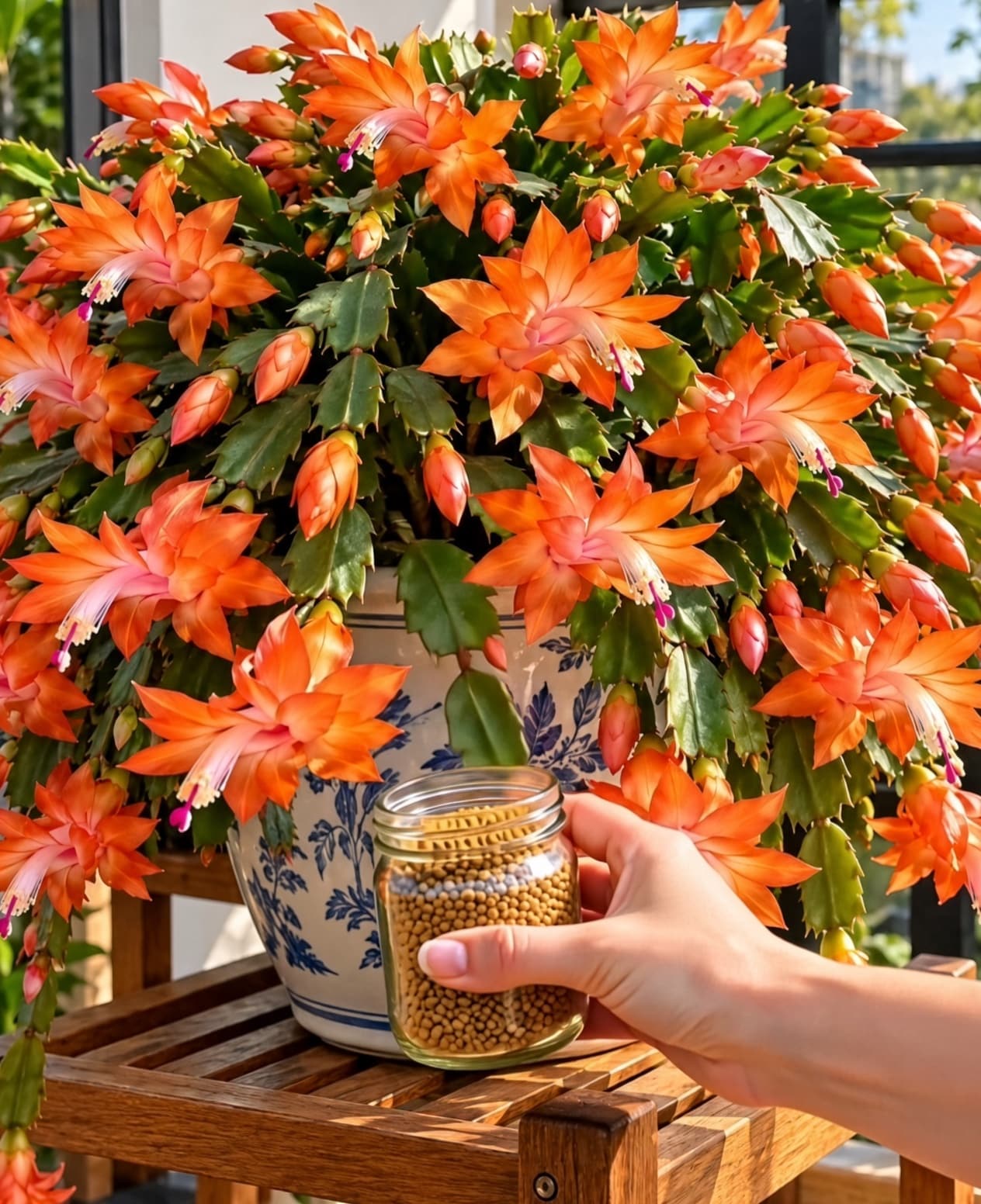
Orange Christmas Cactus Fertiliser Guide
Golden granules, beautiful orange flowers and a flourishing Christmas cactus make an appealing combination for any indoor plant collection. Yet the secret to a healthy holiday cactus is not simply adding more plant food. It is choosing the right fertiliser, combining it with a suitable potting mix and giving the roots the conditions they need to support colourful seasonal blooms.
A mature Christmas cactus can become one of the most spectacular flowering houseplants in a home. Its arching green segments spill naturally over the sides of a container, while orange, coral, peach, pink or red flowers create a bright seasonal display. With careful maintenance, an established plant may flower repeatedly over many years.
For a healthy Christmas cactus, choose a complete, balanced houseplant fertiliser during active growth, maintain a loose and moisture-retentive but well-aerated potting mix, and use a container with effective drainage. A controlled-release fertiliser designed for container plants can be a convenient alternative when its label explicitly supports the plant and application method.
Small golden fertiliser granules are particularly interesting because they resemble some commercially available controlled-release plant foods. These products can provide nutrients gradually instead of requiring frequent liquid feeding. However, different granular products behave differently, and the appearance of the granules alone does not establish what they contain.
Flowering also depends on more than nutrition. Light exposure, watering, temperature, root health and the length of autumn nights all influence how well a holiday cactus develops and retains its buds. A carefully fed plant can still struggle to flower if the surrounding conditions are unsuitable.
This comprehensive guide explains how to choose Christmas cactus fertiliser, compare premium potting mixes, select drainage-friendly planters, prevent root problems and create an attractive indoor display. Whether your cactus is covered in orange flowers or preparing for its next flowering season, these practical techniques will help you care for it confidently.
Christmas Cactus Overview
Common name: Christmas cactus, holiday cactus.
Botanical name: Schlumbergera species and hybrids, commonly including plants sold as Schlumbergera × buckleyi and Schlumbergera truncata.
Plant category: Tropical epiphytic cactus.
Growth habit: Arching and trailing segmented stems.
Flower colours: Orange, peach, coral, pink, red, white and purple-toned varieties.
Best growing location: Bright indoor conditions with filtered or indirect light.
Preferred temperature: Approximately 16–24°C (61–75°F) during ordinary indoor growth.
Growing medium: Airy, free-draining potting mix that retains moderate moisture.
Preferred container: A drainage pot, usually only slightly larger than the existing root system.
Watering: Water thoroughly when the upper layer of potting mix begins to dry, adjusting to the season and environment.
Feeding: Moderate fertilisation during active growth, using the selected product as directed.
Flowering period: Commonly autumn to winter, depending on the hybrid and growing conditions.
Preparation time: Approximately 10–15 minutes to inspect the plant and prepare materials.
Hands-on time: Approximately 5–15 minutes for routine feeding, or 20–40 minutes if repotting is genuinely necessary.
Monitoring period: Several weeks after feeding or repotting, with continued seasonal observation.
Expected growth response: New segments may develop over weeks or months during active growth. Feeding does not guarantee or immediately produce flowers.
Christmas Cactus or Thanksgiving Cactus?
Many plants sold as Christmas cacti are actually Thanksgiving cacti or complex holiday cactus hybrids. Both belong to the genus Schlumbergera and have similar general growing requirements.
Thanksgiving cactus, commonly associated with Schlumbergera truncata, typically has more noticeably pointed projections along the edges of its flattened stem segments. Traditional Christmas cactus hybrids usually have more rounded, scalloped edges and a more pendulous habit.
The orange flowering plant featured here has pronounced pointed segment edges consistent with a Thanksgiving-type holiday cactus. Its abundant blooms and arching habit make it a beautiful example of the broader group of plants often marketed as Christmas cacti.
For everyday care, this difference rarely requires a completely different watering or fertiliser programme. Both generally appreciate good drainage, modest feeding, bright filtered light and appropriate seasonal conditions for bud development.
Why Grow an Orange Christmas Cactus?
1. Spectacular Seasonal Flowers
Orange-flowering holiday cacti provide a striking alternative to traditional pink and red Christmas varieties. Their warm colour is particularly attractive during autumn and winter.
2. Excellent for Decorative Planters
Trailing green stems soften the edges of ceramic pots, raised plant stands and hanging containers. Mature plants can become a focal point in a conservatory or living room.
3. Suitable for Indoor Growing
Unlike many desert cacti, holiday cacti can thrive in bright rooms without requiring intense, all-day direct sunlight.
4. Long-Lived with Suitable Care
Established plants can live for many years and become increasingly impressive as their branching structure develops.
5. Easy to Propagate
Healthy stem segments can be rooted to create additional plants, making an established Christmas cactus useful for sharing with friends.
6. Flexible Feeding Options
Gardeners can choose between suitable liquid fertilisers and labelled controlled-release products, depending on their maintenance preferences.
7. Attractive Through the Year
Even when the flowers have faded, the glossy green segmented stems remain ornamental.
8. Ideal for Seasonal Plant Collections
Orange Christmas cacti pair beautifully with foliage plants, decorative winter arrangements and other flowering houseplants when each receives suitable growing conditions.
Materials and Supplies
Plant Material
- One established Christmas cactus or Thanksgiving-type holiday cactus.
- A clean, stable growing area with suitable indirect light.
Suggested Fertiliser Options
- One commercially labelled, complete controlled-release fertiliser suitable for indoor container plants, if granular feeding is preferred.
- Alternatively, one balanced liquid houseplant fertiliser suitable for holiday cacti.
- Clean water for applying products that require watering-in and for normal irrigation.
The small golden granules visible in the reference image have not been identified. For this guide, a commercially labelled controlled-release houseplant fertiliser is the suggested granular option, rather than an assumption about the jar’s contents.
Application quantity: Follow the exact label rate for the product and container size. There is no reliable universal dose for all golden granular fertilisers.
Suggested Potting Mix Components
- Two parts quality peat-free houseplant potting compost or suitable coco-coir-based potting mix, measured by volume.
- One part fine orchid bark, measured by volume.
- One part horticultural perlite or pumice, measured by volume.
This suggested 2:1:1 mixture is an adjustable starting point, not the confirmed contents of the photographed pot. Some commercial holiday cactus mixes already contain adequate drainage and aeration materials and need no modification.
Container Supplies
- One nursery pot with drainage holes, if repotting is required.
- One decorative ceramic outer planter, optional.
- A saucer or removable inner pot arrangement to prevent water collecting around the roots.
Optional Supplies
- A moisture meter as an additional checking tool.
- A small indoor LED grow light for a room with insufficient natural light.
- Clean secateurs for removing damaged growth.
- Labels to record fertiliser application and repotting dates.
Understanding Fertilisers and Potting Mixes
What Are Golden Fertiliser Granules?
Some commercial controlled-release fertilisers are manufactured as small, round, yellow or golden coated granules. They contain plant nutrients within a coating that regulates nutrient release as water enters the granule.
The rate of nutrient release varies with the product formulation and environmental conditions, especially temperature. A product labelled for several months of feeding may release nutrients more quickly in warm conditions than in cool conditions.
Controlled-release products are not the same as ordinary granular fertilisers, which may dissolve or release nutrients through different mechanisms. Nor are all decorative-looking beads in a jar fertilisers.
For a Christmas cactus, select a complete formulation that includes nitrogen, phosphorus and potassium, plus useful micronutrients where available. The exact nutrient balance matters less than using an appropriate product at a suitable rate.
Why Nitrogen, Phosphorus and Potassium Matter
Nitrogen (N) contributes to the formation of healthy green stems and new vegetative growth. Too much nitrogen, however, can encourage excessive soft growth without improving flowering.
Phosphorus (P) supports important processes such as energy transfer and root development. It is not a magical flowering ingredient; adding extra phosphorus to a plant that already has enough does not automatically create more blooms.
Potassium (K) contributes to normal plant function, including water regulation and overall physiological health.
A balanced fertiliser with appropriate micronutrients is often preferable to a highly concentrated bloom booster used without evidence of a specific deficiency.
Liquid Fertiliser Versus Controlled-Release Granules
Liquid houseplant fertiliser: This is usually diluted in water according to its label. It allows the gardener to adjust feeding frequency and pause applications during periods of stress, slow growth or flowering.
Controlled-release fertiliser: This can offer convenience, particularly for a healthy, established plant in an actively growing season. However, nutrients may continue to be released even when the plant is using less fertiliser.
Water-soluble powdered fertiliser: Some powdered products must be dissolved before application. A powder should not be sprinkled onto a holiday cactus unless its label expressly instructs this method.
Organic container fertiliser: Some formulations provide useful nutrition through materials broken down by microbial activity. Release rates can be less predictable in cool or consistently dry potting media.
Which Option Is Better?
For most beginners, a suitable liquid fertiliser offers straightforward control over when and how the cactus receives nutrients. For an established, actively growing plant, a controlled-release product may reduce maintenance, provided it is suitable for indoor containers and is applied at the labelled rate.
A plant already growing in pre-fertilised commercial compost may need no additional feeding until the original nutrient charge has diminished. Applying multiple fertilisers without accounting for existing nutrients increases the risk of overfeeding.
Equipment You’ll Need
- Watering can: For controlled watering around the potting mix.
- Measuring scoop: For accurately measuring granular fertiliser when the label requires a specific quantity.
- Measuring jug: For diluting liquid fertiliser if that option is chosen.
- Small hand trowel: For mixing potting components and transferring compost during repotting.
- Drainage pot: To allow excess water to leave the root zone.
- Clean secateurs: For removing damaged segments where necessary.
- Protective gloves: When directed by the fertiliser label or when handling irritating materials.
- Plant label or notebook: To track feeding dates and avoid accidentally applying fertiliser too frequently.
Routine feeding should require only a few minutes. Repotting equipment is necessary only if the existing root environment needs improvement.
Step-by-Step Christmas Cactus Feeding Guide
The following method is a newly developed, practical care plan for a healthy, established Christmas cactus. It uses a labelled controlled-release fertiliser as the optional granular feeding approach.
Step 1: Assess the Plant Before Feeding
Examine the green segments, flowering buds and overall shape of your Christmas cactus. Firm, reasonably plump segments and active healthy growth are encouraging signs.
Look for evidence of soft stems, persistent wilting, unusual yellowing, white cottony pests or potting mix that remains saturated for prolonged periods.
If the plant appears stressed, correct drainage and watering problems before adding fertiliser. Nutrients are useful only when the roots can take them up under suitable conditions.
Step 2: Check Whether the Plant Is Actively Growing
Holiday cacti commonly produce fresh stem segments after flowering and during their main growing season.
Active growth is a suitable time to begin a moderate fertiliser programme. When buds are opening or growth has slowed in cooler, darker conditions, additional feeding is often unnecessary.
A heavily flowering plant such as the orange specimen featured here generally does not need an immediate extra dose simply because it has many flowers.
Step 3: Inspect the Existing Potting Mix
Gently insert a finger into the upper layer of the growing medium to assess moisture.
Healthy Christmas cactus roots appreciate access to air as well as water. A medium that is permanently waterlogged can reduce root oxygen and contribute to root deterioration.
If the compost is compacted, poorly draining or persistently wet, feeding should not be the first solution. Review the container and potting mix instead.
Step 4: Select a Suitable Fertiliser
Choose a controlled-release fertiliser specifically labelled for container-grown ornamental plants or suitable houseplants.
Check whether it can be used in pots, whether its nutrient balance is appropriate and whether the label specifies placement on the surface or incorporation into the potting medium.
Do not assume that lawn fertiliser, garden fertiliser or an unidentified jar of pellets can be used interchangeably with a houseplant product.
Step 5: Measure the Correct Amount
Determine the application rate using the exact product instructions and the relevant container size or potting medium volume.
Follow the label rather than using a handful or arbitrary spoonful. Some products are much more concentrated than others.
If the plant is already in fertilised potting mix, consider whether additional feeding is necessary at all.
Step 6: Apply the Granules as Directed
For a product whose label permits surface application, distribute the measured granules over the potting medium rather than piling them against the stem bases.
For products requiring incorporation, follow their instructions and avoid disturbing the delicate surface roots unnecessarily.
Keep fertiliser away from open flowers, stem joints and the crown. Do not bury granules deeply unless the manufacturer’s directions specifically require it.
Step 7: Water Appropriately
Follow the product instructions regarding watering after application.
If the plant requires watering, apply water evenly until excess moisture can drain through the base of the container. Allow the pot to drain completely.
Do not leave the plant standing in a saucer filled with water. If it sits inside a decorative outer pot, remove any collected water.
Step 8: Return the Plant to Suitable Light
Place the Christmas cactus in a bright location where it receives filtered or indirect daylight.
A position close to an east-facing window can work well. A south- or west-facing window may also be suitable when strong sunlight is softened by a sheer curtain or sufficient distance.
Avoid abruptly moving a budded plant between very different temperatures or light conditions.
Step 9: Monitor Moisture and Growth
Over the following weeks, check the upper potting mix before watering and watch for normal healthy stem development.
There is no need to expect an immediate change in flower count. Fertilisation supports the plant’s longer-term nutrient supply; it cannot replace the environmental conditions required for flowering.
Step 10: Record the Application
Write down the fertiliser name, date and amount used.
This is particularly helpful with controlled-release fertilisers, since their feeding duration may extend over several months. A written record reduces the risk of applying additional fertiliser while the first application is still supplying nutrients.
Step 11: Repot Only When Necessary
If the holiday cactus has suitable potting mix, working drainage and enough space for its roots, there is no reason to repot it solely because it is flowering.
Repotting is best considered after flowering, during active growth, or when an urgent root problem makes intervention necessary.
When moving to a new container, choose one only slightly larger than the root mass. Large amounts of unused, wet potting mix can remain damp for too long.
Step 12: Provide Consistent Aftercare
Continue checking moisture, maintain gentle airflow and keep the plant away from heaters, cold draughts and sudden environmental changes.
Once the plant returns to active growth, evaluate whether its ongoing nutrition is already covered by the controlled-release product. Avoid stacking an additional liquid fertiliser programme on top of it without checking both labels.
Choosing the Best Christmas Cactus Fertiliser
What Makes a Fertiliser Suitable?
The best Christmas cactus fertiliser is one that supplies appropriate nutrients without encouraging damaging salt accumulation in the potting mix.
Consider the concentration, feeding duration, micronutrient content, application method and suitability for indoor container plants.
For a healthy specimen, a balanced complete fertiliser is generally a sound starting point. There is no need to assume that a specialised bloom booster will outperform every ordinary houseplant fertiliser.
Understanding NPK Labels
The three main numbers on a fertiliser label represent nitrogen, phosphorus and potassium in the product’s specified nutrient reporting format.
A formulation such as 10-10-10 has equal labelled proportions of the three primary nutrients. A formulation such as 10-5-10 has proportionally less phosphorus.
The numbers do not by themselves determine the proper application dose, nor do they tell you how quickly the nutrients become available.
A concentrated fertiliser and a dilute fertiliser with similar nutrient proportions can require very different application amounts.
Are Slow-Release Fertiliser Granules Good for Christmas Cactus?
They can be appropriate for healthy, actively growing holiday cacti when selected and applied correctly.
Coated controlled-release granules offer the convenience of gradual nutrient supply. This may suit gardeners managing multiple houseplants or those who prefer not to mix liquid fertiliser frequently.
However, the continuing nutrient release makes careful product selection particularly important. A stressed, recently damaged or dormant plant may not benefit from an ongoing nutrient supply.
Should You Use a Special Bloom Booster?
Bloom boosters are frequently advertised for flowering plants, but stronger phosphorus or potassium concentrations do not guarantee better Christmas cactus flowering.
Flower initiation is strongly influenced by seasonal light and temperature cues, while adequate overall nutrition helps maintain plant health.
Excessive fertilisation can cause more problems than it solves. A suitable complete fertiliser and good growing conditions should take priority over dramatic nutrient claims.
What About Organic Christmas Cactus Fertiliser?
Organic fertilisers can be useful when specifically formulated for potted ornamental plants. Their performance depends partly on decomposition and microbial activity in the growing medium.
Check that the product is suitable for indoor use, provides an appropriate nutrient supply and is unlikely to create unpleasant odours or pest problems in the home.
How to Compare Fertiliser Products Before Buying
- Plant suitability: Look for approval or recommendations for container ornamentals and indoor plants.
- Application method: Decide whether liquid feeding, surface granules or incorporation into compost suits your routine.
- Nutrient concentration: Compare the actual label instructions rather than relying on package claims.
- Micronutrients: Complete formulations may include elements such as iron and magnesium.
- Duration: Understand how long a controlled-release product is intended to supply nutrients.
- Container size: Make sure the recommended application quantity can be measured accurately for your pot.
- Storage: Choose packaging that can be safely closed and kept away from children and pets.
When Should Feeding Stop?
Reduce or pause feeding when the plant has entered a slower-growth period, when buds are forming under cooler seasonal conditions or when the roots are showing signs of stress.
For controlled-release products, remember that stopping new applications does not necessarily stop nutrients already contained in the potting mix from being released.
A plant’s actual growth stage matters more than following a rigid fertiliser calendar throughout the year.
Choosing Premium Christmas Cactus Potting Mix
Why Potting Mix Matters as Much as Fertiliser
A Christmas cactus belongs to a group of tropical cacti that naturally grow in environments quite different from the sandy deserts associated with many familiar cactus species.
Holiday cacti are often epiphytic, growing among tree branches or in pockets of organic material where their roots receive moisture together with abundant air.
That is why a good Christmas cactus potting mix should hold some moisture but still drain freely and resist becoming a dense, airless mass.
Option 1: Premium Indoor Potting Mix
A high-quality indoor potting mix may be suitable when it contains enough coarse components to allow good aeration.
Look for a product that does not compact easily and drains well after watering. Fine, heavy compost that remains saturated for long periods may need modification.
Option 2: Orchid Bark-Enriched Potting Mix
Adding fine orchid bark can create a more open structure with larger air spaces.
Fine bark is generally more practical for a holiday cactus than the very large bark pieces often used for mature orchids.
Bark can break down gradually, so the structure of the mix should be reassessed over time.
Option 3: Perlite or Pumice Potting Mix
Perlite and pumice improve physical aeration and help reduce the risk of a dense, overly compacted growing medium.
Perlite is lightweight and easy to obtain, while pumice is heavier and may help stabilise a larger container.
Both can work well when mixed with a suitable moisture-retentive organic base.
A Practical Potting Mix Recipe
For a general-purpose holiday cactus mixture, combine the following ingredients by volume:
- 2 parts quality indoor potting compost or coco-coir-based mix.
- 1 part fine orchid bark.
- 1 part horticultural perlite or pumice.
Blend the ingredients evenly before potting. The result should feel loose and open, with a combination of moisture-retaining particles and visible coarse material.
This recipe can be adjusted according to the home environment. A particularly warm, dry room may require a little more moisture retention, while a cool room with slow evaporation may benefit from greater aeration.
Should You Use Ordinary Cactus Soil?
Some commercial cactus mixes drain very quickly and contain a high proportion of mineral particles. They can work when adjusted to retain enough moisture for a tropical holiday cactus.
Other cactus mixes are more organic and already suitable without modification.
Rather than choosing solely by the word “cactus” on the package, examine the ingredients, texture and drainage performance.
Should You Add Gravel to the Bottom of the Pot?
A separate gravel layer is not necessary for proper drainage and can reduce the space available for the effective root zone.
Use a pot with drainage holes and an appropriately structured growing medium throughout the container instead.
Choosing the Right Pot Size
Christmas cacti often flower well when grown in a moderately snug container, provided the roots remain healthy.
When repotting, selecting a container approximately 2–5 cm (about 1–2 inches) wider than the previous one may be suitable, depending on the size and shape of the root mass.
The aim is not to force the plant into a tiny pot, but to avoid a disproportionately large volume of wet compost around a relatively small root system.
Terracotta Versus Plastic Nursery Pots
Terracotta pots: Their porous walls may allow the potting mix to dry more quickly. They can be useful in humid environments but may require more frequent moisture checks in heated homes.
Plastic nursery pots: These retain moisture longer and are lightweight, making them convenient for use inside decorative ceramic planters.
Glazed ceramic pots: They offer attractive styling but should have reliable drainage or be used as removable outer pots.
Whatever material you prefer, drainage and correct watering matter more than appearance alone.
Light, Watering and Seasonal Blooms
How Much Light Does an Orange Christmas Cactus Need?
Bright, indirect light is usually ideal. Morning sunlight can be beneficial, while strong afternoon sunlight through glass may scorch or discolour segments, particularly after a sudden change in exposure.
An east-facing window often provides a comfortable balance of brightness and gentler direct light.
During autumn, the plant may need a consistent period of uninterrupted darkness to help initiate buds. Artificial light during the normal night period can interfere with the short-day response of some holiday cactus varieties.
Can an LED Grow Light Help?
A suitable full-spectrum LED grow light can supplement daylight in darker homes, especially during the main growing season.
Choose a light intended for houseplants, with adjustable placement and a clear manufacturer’s guidance on hanging distance and brightness.
Holiday cacti do not necessarily need the intense lighting used for desert cacti or high-light vegetable seedlings.
If the goal is autumn bud initiation, avoid extending artificial illumination into the plant’s required uninterrupted night period.
How to Water a Christmas Cactus Properly
Instead of watering according to an inflexible weekly schedule, check the upper portion of the potting mix.
When the upper layer feels dry and the deeper mix is no longer heavily saturated, water the plant thoroughly, allowing excess water to drain away.
The exact interval depends on temperature, pot size, root development, humidity and growing medium.
A large mature Christmas cactus in a warm, bright position may use water faster than a small plant in a cool room.
How to Encourage Seasonal Flowers
Many holiday cacti respond to a combination of shorter days, longer nights and cooler conditions as autumn approaches.
For several weeks, consistent nights of roughly 12–14 hours of darkness can help promote flower initiation in suitable varieties. Cooler temperatures may also stimulate buds, although the precise response differs among hybrids.
Maintain appropriate moisture and avoid extreme temperature changes. Bud initiation is not an overnight process.
Why Do Christmas Cactus Buds Fall Off?
Bud drop can result from several kinds of stress, including abrupt relocation, sudden temperature swings, severe drying, waterlogging or changes in the light environment.
Some buds may also fail to develop fully when the plant is carrying an unusually heavy flower load.
If your cactus is already forming buds, keep conditions as stable as reasonably possible and avoid unnecessary repotting or heavy feeding.
What Makes Orange Flowers So Appealing?
Orange holiday cactus flowers often display subtle changes in colour, ranging from apricot and coral to deep orange with pinkish centres.
Against the glossy green stem segments, these warm tones create a particularly impressive seasonal contrast.
The flower colour is determined primarily by the plant’s genetics. Fertiliser does not change a genetically pink-flowering Christmas cactus into an orange-flowering cultivar.