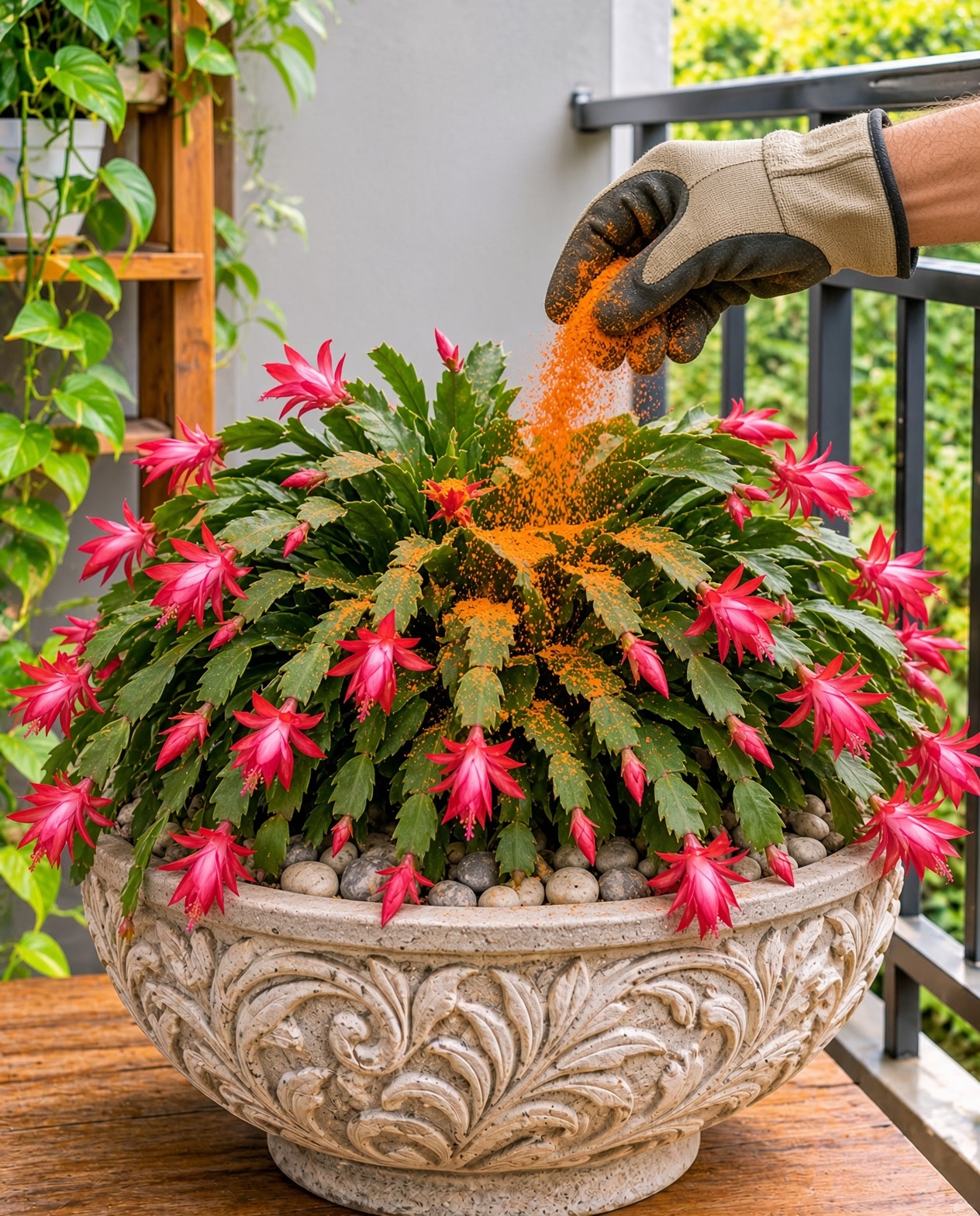
A Christmas Cactus covered in vibrant pink flowers can become one of the most beautiful features of an indoor garden, patio, or balcony. With its cascading green stems and colorful seasonal blooms, this popular houseplant looks especially impressive in a large decorative planter.
The image shows a lush Christmas Cactus (Schlumbergera) growing in an ornate stone-style bowl filled with decorative pebbles. A gloved hand is sprinkling bright orange powder over the foliage and surrounding growing area.
But what is this orange powder, and can it actually help a Christmas Cactus grow healthier roots and produce more flowers?
The answer depends on the ingredients. While some commercial fertilizers contain colored granules or powders, not every orange gardening product is suitable for flowering cacti.
Understanding the difference between balanced fertilizers, soil amendments, and unidentified powders is essential for protecting your plant.
1. What Is the Orange Powder Being Sprinkled on the Christmas Cactus?
The orange material resembles a powdered gardening treatment or colored fertilizer, but its exact composition cannot be identified from the image.
Possible products include:
- Water-soluble plant fertilizer
- Colored mineral fertilizer granules
- Micronutrient supplements
- Commercial flowering plant food
- Powdered soil amendments
The color alone does not reveal whether a product is safe or beneficial.
Is Orange Powder Good for Christmas Cactus?
A properly formulated fertilizer can support healthy growth when used according to its label.
However, sprinkling unidentified powder directly onto cactus stems and flowers is not recommended.
Concentrated fertilizer may cause tissue damage, while unsuitable soil amendments can interfere with root health.
Best practice: Use a clearly labeled fertilizer designed for flowering houseplants or epiphytic cacti. Apply it to the potting medium according to the manufacturer’s instructions rather than coating the foliage.
2. Best Fertilizer for Christmas Cactus Growth and Flowering
Unlike desert cacti, Christmas Cactus naturally grows in humid forest environments, where its roots receive moisture, oxygen, and nutrients from loose organic material.
This means it needs a different care routine from many traditional succulents.
Balanced Liquid Fertilizer
A complete, balanced fertilizer is often the easiest choice for indoor Christmas Cactus care.
Common formulations include:
- 10-10-10 balanced liquid fertilizer
- 20-20-20 water-soluble fertilizer
- Complete fertilizer formulated for flowering houseplants
These products supply nitrogen, phosphorus, and potassium.
What Do These Nutrients Do?
Nitrogen (N): Supports healthy green stem growth.
Phosphorus (P): Supports root development and normal energy transfer.
Potassium (K): Contributes to overall plant function and stress tolerance.
A complete fertilizer should also contain essential micronutrients.
Slow-Release Fertilizer Granules
Controlled-release granules gradually supply nutrients over several weeks or months.
They can be convenient for established container plants, but the dosage must be appropriate for the pot size.
Organic Fertilizer
Commercial organic houseplant fertilizers can also be suitable when used carefully.
Choose a low-odor product designed for indoor containers.
Fertilizer Comparison
| Fertilizer Type | Main Advantage | Best Application |
|---|---|---|
| Balanced liquid fertilizer | Easy dosage adjustment | Active growth |
| Water-soluble fertilizer | Convenient nutrient delivery | Diluted soil feeding |
| Controlled-release granules | Extended nutrient supply | Established plants |
| Organic houseplant fertilizer | Alternative nutrient source | Light seasonal feeding |
| Unidentified orange powder | Unknown composition | Avoid until identified |
Recommended choice: A complete liquid houseplant fertilizer applied at a conservative concentration during active growth.
3. How to Fertilize a Christmas Cactus Correctly
Proper feeding supports healthy growth, but applying excessive fertilizer will not guarantee additional flowers.
Step 1: Check the Plant’s Condition
Inspect the green stem segments, roots, and potting medium.
Avoid fertilizing a plant suffering from root rot, severe dehydration, or significant pest damage.
Step 2: Choose a Suitable Fertilizer
Select a balanced fertilizer labeled for houseplants or flowering container plants.
Step 3: Dilute the Product
Follow the label instructions. A reduced concentration may be appropriate for light feeding when permitted by the manufacturer.
Step 4: Apply to the Growing Medium
Water the root zone evenly with the prepared fertilizer solution.
Avoid pouring concentrated fertilizer onto flowers or stem segments.
Step 5: Allow Excess Water to Drain
Drainage is essential because Christmas Cactus roots require oxygen.
Step 6: Feed During Active Growth
Light feeding every four to six weeks during active spring and summer growth can be suitable, depending on the fertilizer formulation.
Reduce feeding when growth slows or when the plant is entering its fall bud-setting period.
4. How to Encourage More Christmas Cactus Flowers
Christmas Cactus flowers are produced at the ends of mature stem segments.
A healthy plant may develop numerous buds, creating a spectacular cascading display.
However, flowering depends on more than fertilizer.
Provide Bright Indirect Light
Place the plant near a bright window or in a sheltered outdoor location.
Avoid prolonged exposure to intense afternoon sunlight.
Maintain Cooler Autumn Temperatures
Cooler conditions can help encourage flower bud development.
Temperatures around 55–65°F (13–18°C) may support bud initiation, provided the plant is protected from frost.
Provide Long, Uninterrupted Nights
Many Schlumbergera varieties respond to shorter days and longer nights.
Approximately 12–14 hours of uninterrupted darkness over several weeks can help encourage flowering under suitable temperature conditions.
Avoid Sudden Environmental Changes
Moving a plant repeatedly after buds form may contribute to bud drop, especially when light, temperature, or moisture conditions change significantly.
Maintain Consistent Moisture
Allow the upper portion of the potting medium to begin drying between waterings without leaving the entire root ball severely dehydrated.
Important: Fertilizer supports plant nutrition, but appropriate light, seasonal temperatures, and nighttime conditions are often more important for flower initiation.
5. Best Premium Potting Mix for Christmas Cactus
Christmas Cactus requires a loose, well-aerated potting medium that retains some moisture without remaining waterlogged.
Dense garden soil is usually unsuitable for indoor containers.
Recommended Potting Mix
A practical blend includes:
- 40% premium indoor potting soil
- 25% fine orchid bark
- 20% perlite or pumice
- 15% coco coir
This mixture provides a balance of moisture retention and drainage.
Why Orchid Bark Helps
Orchid bark creates air spaces and helps prevent compaction.
Why Perlite Is Important
Perlite improves drainage and allows oxygen to reach the roots.
Why Coco Coir Is Useful
Coco coir retains moisture while helping maintain an open growing structure.
Can You Use Cactus Soil?
Yes, but some commercial desert cactus mixes dry too quickly for Schlumbergera.
Adding fine orchid bark or a moisture-retentive organic component may improve the mixture.
6. How Often Should You Water a Christmas Cactus?
Christmas Cactus generally needs more consistent moisture than desert cacti.
However, excessive watering can still cause root rot.
Proper Watering Method
- Check the upper inch of the potting medium.
- Water when the surface begins to dry.
- Apply water evenly around the roots.
- Allow excess water to drain completely.
- Empty any standing water from the saucer.
Watering frequency varies with temperature, light, pot size, and soil composition.
Signs of Underwatering
- Wrinkled stem segments
- Limp foliage
- Dry potting medium
- Reduced growth
Signs of Overwatering
- Soft or mushy stems
- Persistent wetness
- Yellowing segments
- Root deterioration
Always examine the potting medium before deciding whether to water.
7. Why Christmas Cactus Buds Fall Off Before Opening
Bud drop is one of the most common problems gardeners experience.
Possible causes include:
- Sudden temperature changes
- Irregular watering
- Excessively dry conditions
- Waterlogged roots
- Relocation during bud development
- Low humidity or drafts
How to Prevent Bud Drop
Maintain stable growing conditions once flower buds appear.
Avoid placing the plant near heating vents, cold windows, or frequently opened exterior doors.
Keep moisture reasonably consistent without saturating the roots.
8. Common Christmas Cactus Problems and Solutions
| Problem | Possible Cause | Recommended Solution |
|---|---|---|
| No flowers | Insufficient darkness or unsuitable temperatures | Improve autumn conditions |
| Falling buds | Environmental stress | Stabilize light and watering |
| Wrinkled stems | Dry soil or root damage | Inspect roots and moisture |
| Yellow segments | Excessive light or watering stress | Adjust growing conditions |
| Soft stems | Root or stem rot | Improve drainage |
| Brown stem patches | Sunburn or physical damage | Provide filtered light |
| Slow growth | Low light or limited nutrients | Review care routine |
| White cottony insects | Mealybugs | Use labeled pest treatment |
Can Too Much Fertilizer Damage Christmas Cactus?
Yes. Excess fertilizer can cause salt accumulation, root injury, and damaged stem margins.
Why Are My Christmas Cactus Leaves Turning Purple?
Purple or reddish coloration may develop in response to strong light, temperature stress, or other growing conditions.
Should You Remove Old Flowers?
Yes. Removing spent flowers can improve appearance and make it easier to monitor the plant.
9. Best Gardening Products for Christmas Cactus Care
Choosing the right gardening supplies can improve growing conditions and simplify maintenance.
Premium Epiphytic Cactus Potting Mix
Look for a well-draining blend containing bark, perlite, and organic material.
Balanced Liquid Houseplant Fertilizer
A complete fertilizer provides essential nutrients during active growth.
Controlled-Release Fertilizer
A carefully measured slow-release product can reduce the frequency of feeding.
Decorative Planters With Drainage
Choose containers with drainage holes or use a removable nursery pot inside a decorative planter.
Full-Spectrum LED Grow Lights
Grow lights can supplement natural daylight in dim interiors.
For flowering plants, maintain an appropriate day-night schedule rather than leaving lights on continuously.
Moisture Meter
A moisture meter can provide supplementary information, although checking the soil directly is often more dependable.
Indoor Plant Pest Treatments
Use products specifically labeled for the pest and plant involved.
10. Luxury Balcony and Garden Decor With Christmas Cactus
The image features an impressive Christmas Cactus overflowing with pink flowers from an ornate stone-style planter.
The carved container, decorative pebbles, and surrounding greenery create a sophisticated garden display.
Classic Stone Planter
An ornamental stone or stone-look planter can complement the cascading stems and bright flowers.
Elegant Balcony Centerpiece
Place a mature Christmas Cactus on a sturdy outdoor table in a sheltered location with filtered sunlight.
Luxury Patio Arrangement
Combine the planter with decorative foliage plants and neutral outdoor furniture.
Premium Ceramic Containers
Glazed ceramic planters in cream, charcoal, or muted green can create a refined appearance.
Decorative Pebble Top Dressing
A thin layer of decorative stones can improve the visual finish of a container.
Avoid thick layers that make it difficult to monitor soil moisture.
Design tip: Large decorative bowls should provide drainage. If the outer planter has no drainage holes, grow the cactus in a removable inner pot.
Protect outdoor Christmas Cactus plants from frost and intense afternoon sunlight.
11. Frequently Asked Questions
Is orange powder good for Christmas Cactus?
Only if it is a properly formulated, plant-safe product used according to its label. The color does not establish its suitability.
What fertilizer helps Christmas Cactus bloom?
A complete, balanced fertilizer supports overall plant health. Seasonal light and temperature conditions are important for flowering.
Can I sprinkle fertilizer directly on Christmas Cactus leaves?
It is generally better to apply fertilizer to the potting medium unless the product specifically permits foliar application.
How often should I fertilize Christmas Cactus?
Light feeding every four to six weeks during active growth may be suitable, depending on the product.
Does Christmas Cactus need special soil?
It grows best in a loose, well-draining, moisture-retentive potting mix.
Can Christmas Cactus grow outdoors?
Yes, in suitable frost-free conditions with protection from intense sunlight.
Why is my Christmas Cactus growing but not blooming?
Insufficient nighttime darkness, unsuitable temperatures, or plant immaturity may be contributing factors.
Should I fertilize while the plant is flowering?
Heavy feeding is unnecessary. Maintain stable conditions and avoid excessive fertilizer.
How long do Christmas Cactus flowers last?
Individual flowers may last several days, while a mature plant can remain in bloom for multiple weeks as additional buds open.
Can Christmas Cactus live for many years?
Yes. With suitable care, Schlumbergera plants can remain healthy for decades.
Final Thoughts
A healthy Christmas Cactus can produce a remarkable display of cascading stems and colorful seasonal flowers, especially when grown in a beautiful decorative planter.
The orange powder shown in the image may resemble a gardening fertilizer, but its composition cannot be determined from appearance alone. Applying unknown powders directly to the plant is not a reliable flowering technique.
For dependable results, focus on balanced liquid fertilizer, premium well-draining potting mix, healthy roots, consistent watering, and proper autumn light conditions.
With the right care, your Christmas Cactus can become a stunning seasonal centerpiece that brings color and elegance to your home, patio, or balcony year after year.