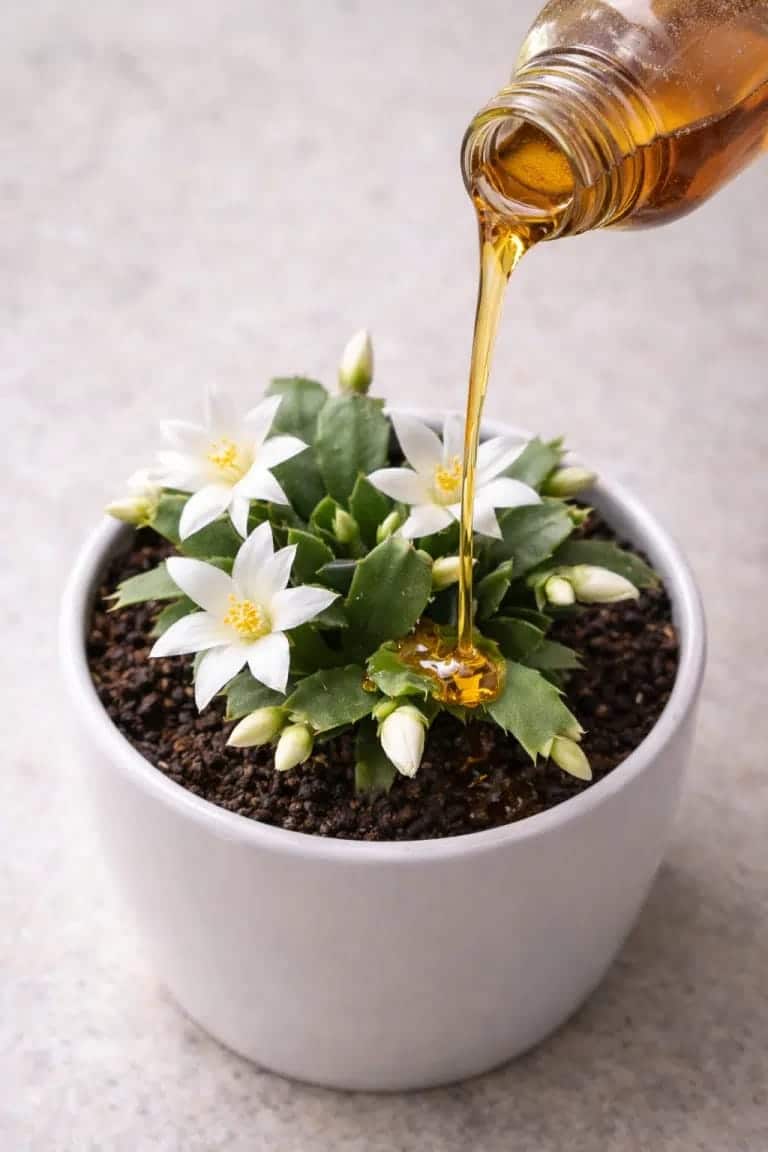
An Easter Cactus covered in delicate white flowers can bring a fresh, elegant look to any indoor garden. Its compact green stems, soft white buds, and star-shaped flowers make it especially attractive during spring.
The image shows a small flowering Easter Cactus in a white ceramic planter, with a thick golden liquid being poured over the plant.
But can golden liquid actually help an Easter Cactus grow stronger roots and produce more flowers?
The answer depends on what the liquid contains. Some properly formulated plant fertilizers support healthy growth, while thick household liquids such as honey or syrup can create problems when applied directly to plants.
Understanding the difference is essential for keeping your Easter Cactus healthy.
1. Understanding Easter Cactus and Its Flowering Needs
Easter Cactus, commonly classified as Rhipsalidopsis (also known as Hatiora in some classifications), is a tropical epiphytic cactus native to Brazil.
Unlike desert cacti, Easter Cactus naturally grows in environments with moderate humidity, filtered sunlight, and good air circulation.
It is especially popular for its spring flowers, which can appear in white, pink, red, orange, or other shades.
Ideal Growing Conditions
- Light: Bright, indirect sunlight.
- Temperature: Approximately 60–75°F (16–24°C) during active growth.
- Watering: Moderate moisture with partial drying between waterings.
- Soil: Loose, well-draining potting mix.
- Humidity: Moderate indoor humidity.
- Fertilizer: Light feeding during active growth.
Easter Cactus vs. Christmas Cactus
Although they look similar, these plants have important differences.
| Feature | Easter Cactus | Christmas Cactus |
|---|---|---|
| Typical blooming | Spring | Late fall to winter |
| Flowers | Often star-shaped | Usually tubular |
| Stem segments | Rounded or scalloped | Rounded or pointed, depending on type |
| Light preference | Bright indirect light | Bright indirect light |
| Soil preference | Airy, well-draining | Airy, well-draining |
The white, star-shaped flowers in the image are consistent with an Easter Cactus.
2. What Is the Golden Liquid Being Poured on the Easter Cactus?
The image shows a thick, amber-colored liquid being poured directly onto the plant.
Its appearance resembles honey or syrup, but its exact identity cannot be established from the photograph.
Some liquid fertilizers also have yellow, amber, or brown coloring.
However, the color of a liquid does not reveal its nutrient content or prove that it benefits plants.
Could It Be Honey?
Honey is sometimes promoted online as a homemade plant treatment.
However, there is no reliable evidence that pouring honey directly onto an Easter Cactus improves flowering or root development.
Honey contains sugars rather than the balanced mineral nutrients plants require.
Applying thick, sugary liquids to the growing medium may encourage microbial growth, attract insects, or create unwanted residue.
Could It Be Liquid Fertilizer?
A commercial liquid fertilizer may contain nitrogen, phosphorus, potassium, and micronutrients.
These nutrients can support normal plant development when applied at the correct concentration.
However, fertilizer should always be diluted and applied according to its label.
Comparing Golden Liquid Treatments
| Treatment | Potential benefit | Recommendation |
|---|---|---|
| Balanced liquid fertilizer | Provides essential nutrients | Suitable when correctly diluted |
| Organic liquid fertilizer | Supplies nutrients depending on formulation | Use according to label |
| Honey | No established flowering benefit | Avoid direct application |
| Sugar syrup | No meaningful fertilizer benefit | Not recommended |
| Liquid seaweed extract | May provide supplementary compounds | Use only as labeled |
| Unknown golden liquid | Cannot assess composition | Do not apply |
For routine care, a complete houseplant fertilizer is a safer and more predictable choice than an unidentified golden liquid.
3. Best Fertilizer for Easter Cactus Flowers
Easter Cactus benefits from moderate feeding during active growth.
A quality fertilizer should provide essential nutrients without creating excessive salt buildup around the roots.
Nitrogen for Healthy Green Growth
Nitrogen supports the development of healthy green plant tissue.
However, excessive nitrogen can encourage vegetative growth without improving flowering.
Phosphorus for Root and Plant Development
Phosphorus is essential for energy transfer and normal root development.
Adding extra phosphorus does not automatically produce more flowers when the plant already has sufficient nutrients.
Potassium for Overall Plant Health
Potassium helps regulate water balance and supports normal plant processes.
A complete fertilizer containing these nutrients can help maintain a healthy Easter Cactus.
4. Best Easter Cactus Fertilizer Options
| Fertilizer type | Main advantage | Best application |
|---|---|---|
| Balanced liquid houseplant fertilizer | Complete nutrition | Active growing season |
| Cactus and succulent fertilizer | Convenient formulation | Routine feeding |
| Organic liquid fertilizer | Organic nutrient source | Light seasonal feeding |
| Slow-release fertilizer | Gradual nutrient supply | Established plants |
| High-phosphorus bloom booster | Specialized formulation | Only when nutrient needs justify it |
How Often Should You Fertilize?
During active spring and summer growth, many Easter Cactus plants benefit from light feeding approximately every four weeks with a suitable diluted fertilizer.
Always follow the manufacturer’s instructions.
Reduce or suspend feeding during the cool resting period and avoid fertilizing a severely stressed plant.
The right fertilizer can support healthy growth, but the roots need the right environment to use those nutrients. Next, discover which potting mixes and watering methods help protect your Easter Cactus from common problems.