The Spider Plant (Chlorophytum comosum) is one of the most popular indoor houseplants, admired for its long, arching leaves, beautiful green-and-white stripes, and impressive ability to produce baby plants.
With proper care, a mature Spider Plant can develop into a lush hanging display filled with cascading stems and dozens of miniature plantlets.
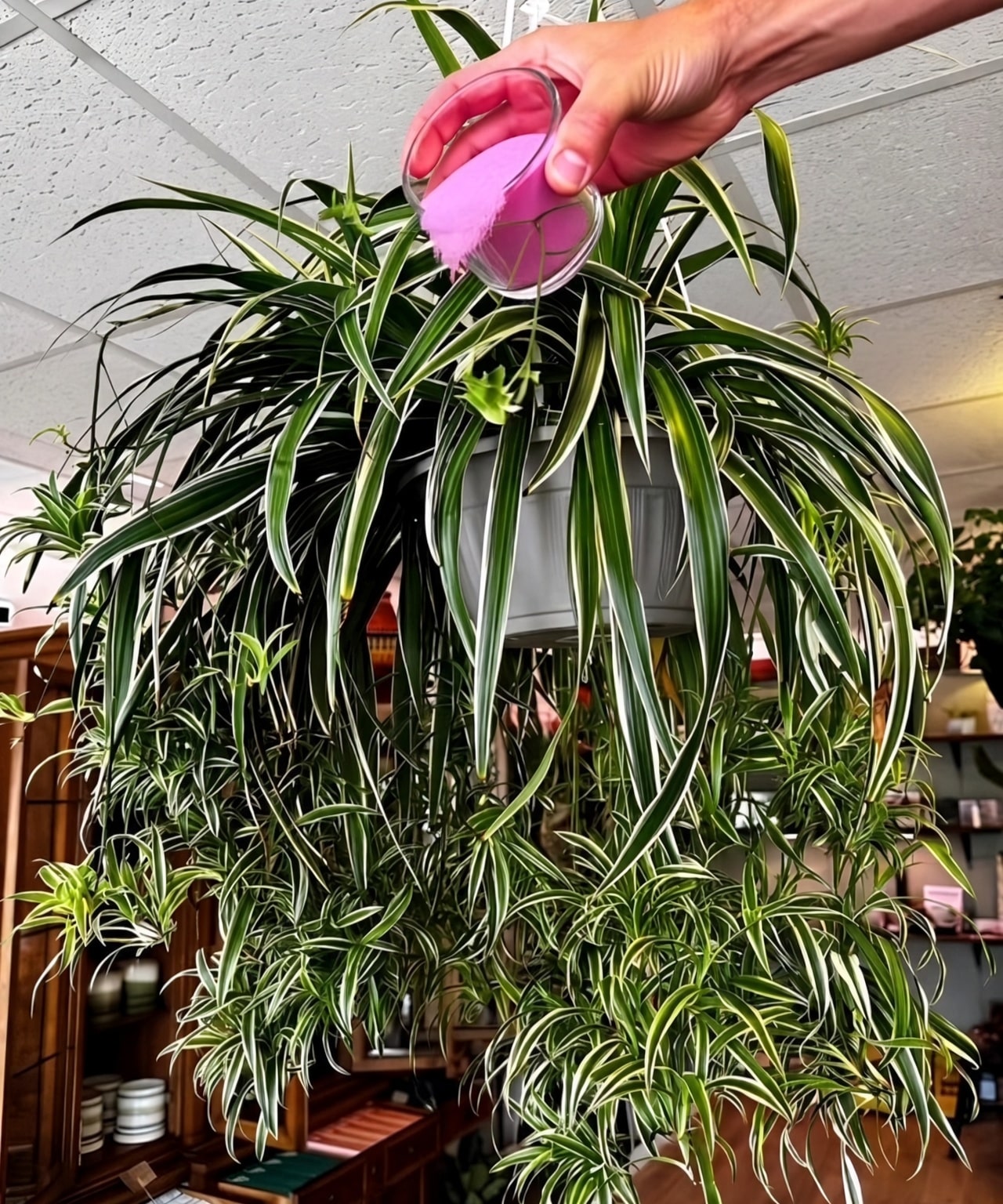
The image shows a spectacular variegated Spider Plant growing in a large white hanging planter. Its long, striped leaves flow gracefully downward, surrounded by numerous spiderettes that create a beautiful indoor waterfall effect. A gardener holds a glass container filled with fine pink powder above the foliage.
Can pink powder fertilizer help Spider Plants develop stronger roots, fuller leaves, and more baby plants?
A properly formulated fertilizer can support healthy Spider Plant growth when nutrients are needed. However, the powder’s ingredients, concentration, and application method are more important than its color.
This guide explains the best Spider Plant fertilizers, pink powder treatments, premium potting mixes, watering techniques, propagation methods, and luxury hanging planter ideas.
1. Understanding Spider Plant Growth
Spider Plants are tropical and subtropical perennials known for their long, narrow leaves and cascading growth habit.
Mature plants often produce arching runners that carry small white flowers and eventually develop miniature plantlets.
These baby plants are commonly called spiderettes or Spider Plant pups.
Why Spider Plants Are Popular
- Attractive green-and-white striped foliage
- Beautiful cascading growth
- Easy propagation from baby plants
- Adaptability to indoor environments
- Excellent suitability for hanging baskets
- Relatively manageable care requirements
Ideal Growing Conditions
| Care factor | Recommended conditions |
|---|---|
| Light | Bright, indirect sunlight |
| Temperature | 60–80°F (16–27°C) |
| Soil | Well-draining indoor potting mix |
| Watering | When the upper soil begins to dry |
| Humidity | Average to moderate household humidity |
| Fertilizer | Diluted balanced houseplant fertilizer |
| Container | Hanging pot with drainage |
| Propagation | Spiderettes or plant division |
2. What Is the Pink Powder Being Used on Spider Plants?
The image shows a small glass container filled with fine pink powder positioned above the Spider Plant.
Some commercial houseplant fertilizers and specialty plant nutrient products are available as colored powders.
However, the exact material cannot be identified from appearance alone.
Common Pink Powder Plant Treatments
| Product type | Possible purpose | Important consideration |
|---|---|---|
| Water-soluble plant fertilizer | Supplies essential nutrients | Usually requires dilution |
| Balanced powdered fertilizer | Supports normal plant growth | Follow product label |
| Micronutrient powder | Supplies trace nutrients | Use when appropriate |
| Specialty foliage fertilizer | Provides formulated nutrition | Check nutrient analysis |
| Mineral soil amendment | Modifies growing conditions | Depends on ingredients |
| Unidentified pink powder | Unknown composition | Avoid until identified |
Can Pink Powder Produce More Spider Plant Babies?
Adequate nutrition can help maintain vigorous growth when nutrients are insufficient.
However, spiderette production also depends on plant maturity, suitable light, genetics, and overall growing conditions.
Fertilizer alone cannot guarantee more runners or baby plants.
3. Best Fertilizer for Spider Plants
Spider Plants benefit from moderate nutrition during active growth.
A complete liquid houseplant fertilizer is often a practical choice because it can be diluted and applied evenly.
Essential Nutrients
Nitrogen (N): Supports healthy green foliage and new leaf growth.
Phosphorus (P): Contributes to root function and normal energy transfer.
Potassium (K): Supports water regulation and plant development.
Magnesium and iron: Help maintain chlorophyll production and healthy foliage.
Fertilizer Comparison
| Fertilizer type | Main advantage | Suitable use |
|---|---|---|
| Balanced liquid fertilizer | Easy to dilute | Active growth |
| Water-soluble powdered fertilizer | Convenient nutrient preparation | Label-directed feeding |
| Complete houseplant fertilizer | Supplies essential nutrients | Routine maintenance |
| Controlled-release fertilizer | Gradual nutrition | Established plants |
| Organic liquid fertilizer | Alternative nutrient source | Seasonal feeding |
| Seaweed-based supplement | Optional supplemental care | Not complete nutrition |
How Often Should You Fertilize?
During spring and summer, a diluted balanced fertilizer approximately every four to six weeks may be sufficient.
Spider Plants can develop brown leaf tips when excessive fertilizer salts accumulate.
Avoid heavy feeding and reduce fertilization when growth slows.
4. How to Apply Pink Powder Fertilizer Safely
The image highlights a pink powder treatment above the plant.
Most water-soluble powdered fertilizers should be dissolved in water before application.
Sprinkling concentrated fertilizer directly onto leaves, runners, or spiderettes may cause unwanted residue or tissue damage.
Step-by-Step Application
- Identify the fertilizer and read its instructions.
- Confirm that it is suitable for indoor foliage plants.
- Measure the recommended quantity.
- Dissolve the powder in the specified amount of clean water.
- Check the moisture level of the potting mix.
- Apply the solution evenly around the root zone.
- Avoid leaving concentrated fertilizer on the leaves.
- Allow excess water to drain completely.
Signs of Excess Fertilizer
- Brown leaf tips
- Yellowing foliage
- White mineral deposits on the soil
- Reduced root growth
- Leaf edge damage
- General plant stress
If these symptoms develop, review fertilizer concentration and watering practices.
The secret to a beautiful cascading Spider Plant begins with healthy roots. Next, discover which premium potting mixes and watering techniques help support stronger foliage and vigorous new growth.