A large, healthy Peace Lily can transform an ordinary living room into a beautiful indoor garden. With glossy green leaves, elegant white flowers, and a naturally tropical appearance, this popular houseplant is an excellent choice for bright apartments, modern homes, offices, and decorative indoor plant collections.
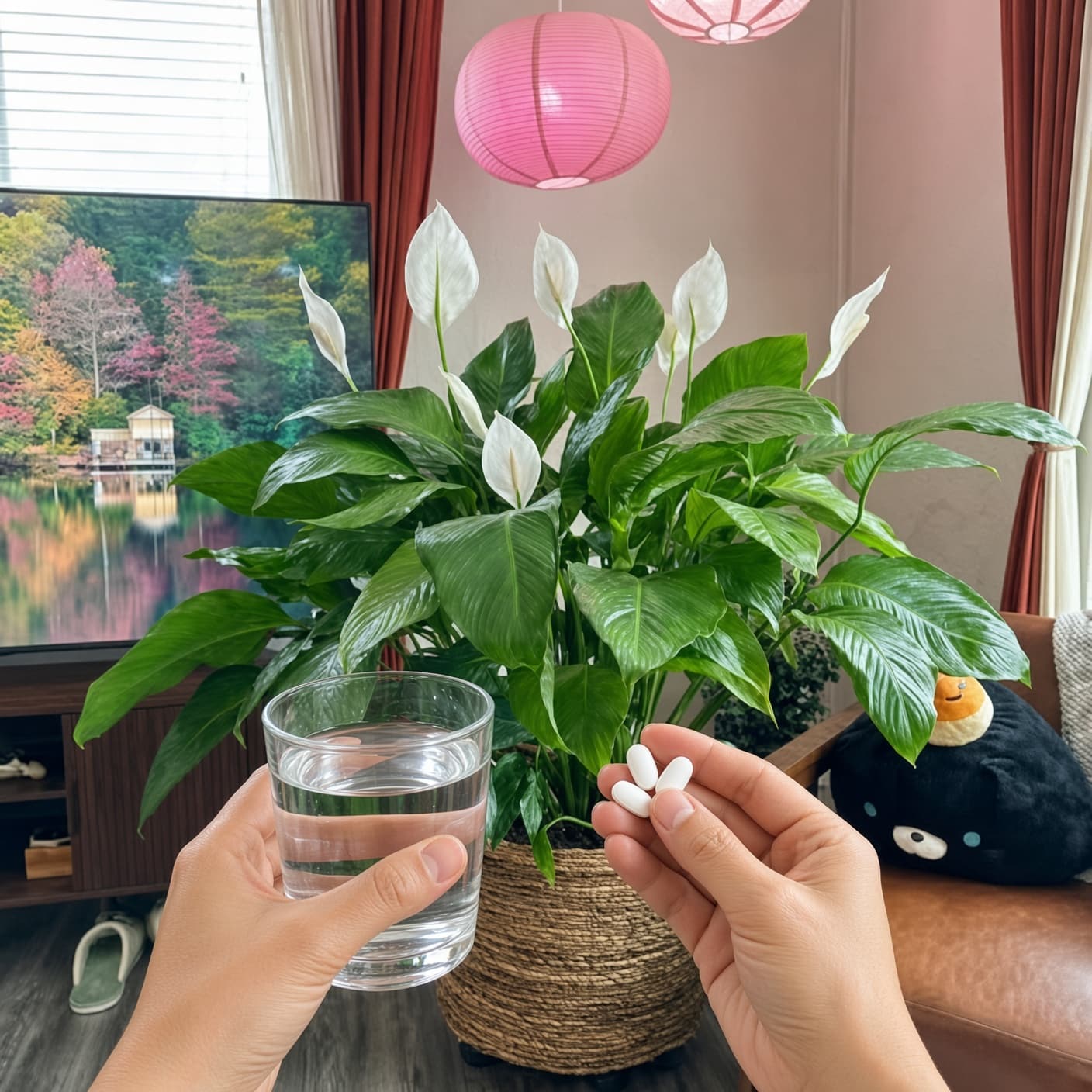
The image shows a mature Peace Lily growing in a large woven-style planter inside a cozy living room. Its broad green leaves spread outward, while several tall white blooms rise above the foliage.
In the foreground, one hand holds a clear glass of water while the other displays several small white tablets.
The scene suggests a simple plant treatment: dissolving white tablets in water before applying the liquid to the Peace Lily.
But can white tablets really improve Peace Lily growth, encourage larger leaves, strengthen roots, or produce more flowers?
The answer depends entirely on what those tablets contain.
Some commercially manufactured plant fertilizer tablets are designed to dissolve in water and provide essential nutrients. Others are intended for placement directly into growing media. Unidentified tablets, including household cleaning products and human medications, should never be used as improvised plant treatments.
Even a suitable fertilizer tablet cannot guarantee bigger leaves or additional flowers. Healthy Peace Lily growth depends on balanced nutrition, appropriate light, healthy roots, proper watering, and a suitable indoor environment.
This guide explains how to evaluate the white tablet treatment, choose premium indoor plant fertilizers, improve root health, select the best potting soil, prevent common problems, and maintain a beautiful flowering Peace Lily throughout the year.
Quick Answer: Can White Tablets in Water Help a Peace Lily?
A white tablet may support Peace Lily growth only if it is a properly identified plant nutrient product suitable for indoor ornamental plants.
A legitimate fertilizer tablet can provide nutrients when the plant needs them, but its effectiveness depends on its formulation, concentration, and application instructions.
Never assume that a tablet is safe because it is white, small, or dissolves easily in water.
For healthier Peace Lily growth:
- Use a suitable, clearly labeled indoor plant fertilizer.
- Follow the manufacturer’s dilution instructions.
- Check soil moisture before watering.
- Maintain a well-draining potting mix.
- Provide bright, indirect light.
- Avoid excessive fertilizer.
- Inspect roots when leaves become yellow or wilted.
- Maintain stable indoor temperatures.
- Protect the plant from harsh direct sunlight.
- Avoid using unidentified household tablets.
A healthy Peace Lily generally benefits more from consistent care than from experimental treatments.
What Is a Peace Lily?
Peace Lily, botanically known as Spathiphyllum, is a tropical ornamental plant belonging to the Araceae family.
It is widely grown indoors for its attractive foliage and distinctive white flower structures.
Peace Lilies are native to tropical regions and typically grow in environments with filtered light and relatively consistent moisture.
They are not true lilies.
Why Peace Lilies Are Popular Indoor Plants
Peace Lilies are valued for several characteristics.
Elegant white blooms: Their white spathes create a striking contrast against dark green foliage.
Glossy tropical leaves: Mature plants develop broad, attractive leaves that complement modern interiors.
Adaptability: Peace Lilies tolerate a range of indoor lighting conditions, although flowering is usually better in brighter indirect light.
Decorative versatility: They work well in ceramic planters, woven baskets, plant stands, and indoor garden arrangements.
Long-term ornamental value: With suitable care, established plants can remain attractive for many years.
Understanding the White Flowers
The white structures commonly called Peace Lily flowers are technically spathes.
A spathe is a modified leaf-like structure surrounding a central flower spike called the spadix.
The actual flowers are small and arranged along the spadix.
Why This Matters
The white spathe is an important indicator of the plant’s ornamental appeal, but its presence does not necessarily mean that the plant needs more fertilizer.
Flowering depends on several factors, including:
- Plant maturity
- Light exposure
- Genetics
- Overall health
- Nutrient availability
- Growing conditions
Adding fertilizer to an already healthy Peace Lily will not automatically produce more white blooms.
What Are the White Tablets in the Image?
The image shows several small white tablets beside a glass of clear water.
Their exact identity cannot be established visually.
Several products can have similar appearances.
1. Water-Soluble Plant Fertilizer Tablets
Some commercial fertilizers are manufactured as tablets designed to dissolve in a specified amount of water.
These products may supply nitrogen, phosphorus, potassium, and other nutrients.
Their suitability depends on the label.
2. Plant Nutrient Tablets
Certain tablets are marketed for indoor plant nutrition or specialized growing systems.
Not every product is suitable for soil-grown Peace Lilies.
3. Controlled-Release Fertilizer Tablets
Some fertilizer tablets are intended to be placed in the growing medium rather than dissolved.
Using them incorrectly may cause excessive nutrient concentration.
4. Human Medication Tablets
Human medications should not be used as improvised plant fertilizers.
Their ingredients are not formulated for Peace Lily nutrition.
5. Cleaning Tablets
Cleaning tablets may contain ingredients that damage plant roots.
They should never be added to houseplant watering solutions.
6. Unknown Household Tablets
If the ingredients and intended use are unknown, do not apply the tablets.
Why Nutrients Matter for Peace Lily Growth
Peace Lilies require essential mineral nutrients for normal development.
These nutrients support different plant functions.
Nitrogen
Nitrogen supports chlorophyll production and vegetative growth.
Insufficient nitrogen can contribute to pale foliage and reduced growth.
Phosphorus
Phosphorus plays an important role in energy transfer and normal plant development.
Potassium
Potassium contributes to water regulation and several physiological processes.
Calcium
Calcium is important for cell structure and developing tissues.
Magnesium
Magnesium is a central component of chlorophyll.
Micronutrients
Iron, manganese, zinc, and other micronutrients are required in smaller quantities.
Important Point
More fertilizer does not always mean healthier growth.
Excess nutrients can damage roots and contribute to leaf-tip browning.
Can White Fertilizer Tablets Make Peace Lily Leaves Bigger?
A suitable fertilizer may support healthy leaf development when nutrient availability is limiting growth.
However, leaf size also depends on the plant’s variety, maturity, lighting, root system, and growing conditions.
Factors That Influence Leaf Size
Genetics: Some Peace Lily cultivars naturally produce larger leaves.
Light: Appropriate indirect light supports photosynthesis.
Root health: Healthy roots absorb water and nutrients efficiently.
Watering: Severe moisture stress can reduce growth.
Nutrition: Balanced nutrients support normal development.
Temperature: Stable, warm conditions encourage healthy tropical plant growth.
Fertilizer cannot turn a naturally compact cultivar into a giant Peace Lily variety.
Can White Tablets Encourage More Peace Lily Flowers?
A balanced fertilizer can support overall plant health when nutrients are insufficient.
However, flowering is strongly influenced by light and plant maturity.
Why Some Peace Lilies Produce Few Flowers
Common reasons include:
- Insufficient light
- Immature plants
- Root stress
- Inappropriate watering
- Seasonal changes
- Environmental stress
- Natural cultivar differences
The Most Important Flowering Factor
Peace Lilies often flower more reliably in bright, indirect light than in very dark indoor locations.
Before increasing fertilizer, evaluate the plant’s lighting conditions.
Best Fertilizer for Peace Lily Indoor Plants
Choosing the right fertilizer is more important than choosing an unusual treatment.
Balanced Liquid Houseplant Fertilizer
A balanced liquid fertilizer is a practical choice for many indoor Peace Lilies.
It can be measured and diluted according to the product label.
Organic Indoor Plant Fertilizer
Organic fertilizers may contain nutrients derived from different natural materials.
Their nutrient release rates vary.
Controlled-Release Fertilizer
Controlled-release fertilizers gradually supply nutrients over time.
They may reduce the need for frequent feeding.
Water-Soluble Fertilizer Tablets
These products can be convenient when specifically formulated for indoor plants.
They should only be dissolved when the manufacturer instructs users to do so.
Specialized Flowering Houseplant Fertilizer
Some products are marketed for flowering indoor plants.
Check the nutrient analysis rather than relying solely on marketing claims.
Peace Lily Fertilizer Comparison
| Fertilizer type | Main advantage | Best use | Important caution |
|---|---|---|---|
| Balanced liquid fertilizer | Easy to measure | Active growth | Avoid excessive concentration |
| Organic houseplant fertilizer | Alternative nutrient sources | Suitable indoor growing systems | Nutrient release varies |
| Controlled-release fertilizer | Gradual nutrient supply | Established plants | Follow application limits |
| Water-soluble plant tablets | Convenient measured formulation | Label-approved applications | Verify dilution instructions |
| Flowering plant fertilizer | Convenient product category | Appropriate flowering plants | Not guaranteed to increase blooms |
| Unknown white tablets | No confirmed benefit | Not recommended | Ingredients may be harmful |
How to Use Water-Soluble Fertilizer Tablets Safely
If the white tablets are clearly identified as a suitable plant fertilizer, follow the manufacturer’s directions.
Step 1: Identify the Product
Read the label carefully.
Check its nutrient analysis and intended use.
Step 2: Confirm That It Is Designed to Dissolve
Some tablets are meant for water.
Others are designed for direct placement in potting soil.
Step 3: Measure the Water
Use the exact amount recommended by the manufacturer.
Step 4: Dissolve According to Instructions
Do not increase the number of tablets to create a stronger solution.
Step 5: Check Soil Moisture
Avoid applying additional water when the potting medium is already excessively wet.
Step 6: Apply to the Growing Medium
If the product is labeled for soil application, water the potting medium as directed.
Step 7: Allow Excess Water to Drain
Do not leave the planter standing in accumulated fertilizer solution.
Step 8: Monitor the Plant
Watch for browning, yellowing, or other signs of stress.
How Often Should You Fertilize a Peace Lily?
Feeding frequency depends on plant growth, light, potting medium, and fertilizer formulation.
Spring
As natural light increases, Peace Lilies may begin growing more actively.
Fertilizer may be appropriate when nutrients are needed.
Summer
Healthy plants may continue active growth.
Follow the fertilizer label.
Fall
Growth may slow as daylight decreases.
Reduce feeding when appropriate.
Winter
Many indoor Peace Lilies grow more slowly during winter.
Routine fertilizer may be unnecessary when growth is minimal.
After Repotting
Fresh commercial potting mixes sometimes contain fertilizer.
Check the product information before adding more nutrients.
Best Premium Indoor Potting Soil for Peace Lily
Peace Lilies prefer a growing medium that retains moisture while allowing sufficient oxygen around the roots.
A compact, waterlogged mixture can damage the root system.
Quality Indoor Potting Mix
A suitable indoor potting mix provides the foundation.
Perlite
Perlite improves aeration and helps reduce compaction.
Orchid Bark
Fine orchid bark adds structure and air spaces.
Coco Coir
Coco coir helps retain moisture.
Pumice
Pumice improves drainage and growing-medium structure.
A Practical Peace Lily Soil Recipe
A useful starting mixture is:
- 2 parts quality indoor potting mix
- 1 part perlite or pumice
- 1 part fine orchid bark or another suitable structural amendment
Adjust the mixture according to indoor humidity, pot size, and watering habits.
The goal is a medium that stays moderately moist without becoming stagnant.
Potting Soil Comparison
| Material | Main advantage | Main concern |
|---|---|---|
| Indoor potting mix | Moisture retention | May compact |
| Perlite | Improves airflow | Provides little nutrition |
| Orchid bark | Adds structure | May dry more quickly |
| Coco coir | Retains moisture | Can stay wet if overused |
| Pumice | Improves aeration | Adds weight |
| Dense garden soil | Inexpensive | Often unsuitable for indoor containers |
Choosing the Best Planter for a Large Peace Lily
The image shows a mature Peace Lily displayed in a decorative woven-style planter.
This type of container creates a warm, natural appearance.
However, the decorative outer basket should not be assumed to provide drainage.
Ceramic Planters
Ceramic containers are attractive and available in many finishes.
Choose a pot with drainage holes or use an inner nursery pot.
Plastic Nursery Pots
Plastic nursery pots are practical and lightweight.
They are useful inside decorative outer containers.
Terracotta Pots
Unglazed terracotta allows moisture to evaporate through the container walls.
Peace Lilies grown in terracotta may need more frequent moisture checks.
Self-Watering Planters
Self-watering systems may help maintain consistent moisture.
However, they require suitable growing media and careful monitoring.
Decorative Woven Baskets
Woven baskets create an attractive interior design effect.
Use a suitable inner container to protect the basket from moisture.
Planter Comparison
| Planter type | Main advantage | Main concern |
|---|---|---|
| Ceramic | Elegant appearance | Drainage varies |
| Plastic nursery pot | Lightweight and practical | Retains moisture |
| Terracotta | Porous material | Faster drying |
| Self-watering planter | Convenient moisture control | Requires correct setup |
| Woven decorative basket | Natural interior style | Needs suitable inner pot |
How to Water Peace Lily Correctly
Watering is one of the most important parts of Peace Lily care.
These tropical plants generally prefer consistently moderate moisture without prolonged waterlogging.
Check the Soil
Allow the upper portion of the growing medium to dry slightly before watering again.
Water Thoroughly
When watering is needed, moisten the growing medium and allow excess water to drain.
Avoid Standing Water
Empty water collected in decorative outer containers.
Adjust for Light
Plants receiving brighter light may use water more quickly.
Adjust for Temperature
Cooler conditions often reduce water use.
Avoid Rigid Watering Schedules
Check the growing medium rather than watering automatically on a fixed day.
Why Peace Lily Leaves Droop
Peace Lilies are known for visible drooping when moisture conditions are unsuitable.
However, drooping does not always mean that the plant needs water.
Underwatering
Dry soil can cause leaves to lose firmness.
Overwatering
Prolonged saturation may damage roots.
Root Rot
Damaged roots may fail to absorb water effectively.
Temperature Stress
Cold drafts and excessive heat can affect foliage.
Repotting Stress
Recently disturbed roots may temporarily reduce water uptake.
What to Do
Check soil moisture and root condition before adding more water.
Why Peace Lily Leaves Turn Yellow
Yellowing leaves can have several causes.
Natural Aging
Older leaves eventually decline.
Excessive Watering
Waterlogged soil can contribute to root stress.
Insufficient Light
Very low light may reduce healthy growth.
Nutrient Imbalance
Deficiencies or excess fertilizer may affect foliage.
Root Problems
Damaged roots can interfere with nutrient and water uptake.
Practical Solution
Evaluate watering, light, roots, and fertilizer history before choosing a treatment.
Why Peace Lily Leaf Tips Turn Brown
Brown leaf tips are a common concern.
Possible contributing factors include:
- Inconsistent watering
- Excess fertilizer salts
- Low indoor humidity
- Water quality
- Root stress
- Environmental changes
How to Reduce Browning
Maintain appropriate moisture.
Avoid excessive fertilizer.
Provide stable indoor conditions.
Use a suitable growing medium.
Monitor water quality if problems persist.
Best Light for Peace Lily Flowers and Large Leaves
Peace Lilies tolerate lower light than many tropical houseplants, but brighter indirect light generally supports better growth and flowering.
East-Facing Windows
Gentle morning light can be suitable.
South-Facing Windows
Filtered light may provide excellent growing conditions.
West-Facing Windows
Protect the plant from harsh afternoon sunlight.
North-Facing Windows
Some north-facing windows provide enough light for foliage but may limit flowering.
Avoid Harsh Direct Sunlight
Strong sunlight can scorch leaves.
Rotate the Plant
Occasional rotation can encourage balanced growth.
Professional LED Grow Lights for Peace Lily
LED grow lights can support healthy growth when natural daylight is insufficient.
They may be useful in apartments, offices, and rooms with limited window exposure.
Useful Features
- Adjustable brightness
- Appropriate coverage area
- Timer controls
- Adjustable height
- Low heat generation
- Energy-efficient operation
- Manufacturer-provided light output information
Lighting Comparison
| Lighting option | Main advantage | Main limitation |
|---|---|---|
| Bright indirect daylight | Natural and inexpensive | Depends on window exposure |
| Basic LED grow light | Useful in dim rooms | Requires correct positioning |
| Adjustable LED grow light | Greater control | Higher purchase cost |
| Timer-controlled LED | Consistent schedule | Requires suitable settings |
| Strong direct sunlight | High intensity | May scorch foliage |
How to Encourage Bigger Peace Lily Leaves
Large leaves develop when the plant has suitable growing conditions.
Provide Adequate Light
Bright indirect light supports photosynthesis.
Maintain Healthy Roots
Use an airy, moisture-retentive growing medium.
Water Consistently
Avoid severe drying and prolonged saturation.
Fertilize Appropriately
Balanced nutrition supports normal development.
Maintain Stable Temperatures
Peace Lilies prefer warm indoor conditions.
Choose the Right Cultivar
Some Peace Lily varieties naturally develop larger leaves than others.
Avoid Overcrowding
Give the foliage enough room to spread.
How to Encourage More White Peace Lily Blooms
A flowering Peace Lily can create a beautiful focal point in a living room.
Improve Light Exposure
Bright indirect light is often the most important adjustment.
Maintain Healthy Roots
Root stress can reduce flowering.
Avoid Excess Fertilizer
Too much fertilizer does not guarantee more blooms.
Maintain Stable Care
Avoid sudden temperature changes and severe watering stress.
Remove Spent Flowers
Cut aging flower stalks near their base using clean tools.
Be Patient
Flowering depends on plant maturity, cultivar, and growing conditions.
How to Repot a Large Peace Lily
A mature Peace Lily may eventually outgrow its container.
Repotting can improve root space and growing-medium quality.
Step 1: Choose a Suitable Pot
Select a container only slightly larger than the root system.
Step 2: Prepare Fresh Soil
Use an airy, moisture-retentive potting mix.
Step 3: Remove the Plant Carefully
Support the root ball while lifting the plant.
Step 4: Inspect the Roots
Look for healthy roots and signs of decay.
Step 5: Remove Severely Damaged Roots
Use clean tools when necessary.
Step 6: Replant at the Correct Depth
Keep the plant at approximately the same depth.
Step 7: Water Appropriately
Moisten the growing medium and allow excess water to drain.
Step 8: Provide Stable Conditions
Avoid harsh sunlight immediately after repotting.
Peace Lily Root Rot Treatment
Root rot can develop when the growing medium remains excessively wet and poorly aerated.
Warning Signs
- Yellowing leaves
- Wilting despite wet soil
- Soft stems
- Unpleasant soil odor
- Dark, decaying roots
- Slow growth
How to Respond
Remove the plant carefully if root rot is suspected.
Inspect the roots.
Trim severely decayed roots with clean tools.
Replace unsuitable potting medium.
Use a container with drainage holes.
Avoid excessive watering.
Do not apply additional fertilizer until the plant stabilizes.
Propagating Peace Lily by Division
Peace Lilies are commonly propagated by dividing established plants.
They are not typically propagated from ordinary leaf cuttings.
Step 1: Choose a Healthy Mature Plant
Select a plant with multiple established crowns.
Step 2: Remove It From the Pot
Carefully lift the root ball.
Step 3: Identify Natural Divisions
Look for separate crowns with their own roots.
Step 4: Separate the Divisions
Gently divide the plant while preserving as many healthy roots as possible.
Step 5: Prepare Suitable Containers
Use pots with drainage holes.
Step 6: Replant
Position each division at the appropriate depth.
Step 7: Water Carefully
Moisten the growing medium without saturating it.
Step 8: Provide Indirect Light
Keep newly divided plants in stable conditions while they establish.
Peace Lily Pest Control
Peace Lilies can occasionally develop pest problems.
Common pests include mealybugs, spider mites, scale insects, and thrips.
Mealybugs
Mealybugs may appear as white cotton-like clusters.
Spider Mites
Spider mites can cause fine leaf discoloration.
Scale Insects
Scale insects may appear as small attached bumps.
Thrips
Thrips can cause leaf scarring and distorted growth.
Choosing Pest Control Products
Use products labeled for the identified pest and suitable ornamental plants.
Follow application instructions.
Avoid applying unidentified household mixtures.
Common Peace Lily Care Problems
| Problem | Possible cause | Practical solution |
|---|---|---|
| Drooping leaves | Underwatering or root stress | Check soil and roots |
| Yellow leaves | Excess moisture or aging | Review watering |
| Brown tips | Fertilizer salts or environmental stress | Evaluate care |
| No flowers | Insufficient light or immaturity | Improve indirect light |
| Small leaves | Limited light or root problems | Review growing conditions |
| Soft stems | Possible rot | Inspect roots |
| Slow growth | Seasonal or environmental factors | Maintain stable care |
| Brown leaf patches | Excessive sunlight | Move to filtered light |
Luxury Living Room Plant Placement
The image shows a mature Peace Lily displayed in a large decorative planter within a furnished living room.
Its broad foliage and white flowers create an attractive contrast against the warm interior colors.
Modern Living Room Styling
A large Peace Lily can become a focal point beside a bright window.
Luxury Apartment Decor
Peace Lilies can complement contemporary apartments with neutral furniture and natural textures.
Decorative Woven Planters
Woven baskets add warmth and texture.
Use a suitable inner pot to protect the decorative container from moisture.
Premium Ceramic Planters
White, beige, and stone-colored ceramic planters complement glossy green foliage.
Home Office Greenery
A smaller Peace Lily can brighten a workspace with appropriate light.
Interior Design Combinations
Peace Lilies pair well with:
- Natural wood furniture
- Neutral-colored sofas
- Woven decorative baskets
- Ceramic floor planters
- Stone flooring
- Modern shelving
- Soft window curtains
- Contemporary living room decor
Decorative placement should always support the plant’s light and watering needs.
Best Indoor Plant Equipment for Peace Lily
Not every Peace Lily requires expensive equipment.
Useful products solve specific growing problems.
Quality Indoor Potting Soil
An appropriate growing medium supports healthy roots.
Balanced Houseplant Fertilizer
Suitable fertilizer provides nutrients when needed.
LED Grow Lights
Supplemental lighting may help plants in dim rooms.
Decorative Planters
Quality planters improve presentation while suitable drainage protects the roots.
Moisture Monitoring Tools
Moisture meters may assist with watering decisions.
However, readings should be checked against actual soil conditions.
Humidity Management
A humidifier may help in very dry indoor environments.
Avoid excessive humidity and stagnant air.
Peace Lily Care Schedule
| Care factor | Recommended approach |
|---|---|
| Light | Bright indirect light |
| Soil | Airy, moisture-retentive indoor mix |
| Watering | Maintain moderate moisture without waterlogging |
| Fertilizer | Balanced feeding during active growth when needed |
| Temperature | Stable warm indoor conditions |
| Humidity | Moderate humidity with airflow |
| Container | Pot with drainage holes |
| Repotting | When root or soil conditions require it |
| Propagation | Division of established crowns |
| Flowering | Adequate indirect light and healthy growth |
| Decorative use | Living rooms, offices, bright apartments |
Frequently Asked Questions
Can White Tablets in Water Help Peace Lily Grow Faster?
Only if they are suitable plant nutrient products and the plant requires additional nutrients.
What Are the White Tablets in the Image?
Their identity cannot be determined from appearance alone.
Can I Dissolve Human Medication Tablets for Peace Lily?
No. Human medications should not be used as improvised houseplant fertilizers.
Can Fertilizer Tablets Make Peace Lily Bloom?
Appropriate nutrition supports plant health, but flowering also depends on light, maturity, and growing conditions.
What Is the Best Fertilizer for Peace Lily?
A suitable balanced houseplant fertilizer is generally sufficient.
Why Are My Peace Lily Leaves Drooping?
Possible causes include underwatering, overwatering, root damage, and environmental stress.
Why Are My Peace Lily Leaves Turning Yellow?
Yellowing may result from aging, excessive moisture, root problems, or other growing conditions.
How Can I Encourage Bigger Peace Lily Leaves?
Provide appropriate light, healthy roots, consistent watering, and balanced nutrition.
Can Peace Lily Grow in Low Light?
Peace Lilies tolerate relatively low light, but brighter indirect light generally supports stronger growth and flowering.
Can LED Grow Lights Help Peace Lily?
Yes. Suitable supplemental lighting can support growth when natural daylight is insufficient.
Should I Fertilize a Newly Repotted Peace Lily?
Check whether the fresh potting mix already contains fertilizer and allow the plant to stabilize before adding unnecessary nutrients.
Is Peace Lily Safe for Cats and Dogs?
No. Peace Lilies contain insoluble calcium oxalate crystals that can cause mouth irritation, drooling, and other symptoms if chewed by cats or dogs. Keep them away from pets and children who may chew plant tissue.
Final Thoughts
The image shows a beautiful mature Peace Lily with glossy green leaves and elegant white blooms while several white tablets are held beside a glass of water.
Although the scene suggests a simple indoor plant treatment, the identity of the tablets cannot be confirmed visually.
A properly formulated fertilizer tablet may provide useful nutrients when applied according to its label, but unidentified tablets should never be used.
For stronger roots, larger healthy leaves, and attractive flowers, focus on appropriate lighting, consistent moisture, reliable drainage, suitable potting soil, and balanced nutrition.
Premium indoor plant fertilizers, LED grow lights, decorative ceramic planters, and moisture-management tools can improve plant care when chosen for a genuine need.
With the right environment and consistent attention, a Peace Lily can remain an elegant centerpiece in a modern living room, apartment, or home office for many years.
The most effective Peace Lily care secret is not an unknown white tablet. It is understanding the plant’s natural growing requirements and providing the conditions that allow it to thrive.