Fuchsia is one of the most spectacular flowering plants for balconies, patios, hanging baskets, and decorative outdoor gardens. Its graceful, dangling blossoms, vibrant colors, and attractive green foliage create a beautiful display throughout the growing season.
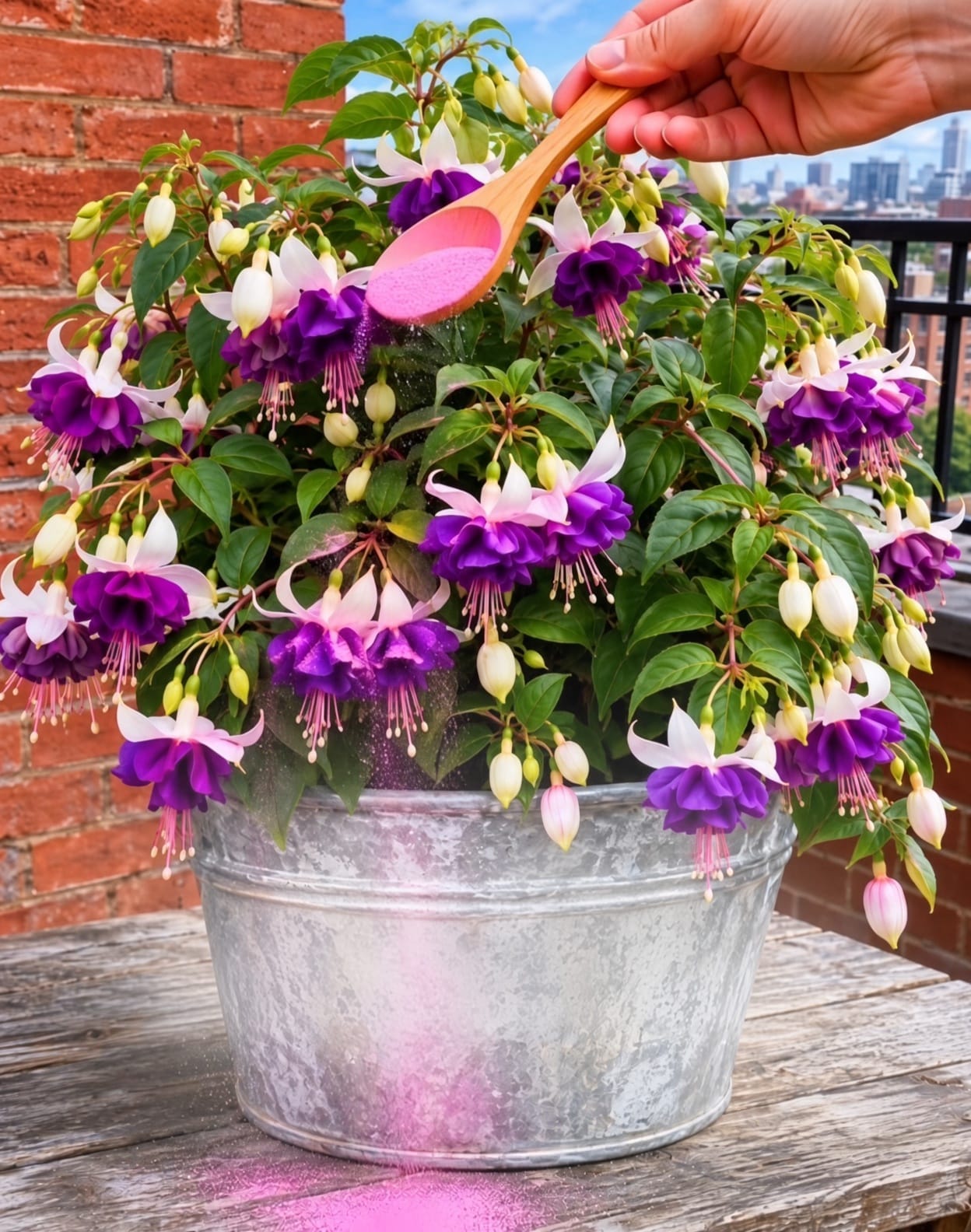
The image shows a lush Fuchsia plant covered in elegant purple-and-white flowers with long pink stamens. Numerous pale flower buds hang among the healthy green leaves, while the plant grows in a large galvanized metal container on a rustic wooden table. Above the flowers, a gardener holds a wooden spoon filled with fine pink powder.
Can pink powder fertilizer help Fuchsia plants develop stronger roots, healthier foliage, and more abundant flowers?
A properly formulated flowering plant fertilizer can support healthy growth when nutrients are needed. However, the powder’s color does not reveal its ingredients, and most concentrated fertilizers should not be sprinkled directly onto delicate flowers.
This guide explains pink powder treatments, the best Fuchsia fertilizers, premium potting mixes, watering techniques, flower bud care, and luxury balcony decorating ideas.
1. Understanding Fuchsia Plants
Fuchsias are flowering shrubs and perennials known for their distinctive hanging blossoms.
Their flowers often feature contrasting sepals and petals, creating beautiful combinations of pink, purple, red, white, and lavender.
The plant in the image resembles a decorative double-flowered Fuchsia variety, with pale outer sepals and richly colored purple inner petals.
Why Fuchsias Are Popular
- Beautiful pendant flowers
- Attractive multicolored blossoms
- Excellent hanging basket plants
- Suitable for sheltered balconies
- Long flowering potential
- Elegant container garden appearance
Ideal Growing Conditions
| Care factor | Recommended conditions |
|---|---|
| Light | Morning sun or bright partial shade |
| Temperature | Approximately 55–75°F (13–24°C) |
| Soil | Fertile, well-draining potting mix |
| Watering | Consistently moist, not waterlogged |
| Humidity | Moderate humidity |
| Fertilizer | Complete flowering plant fertilizer |
| Container | Pot with drainage holes |
| Flowering | Active growing season |
Fuchsias generally prefer cooler growing conditions than many tropical flowering plants.
2. What Is the Pink Powder Being Used on Fuchsia?
The image shows fine pink powder falling from a wooden spoon above the flowers and foliage.
Several commercial fertilizers and mineral plant supplements are available as pink or reddish powders.
However, the exact material cannot be identified from its appearance alone.
Common Pink Powder Garden Treatments
| Product type | Possible purpose | Important consideration |
|---|---|---|
| Water-soluble fertilizer | Supplies essential nutrients | Usually requires dilution |
| Flowering plant fertilizer | Supports healthy growth | Follow nutrient instructions |
| Balanced NPK powder | Provides complete nutrition | Avoid excessive concentration |
| Micronutrient supplement | Supplies trace minerals | Use only when appropriate |
| Specialty flowering formula | Provides formulated nutrients | Results depend on growing conditions |
| Unidentified pink powder | Unknown composition | Avoid until identified |
Can Pink Powder Make Fuchsia Produce More Flowers?
Appropriate nutrition can support normal flowering when a plant is nutrient deficient.
However, flower production also depends on sufficient light, moderate temperatures, healthy roots, and consistent watering.
Extra fertilizer cannot compensate for excessive heat or unsuitable growing conditions.
3. Best Fertilizer for Fuchsia Flowers
Fuchsias are active growers during favorable conditions and may benefit from regular feeding, particularly in containers.
A complete liquid fertilizer formulated for flowering plants is often a practical choice.
Essential Nutrients
Nitrogen (N): Supports healthy leaf and stem development.
Phosphorus (P): Contributes to root function and energy transfer.
Potassium (K): Supports water regulation and normal flower development.
Magnesium and iron: Help maintain healthy green foliage.
Fertilizer Comparison
| Fertilizer type | Main advantage | Suitable use |
|---|---|---|
| Complete liquid fertilizer | Easy to dilute | Active growth |
| Water-soluble flowering fertilizer | Convenient nutrient preparation | Label-directed feeding |
| Controlled-release fertilizer | Gradual nutrition | Established container plants |
| Organic liquid fertilizer | Alternative nutrient source | Moderate seasonal feeding |
| Balanced granular fertilizer | Supplies essential nutrients | Soil application |
| Seaweed supplement | Optional supplemental care | Not complete nutrition |
How Often Should You Fertilize?
During active growth, diluted liquid fertilizer may be applied every one to two weeks, depending on the product’s instructions.
Controlled-release fertilizers typically require less frequent application.
Reduce feeding when growth slows or the plant is stressed by excessive heat.
4. How to Apply Pink Powder Fertilizer Safely
The image features pink powder being sprinkled over the Fuchsia plant.
Most water-soluble powdered fertilizers should be dissolved in water before being applied to the root zone.
Directly sprinkling concentrated powder over delicate flowers can cause staining, residue accumulation, or tissue damage.
Step-by-Step Application
- Identify the fertilizer and review its nutrient analysis.
- Confirm that it is suitable for flowering container plants.
- Measure the recommended quantity.
- Dissolve it in the specified amount of clean water if required.
- Check the moisture level of the potting medium.
- Apply the prepared fertilizer around the root zone.
- Avoid leaving concentrated fertilizer on flowers or leaves.
- Allow excess water to drain completely.
Signs of Excess Fertilizer
- Brown leaf edges
- Yellowing foliage
- White mineral deposits on the soil
- Reduced root growth
- Wilting despite moist soil
- General plant stress
Avoid increasing fertilizer strength to force more blooms.
The most beautiful Fuchsia flowers begin with healthy roots and balanced growing conditions. Next, discover how premium potting mixes, consistent watering, and proper light help protect delicate buds and support vigorous flowering.