Roselily plants are among the most luxurious flowering lilies available for home gardens, balconies, patios, and decorative container arrangements. Their enormous double flowers, elegant petals, and extraordinary color combinations make them a favorite for gardeners who want a dramatic floral display without maintaining a large outdoor garden.
Unlike traditional lilies, Roselily varieties are specially bred Oriental lilies recognized for their beautiful double blooms. Many varieties have little or no pollen, making them especially attractive for ornamental displays and cut-flower arrangements.
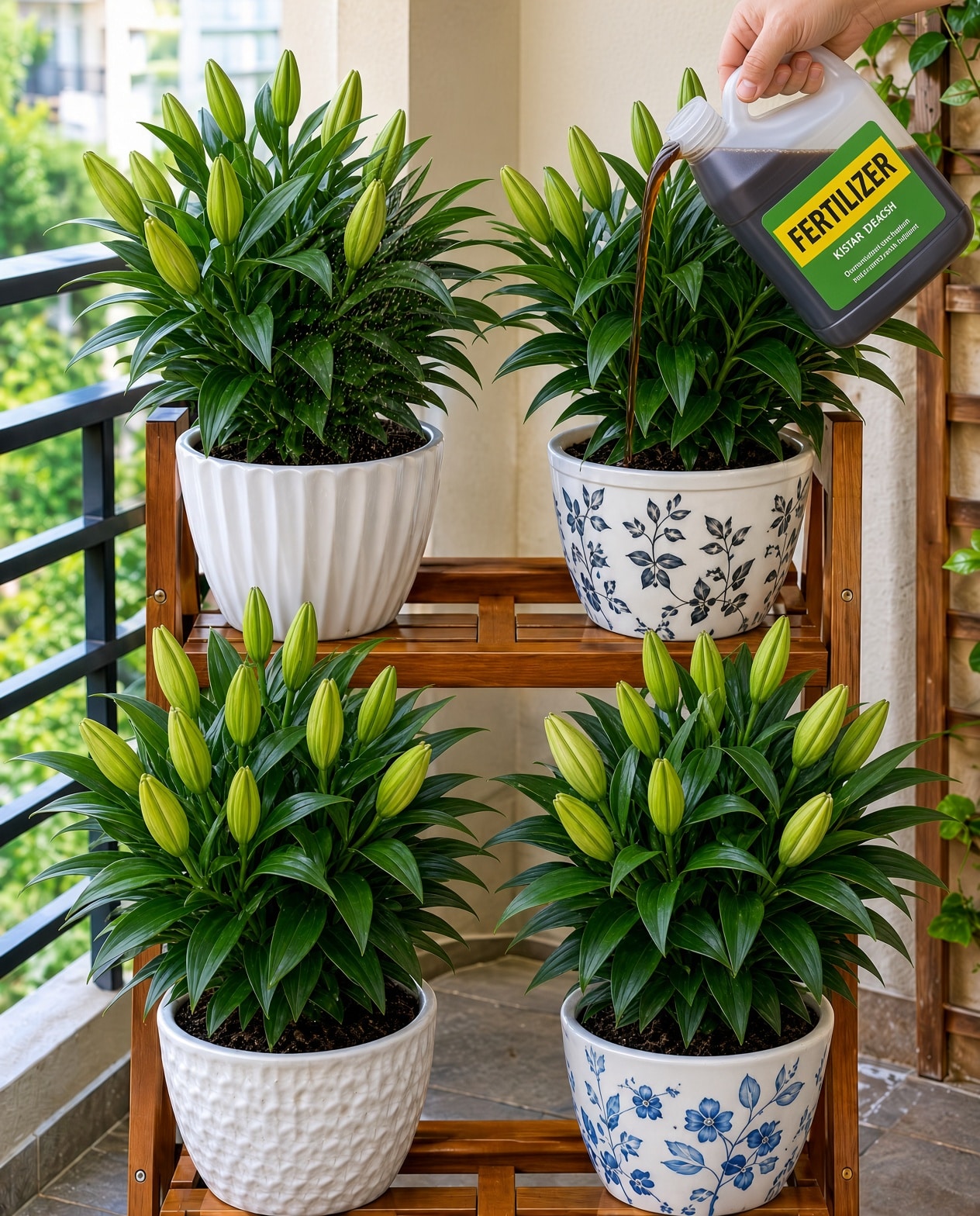
The images show four compact potted Roselily plants arranged on a wooden balcony stand. Before flowering, the plants display glossy green leaves and numerous large, upright flower buds. A dark liquid fertilizer is being poured toward the potting soil of one plant.
The second image illustrates the same type of arrangement with magnificent double flowers in red, white, yellow, and purple-pink combinations.
These images highlight an important question for home gardeners:
Can the right liquid fertilizer help Roselily plants develop stronger stems, healthier buds, and more impressive flowers?
A suitable fertilizer can support healthy growth and flower development, but it cannot guarantee the dramatic transformation shown in a before-and-after image. Flower color, petal count, and bloom shape are determined primarily by the variety, while flowering performance depends on bulb health, light, water, temperature, and balanced nutrition.
This complete guide explains how to grow Roselily plants successfully, choose the best liquid fertilizer, care for developing flower buds, prevent common problems, select premium potting soil, and create stunning balcony displays.
Quick Answer: What Is the Best Fertilizer for Roselily Plants?
Roselily plants benefit from balanced nutrition during active growth.
A complete fertilizer designed for flowering bulbs or container-grown flowering plants is generally a good choice.
For many gardeners, a water-soluble liquid fertilizer is convenient because it can be applied during regular watering at a controlled concentration.
However, concentrated liquid fertilizer should never be poured directly onto the soil without dilution unless the manufacturer’s instructions specifically permit it.
Essential Roselily Growing Requirements
- Light: Full sun to bright partial sun, depending on climate
- Soil: Fertile, well-draining potting mix
- Watering: Consistent moisture without waterlogging
- Fertilizer: Balanced fertilizer during active growth
- Container: Deep pot with drainage holes
- Temperature: Moderate growing conditions
- Flowering: Usually summer, depending on cultivar and planting time
- Propagation: Bulbs, offsets, and specialized bulb propagation
- Maintenance: Remove spent flowers and protect foliage after blooming
- Outdoor placement: Sunny balconies, patios, terraces, and garden borders
The most important rule is to support healthy bulb development rather than relying on excessive fertilizer.
What Are Roselily Plants?
Roselily is a group of double-flowered Oriental lily cultivars belonging to the genus Lilium.
These ornamental lilies are known for their layered petals, often resembling roses.
Their distinctive flowers may feature:
- Multiple layers of petals
- Large decorative blooms
- Rich pink and red coloration
- White petals with contrasting markings
- Purple or magenta tones
- Soft yellow or cream shades in some ornamental lilies
- Reduced or absent pollen in many Roselily cultivars
- Strong upright flowering stems
Not every double-flowered lily is necessarily a Roselily-branded cultivar, and individual flower colors and characteristics depend on the specific variety.
The plants shown in the images have the upright buds, narrow leaves, and ornamental flowers associated with cultivated lilies.
The exact cultivars cannot be confirmed from the photographs alone.
Why Roselily Flowers Are Popular for Premium Garden Design
Roselily plants combine the elegance of traditional Oriental lilies with the elaborate appearance of double-flowered ornamental varieties.
They are especially attractive in:
- Luxury balcony gardens
- Modern terrace arrangements
- Decorative ceramic planters
- Formal garden borders
- Outdoor dining areas
- Contemporary courtyard gardens
- Seasonal floral displays
- Premium landscape designs
Their dramatic flowers can create a sophisticated display even when grown in relatively small spaces.
A collection of differently colored cultivars can provide an impressive arrangement without requiring a large garden.
Understanding the Liquid Fertilizer Treatment in the Image
The first image shows a dark brown liquid being poured from a large fertilizer container into the potting medium of a budding Roselily plant.
The container is labeled as fertilizer, but the specific nutrient composition and dilution requirements cannot be verified from the image.
Dark liquid fertilizers may include several types of horticultural products.
Possible Liquid Fertilizer Types
- Concentrated mineral fertilizer
- Organic liquid fertilizer
- Fish-based fertilizer
- Seaweed-based plant supplement
- Humic acid products
- Liquid compost-derived fertilizer
- Specialized flowering bulb fertilizer
These products have different purposes and nutrient concentrations.
A dark color does not necessarily indicate higher nutrient quality or stronger flowering performance.
Important Fertilizer Safety Warning
Never apply an unidentified concentrated fertilizer directly to Roselily roots.
Concentrated fertilizer may cause:
- Root burn
- Excessive soluble salt accumulation
- Leaf browning
- Reduced water uptake
- Weak growth
- Premature bud decline
- Damage to developing bulbs
Always identify the product and follow the manufacturer’s dilution instructions.
How Liquid Fertilizer Supports Roselily Growth
Roselily plants grow from underground bulbs.
These bulbs store carbohydrates and nutrients that support the development of stems, leaves, and flowers.
As the plant grows, its roots absorb additional nutrients from the soil.
Proper fertilization helps maintain the nutrients needed for healthy development.
Nitrogen for Green Foliage
Nitrogen contributes to chlorophyll formation and vegetative growth.
Healthy leaves are important because they produce carbohydrates through photosynthesis.
Phosphorus for Plant Development
Phosphorus supports energy transfer and several essential physiological processes.
Adequate phosphorus is important, but excessive phosphorus does not automatically create more flowers.
Potassium for Overall Plant Function
Potassium supports water regulation, enzyme activity, and general plant health.
Balanced potassium nutrition contributes to normal growth and stress tolerance.
Secondary Nutrients and Micronutrients
Roselily plants also require smaller quantities of nutrients such as:
- Calcium
- Magnesium
- Sulfur
- Iron
- Manganese
- Zinc
- Boron
A complete fertilizer can help supply nutrients that may be limited in container-grown plants.
Best Fertilizer for Roselily Plants
The best fertilizer depends on the growing medium, existing nutrient availability, and stage of growth.
1. Balanced Liquid Fertilizer
A complete liquid fertilizer is often a practical option for container-grown Roselily plants.
It allows controlled nutrient application during active growth.
2. Slow-Release Granular Fertilizer
Controlled-release fertilizer granules gradually supply nutrients.
They can be useful for gardeners who prefer fewer feeding applications.
The release rate depends on the product, temperature, and soil moisture.
3. Organic Liquid Fertilizer
Organic liquid products may provide useful nutrients when properly formulated.
However, their nutrient composition and availability can vary.
4. Fertilizer for Flowering Bulbs
Products specifically formulated for flowering bulbs may be appropriate for Roselily plants.
Choose a complete fertilizer and follow the label.
5. Seaweed-Based Supplements
Seaweed extracts are sometimes used as supplemental horticultural products.
However, many seaweed products do not provide enough nitrogen, phosphorus, and potassium to replace a complete fertilizer.
Fertilizer Comparison Table
| Fertilizer type | Main advantage | Important consideration |
|---|---|---|
| Balanced liquid fertilizer | Controlled nutrient delivery | Proper dilution |
| Slow-release granules | Gradual feeding | Temperature-dependent release |
| Organic liquid fertilizer | Alternative nutrient source | Variable composition |
| Flowering bulb fertilizer | Formulated for bulb crops | Follow label |
| Seaweed supplement | Supplemental plant treatment | Not always complete nutrition |
| Concentrated dark liquid | Depends on formulation | Never guess dilution |
For most home gardeners, a complete fertilizer with clear application instructions is preferable to an unidentified concentrated product.
Step-by-Step: How to Apply Liquid Fertilizer to Roselily Plants
The liquid application shown in the image should be approached carefully.
Step 1: Identify the Fertilizer
Read the complete label.
Confirm that the product is suitable for ornamental flowering plants or bulbs.
Step 2: Check the Growing Medium
The soil should be in appropriate condition for feeding.
Avoid fertilizing severely dehydrated or waterlogged plants.
Step 3: Dilute the Fertilizer
Follow the manufacturer’s dilution rate.
Do not assume that a dark-colored fertilizer can be used undiluted.
Step 4: Use a Clean Watering Container
Prepare the solution in a suitable watering can.
Mix thoroughly according to the product instructions.
Step 5: Apply to the Potting Medium
Pour the prepared fertilizer solution evenly onto the soil.
Avoid unnecessarily soaking leaves and flower buds.
Step 6: Allow Excess Water to Drain
Make sure the container has functioning drainage holes.
Do not allow fertilizer solution to remain in a water-filled saucer.
Step 7: Observe the Plant
Monitor leaf color, stem firmness, and bud development over the following days.
Step 8: Avoid Repeated Overfeeding
Follow the recommended feeding interval.
More fertilizer does not necessarily produce larger flowers.
When Should You Fertilize Roselily Plants?
The best feeding schedule follows the plant’s active growth cycle.
Roselily bulbs begin growing using stored reserves.
As leaves and stems develop, roots absorb nutrients from the surrounding soil.
Early Growth
Appropriate nutrition can support developing stems and foliage.
Bud Formation
Maintain balanced nutrition and consistent soil moisture.
Flowering
Avoid excessive feeding and sudden environmental changes.
After Flowering
Healthy leaves continue photosynthesis and help replenish bulb reserves.
Moderate feeding may continue when appropriate, while the foliage remains actively growing.
Dormancy
Stop routine fertilizer applications once the plant has entered dormancy.
Roselily Feeding Schedule
| Growth stage | Feeding approach |
|---|---|
| Dormant bulb | No routine liquid feeding |
| Emerging shoots | Begin appropriate nutrition when needed |
| Active leaf growth | Follow fertilizer label |
| Bud development | Maintain balanced feeding |
| Open flowers | Avoid excessive fertilizer |
| Post-flowering foliage | Support healthy bulb replenishment |
| Yellowing dormant foliage | Discontinue feeding |
How Long Does It Take Roselily Buds to Open?
The first image shows numerous unopened lily buds.
These buds are already well developed, suggesting the plants are approaching their flowering period.
The time required for buds to open depends on:
- Cultivar
- Temperature
- Sunlight
- Water availability
- Plant maturity
- Environmental stress
Under favorable conditions, mature lily buds may begin opening within days to a few weeks.
However, fertilizer does not cause all buds to open immediately.
Signs That Roselily Buds Are Ready to Open
- Buds become larger
- The outer surface begins showing flower color
- Buds become fuller
- Petal separation becomes visible
- Flower stems remain firm
Healthy buds generally develop gradually.
Can Fertilizer Change Roselily Flower Color?
No. Fertilizer cannot reliably transform one Roselily cultivar into a completely different flower color.
The second image shows red, white, yellow, and purple-pink flowers.
These colors represent the ornamental characteristics of different lily varieties.
Flower color is primarily determined by genetics.
Environmental conditions may influence color intensity, but a fertilizer cannot turn a genetically white-flowering cultivar into a red or purple one.
Similarly, fertilizer cannot turn a single-flowered lily into a genetically double-flowered Roselily.
The flower shape, color pattern, and potential petal count are determined mainly by the cultivar.
Balanced nutrition supports the plant’s ability to express its natural characteristics.
Best Soil for Roselily Plants
Roselily plants need fertile, well-draining soil.
Their bulbs are vulnerable to prolonged waterlogging.
A suitable potting mix should provide:
- Good drainage
- Adequate aeration
- Moderate moisture retention
- Stable structure
- Appropriate nutrient availability
Recommended Potting Mix
A practical container mixture may contain:
- 2 parts premium potting mix
- 1 part perlite or pumice
- 1 part fine pine bark or another suitable structural amendment
Adjust the mixture according to the components already present in the commercial potting soil.
Why Drainage Matters
Lily roots require oxygen.
When soil remains saturated for extended periods, oxygen availability decreases.
This can encourage root damage and bulb decay.
Premium Soil Comparison
| Growing medium | Main benefit | Suitability |
|---|---|---|
| Premium container potting mix | Balanced structure | Excellent starting point |
| Potting mix with perlite | Improved drainage | Very good |
| Pine bark amendment | Aeration | Useful in moderation |
| Heavy garden soil | Can compact in containers | Generally unsuitable |
| Pure sand | Limited nutrient retention | Not recommended alone |
| Dense compost | Can remain excessively wet | Use carefully |
Choosing the Best Pot for Roselily Bulbs
The images show Roselily plants growing in attractive ceramic containers.
The planters include white ribbed designs and blue-and-white floral patterns.
These decorative containers complement the flowers and create an elegant balcony arrangement.
However, appearance should not be the only consideration.
Essential Pot Features
- Adequate depth
- Drainage holes
- Sufficient space for bulb roots
- Stable construction
- Appropriate soil capacity
- Suitable material for outdoor conditions
How Deep Should a Roselily Pot Be?
A relatively deep container is preferable because lilies develop extensive roots.
For many container-grown lilies, a pot approximately 12–16 inches deep can be a practical starting point, although exact requirements depend on bulb size, cultivar, and planting arrangement.
Choose enough depth to accommodate the bulb at its recommended planting depth and allow room for roots.
Ceramic vs Plastic vs Terracotta
| Pot type | Advantages | Considerations |
|---|---|---|
| Glazed ceramic | Decorative and stable | Heavy; drainage required |
| Plastic | Lightweight and affordable | Can heat in direct sun |
| Terracotta | Porous and traditional | Dries more quickly |
| Fiberglass | Lightweight premium appearance | Quality varies |
| Decorative cachepot | Flexible styling | Must prevent standing water |
How to Plant Roselily Bulbs in Containers
Planting correctly is essential for strong growth.
Step 1: Select Healthy Bulbs
Choose firm bulbs without obvious rot or extensive damage.
Step 2: Prepare the Container
Use a pot with adequate drainage holes.
Step 3: Add Potting Mix
Fill the lower portion with suitable growing medium.
Step 4: Position the Bulbs
Place bulbs with their growing points facing upward.
Step 5: Use the Correct Planting Depth
Many lilies are planted with approximately two to three bulb heights of soil above them, but follow cultivar and supplier recommendations.
Step 6: Space the Bulbs
Allow sufficient room for roots and stems.
Step 7: Water After Planting
Moisten the potting medium without leaving it waterlogged.
Step 8: Place in Suitable Light
Provide a bright location appropriate for the climate.
How Much Sunlight Do Roselily Plants Need?
Roselily plants generally perform best with plenty of light.
Many lilies grow well in full sun or bright partial sun.
However, intense afternoon heat can stress container-grown plants, particularly in hot climates.
Morning Sunlight
Morning sunlight is often beneficial because it provides strong light with less extreme heat.
Afternoon Sunlight
In hot regions, protection from intense afternoon sun may help reduce heat stress.
Shaded Balconies
Deep shade may lead to weaker stems and reduced flowering.
Indoor Windows
Roselily plants may be displayed indoors temporarily, but they generally require more light than typical low-light houseplants.
A bright balcony or outdoor container garden is usually more suitable for long-term growth.
Watering Roselily Plants Correctly
Roselily plants require moisture during active growth, but they should not remain constantly saturated.
The correct watering frequency depends on:
- Pot size
- Soil composition
- Temperature
- Sun exposure
- Wind
- Rainfall
- Growth stage
Best Watering Method
Check the upper portion of the soil.
Water when the medium has begun drying and the plant requires moisture.
Apply water thoroughly until excess begins draining from the bottom.
Avoid leaving pots in standing water.
Watering During Bud Formation
Consistent moisture is particularly important when buds are developing.
Severe drought stress may contribute to bud problems.
Watering During Dormancy
Once foliage has naturally died back, reduce watering substantially.
Dormant bulbs should not remain in persistently wet soil.
Roselily Watering and Care Schedule
| Condition | Care recommendation |
|---|---|
| Active spring growth | Maintain moderate moisture |
| Developing buds | Avoid severe drying |
| Flowering | Keep soil evenly but not excessively moist |
| Hot balcony | Check soil more frequently |
| Rainy weather | Protect from waterlogging |
| After flowering | Maintain foliage while green |
| Dormancy | Reduce watering significantly |
How to Get Bigger Roselily Flowers
Large flowers depend on several factors.
1. Start With Healthy Bulbs
Larger, mature bulbs of suitable cultivars often have greater flowering potential.
2. Provide Enough Sunlight
Good light supports photosynthesis and plant development.
3. Maintain Balanced Nutrition
Avoid nutrient deficiencies and excessive fertilizer.
4. Water Consistently
Prevent severe moisture stress during active growth.
5. Protect Flower Buds
Avoid damaging developing buds.
6. Prevent Root Rot
Maintain good drainage.
7. Avoid Overcrowding
Give each plant adequate space.
8. Allow Post-Flowering Recovery
Keep healthy leaves intact after flowering so the bulbs can replenish their reserves.
Why Roselily Plants Produce Many Buds but Few Flowers
A plant may develop numerous buds without opening all of them successfully.
Possible reasons include:
- Severe heat stress
- Water shortages
- Root damage
- Nutrient imbalance
- Insufficient light
- Pest activity
- Sudden environmental changes
- Disease
- Natural bud abortion
Before applying additional fertilizer, inspect the plant and growing conditions.
Adding more fertilizer to a stressed plant may worsen the problem.
Roselily Flower Bud Development Timeline
| Stage | Visible change | Care priority |
|---|---|---|
| Early growth | Leaves and stems emerge | Light and drainage |
| Vegetative development | Foliage expands | Balanced nutrition |
| Bud initiation | Small buds appear | Stable conditions |
| Bud enlargement | Buds become longer | Consistent moisture |
| Color development | Petal colors become visible | Avoid stress |
| Flower opening | Petals gradually unfold | Protect blooms |
| Post-flowering | Flowers fade | Preserve healthy leaves |
Actual timing varies considerably.
What to Do After Roselily Flowers Fade
Many gardeners make the mistake of cutting down lily stems immediately after flowering.
This can interfere with the bulb’s ability to rebuild energy reserves.
Remove Spent Flowers
Carefully remove faded flowers and developing seed pods when seed production is not desired.
Keep the Leaves
Leave healthy green foliage in place.
Continue Appropriate Watering
Maintain moisture according to the plant’s needs.
Feed When Appropriate
Continue a suitable feeding program while the plant is actively growing, if nutrients are needed.
Allow Natural Yellowing
Let foliage decline naturally as the bulb approaches dormancy.
Reduce Watering
Once the plant becomes dormant, avoid excessive moisture.
Will Roselily Plants Bloom Again Next Year?
Roselily plants are perennial bulb plants.
Under suitable conditions, healthy bulbs can survive and flower in subsequent growing seasons.
However, successful reblooming depends on:
- Bulb health
- Climate
- Winter conditions
- Drainage
- Sunlight
- Nutrient availability
- Post-flowering care
In unsuitable climates or poorly drained containers, bulbs may decline.
The goal after flowering is to maintain healthy foliage long enough to replenish the bulb.
Roselily Winter Care
Winter requirements vary by cultivar and local climate.
Many Oriental lilies need a cool seasonal period and suitable winter conditions.
In Cold Regions
Protect container bulbs from extreme freezing and repeated freeze-thaw cycles.
In Mild Regions
Bulbs may remain outdoors if temperatures and drainage are suitable.
In Wet Winter Climates
Prevent prolonged saturation of dormant bulbs.
Indoor Storage
Where necessary, bulbs or containers may be stored under appropriate cool conditions.
Avoid warm, excessively wet storage.
Common Roselily Problems
| Problem | Possible cause | Recommended action |
|---|---|---|
| Yellow leaves | Natural aging or stress | Check growth stage |
| Brown leaf tips | Heat, drought, or salts | Review watering and feeding |
| Weak stems | Low light or overcrowding | Improve light |
| Bud drop | Environmental stress | Stabilize conditions |
| No flowers | Immature bulbs or poor conditions | Evaluate bulb and light |
| Soft bulbs | Possible rot | Inspect and improve drainage |
| Leaf spots | Disease or injury | Remove affected debris |
| Slow growth | Temperature or root issues | Check soil and roots |
| White soil crust | Salt accumulation | Review fertilizer and water |
| Wilting | Drought or root damage | Check moisture and roots |
Preventing Roselily Root and Bulb Rot
Bulb rot is one of the most serious problems for container-grown lilies.
Prevention Tips
Use well-draining soil.
Choose pots with drainage holes.
Avoid standing water.
Do not overwater dormant bulbs.
Inspect bulbs before planting.
Avoid damaged or decaying planting material.
Maintain appropriate spacing.
Prevent excessive fertilizer buildup.
Common Roselily Pests
Aphids
Aphids may gather around new growth and developing buds.
Lily Beetles
Lily beetles can damage foliage and flowers.
Thrips
Thrips may cause flower discoloration and distorted petals.
Spider Mites
Spider mites can become problematic during hot, dry conditions.
Slugs and Snails
These pests may damage young shoots and leaves.
Bulb Pests
Some soil-dwelling pests may damage underground bulb tissue.
Pest Control for Roselily Plants
Use pest-specific management methods.
Depending on the problem, options may include:
- Hand removal
- Inspection of leaves
- Isolation of infested plants
- Removal of damaged plant material
- Appropriate insecticidal soap
- Other registered horticultural treatments
- Improved garden sanitation
Always follow product labels and avoid unnecessary pesticide applications.
Organic vs Synthetic Fertilizer for Roselily
Both organic and synthetic fertilizers can provide nutrients.
The most important factors are appropriate nutrient supply and correct application.
Organic Fertilizers
These may contain nutrients that become available through biological and chemical processes.
Synthetic Fertilizers
These often provide a more predictable nutrient analysis.
Which Is Better?
Neither category automatically guarantees better flowering.
The best choice is a suitable product used correctly.
Can You Use Coffee Grounds on Roselily Plants?
Coffee grounds are sometimes promoted as a homemade fertilizer.
However, direct application is not a reliable substitute for balanced nutrition.
Excessive grounds may affect the physical properties of the potting medium.
Composted organic materials may be useful in appropriate soil mixes, but fresh coffee grounds should not be relied upon as the primary fertilizer.
Can You Use Banana Peel Water?
Banana peel water has an unpredictable nutrient composition.
It is not a complete fertilizer.
A properly formulated flowering plant fertilizer is a more reliable option.
Is Epsom Salt Good for Roselily?
Epsom salt supplies magnesium and sulfur.
It should only be used when magnesium supplementation is appropriate.
Unnecessary applications may disrupt nutrient balance.
Premium Balcony Garden Design With Roselily Plants
The images demonstrate a beautiful way to display Roselily plants in a compact outdoor space.
Four ceramic planters are arranged on a two-tier wooden stand.
The arrangement creates a balanced display with two plants on the upper shelf and two on the lower shelf.
This layout provides visual structure and makes each flowering plant easier to appreciate.
White Ceramic Planters
White ceramic pots create a clean, modern appearance.
They work especially well with red, purple, and pink flowers.
Blue-and-White Floral Planters
Traditional blue-and-white designs provide an elegant contrast against green foliage.
Wooden Plant Stands
Wooden shelving adds warmth and creates vertical interest.
Choose a sturdy, weather-resistant stand with adequate load capacity.
Mixed Flower Colors
Combining several cultivars can create a dramatic seasonal display.
The colors shown in the second image provide a striking example of coordinated ornamental planting.
Where to Place This Indoor and Outdoor Plant: Advanced Interior Styling & Architectural Placement
Roselily plants can serve as statement flowers in both residential and commercial landscapes.
However, long-term placement should prioritize appropriate sunlight and growing conditions.
Luxury Balconies
Place Roselily containers where they receive strong morning light and protection from excessive afternoon heat when needed.
Modern Patios
Use coordinated ceramic planters to frame seating areas.
Outdoor Dining Spaces
Position flowering containers where their appearance can be appreciated without obstructing movement.
Courtyard Gardens
Combine Roselily plants with compatible seasonal flowers and ornamental foliage.
Bright Sunrooms
A sufficiently bright sunroom may provide temporary display conditions.
Contemporary Garden Entrances
Large decorative planters can create a formal seasonal arrangement.
Premium Landscape Design
Roselily plants can be incorporated into professionally designed flower borders and container displays.
Small Apartment Balconies
Vertical stands maximize display space, but ensure each plant receives enough light and airflow.
Pet safety: All true lilies (Lilium species), including Roselily cultivars, are extremely toxic to cats. Even small exposures to pollen, plant material, or vase water can cause life-threatening kidney injury. Keep them completely inaccessible to cats.
How to Create a Four-Pot Roselily Balcony Display
The arrangement in the image can inspire a practical home gardening project.
Materials
- Four healthy Roselily plants or bulbs
- Four adequately sized planters
- Premium well-draining potting mix
- A sturdy wooden plant stand
- Suitable complete fertilizer
- Watering can
- Gardening gloves
- Drainage saucers where appropriate
Step 1: Choose Compatible Varieties
Select cultivars with similar growing requirements.
Step 2: Prepare the Containers
Ensure every planter has adequate drainage.
Step 3: Plant at the Correct Depth
Follow the bulb supplier’s recommendations.
Step 4: Arrange the Pots
Place two containers on the upper level and two on the lower level.
Step 5: Check Light Exposure
Ensure lower-level plants are not permanently shaded by the upper shelf.
Step 6: Water Carefully
Water according to soil moisture.
Step 7: Feed During Active Growth
Use an appropriate fertilizer at the labeled rate.
Step 8: Maintain the Display
Remove faded flowers, monitor pests, and protect the plants from environmental stress.
Best Companion Plants for Roselily Containers
Roselily plants can be displayed near other ornamental plants with compatible environmental requirements.
Possible companion displays include:
- Lavender in separate containers
- Ornamental grasses
- Petunias
- Salvia
- Compact seasonal annuals
- Decorative foliage plants
When combining different plants, consider their sunlight and watering needs.
Separate containers often make care easier.
Are Roselily Plants Suitable for Indoor Decoration?
Roselily plants can be brought indoors temporarily when flowering.
Their large blooms make attractive decorative accents.
However, they generally require more light than many traditional houseplants.
Long-term indoor cultivation may be difficult without sufficient light.
Keep flowering plants away from excessive heat and dry indoor air.
Never display true lilies in homes where cats may access them.
Roselily Care Throughout the Year
| Season | Main activity | Care focus |
|---|---|---|
| Spring | New growth | Light, watering, nutrition |
| Summer | Bud development and flowering | Consistent moisture |
| Late summer | Post-flowering recovery | Preserve foliage |
| Autumn | Foliage decline | Gradually reduce watering |
| Winter | Dormancy | Protect bulbs appropriately |
Timing varies by region and cultivar.
Frequently Asked Questions
What Is a Roselily Plant?
Roselily refers to double-flowered Oriental lily cultivars known for their layered ornamental blooms.
Does Liquid Fertilizer Make Roselily Bloom Faster?
Appropriate fertilizer supports healthy development, but it does not guarantee faster flowering.
What Is the Best Fertilizer for Roselily?
A suitable complete fertilizer formulated for flowering bulbs or container plants is generally recommended.
Can I Pour Dark Liquid Fertilizer Directly Into the Pot?
Only if the product instructions specifically permit direct application. Concentrated fertilizers usually require dilution.
How Often Should I Fertilize Roselily?
Follow the product label and adjust feeding to the plant’s active growth stage.
Do Roselily Plants Need Full Sun?
They generally prefer abundant light, with some protection from intense heat in hot climates.
Can Roselily Grow in Pots?
Yes. Roselily plants can grow successfully in sufficiently deep, well-draining containers.
Why Are My Roselily Buds Not Opening?
Possible causes include temperature stress, inadequate moisture, root damage, or other environmental problems.
Can Fertilizer Change Roselily Flower Color?
No. Flower color is primarily determined by the cultivar’s genetics.
Do Roselily Plants Come Back Every Year?
Healthy bulbs can return in subsequent seasons when growing and winter conditions are suitable.
Should I Cut Roselily Leaves After Flowering?
Leave healthy foliage until it naturally declines.
Can Roselily Grow Indoors?
It can be displayed indoors temporarily, but long-term growth generally requires strong light.
Are Roselily Plants Fragrant?
Fragrance varies among cultivars. Some have noticeable fragrance, while others are milder.
Are Roselily Plants Pollen-Free?
Many Roselily cultivars are bred for reduced or absent pollen, but characteristics should be confirmed for the specific variety.
Can Roselily Bulbs Multiply?
Yes. Healthy bulbs may produce offsets over time.
Why Are My Roselily Leaves Turning Yellow?
Possible reasons include natural aging, watering problems, nutrient imbalance, or root stress.
What Is the Best Soil for Roselily?
A fertile, well-draining container potting mix is generally suitable.
How Deep Should Roselily Pots Be?
Many container lilies benefit from pots around 12–16 inches deep, depending on the variety and bulb size.
Can I Grow Different Roselily Colors Together?
Yes, provided the varieties have compatible growing requirements and adequate space.
Are Roselily Plants Safe for Cats?
No. Roselily plants are true lilies and are extremely toxic to cats.
Quick Roselily Care Notes
| Care category | Recommendation |
|---|---|
| Plant | Roselily |
| Botanical group | Double-flowered Oriental Lilium cultivars |
| Plant type | Perennial bulb |
| Light | Full sun to bright partial sun |
| Soil | Fertile, well-draining |
| Water | Moderate and consistent during growth |
| Fertilizer | Complete flowering plant fertilizer |
| Liquid treatment | Dilute according to label |
| Container | Deep pot with drainage |
| Flowering season | Usually summer |
| Flower colors | Cultivar-dependent |
| Flower shape | Double, layered petals |
| Pollen | Reduced or absent in many cultivars |
| Propagation | Bulb offsets and other bulb methods |
| Post-flowering | Preserve healthy foliage |
| Winter | Protect according to climate |
| Best display | Balcony, patio, terrace, garden |
| Main risk | Waterlogged bulbs |
| Cat safety | Extremely toxic |
Final Thoughts
Roselily plants offer an exceptional combination of luxurious flowers, attractive foliage, and versatile container-growing possibilities.
The images show how a collection of budding lily plants can become a dramatic ornamental display when the plants reach their natural flowering stage.
The dark liquid fertilizer treatment illustrates the importance of appropriate plant nutrition, but successful Roselily cultivation requires much more than a single feeding application.
Healthy bulbs, premium well-draining soil, suitable sunlight, consistent watering, and carefully managed fertilizer are the foundation of reliable growth.
For gardeners designing elegant balconies or decorative patio arrangements, Roselily plants can be paired with premium ceramic planters, attractive wooden stands, and complementary flowering varieties to create an impressive seasonal display.
The most important lesson is simple: feed Roselily plants correctly, protect their bulbs, maintain healthy foliage, and allow their naturally beautiful double flowers to develop under suitable growing conditions.
With appropriate care, these spectacular flowering lilies can become a memorable highlight of the summer garden.