A struggling orchid with yellow leaves, damaged roots, and a lifeless appearance can be one of the most frustrating sights for any indoor plant enthusiast. Yet the transformation of a neglected orchid into a healthy plant with glossy green foliage and spectacular pink-and-white flowers is exactly what makes orchid care so rewarding.
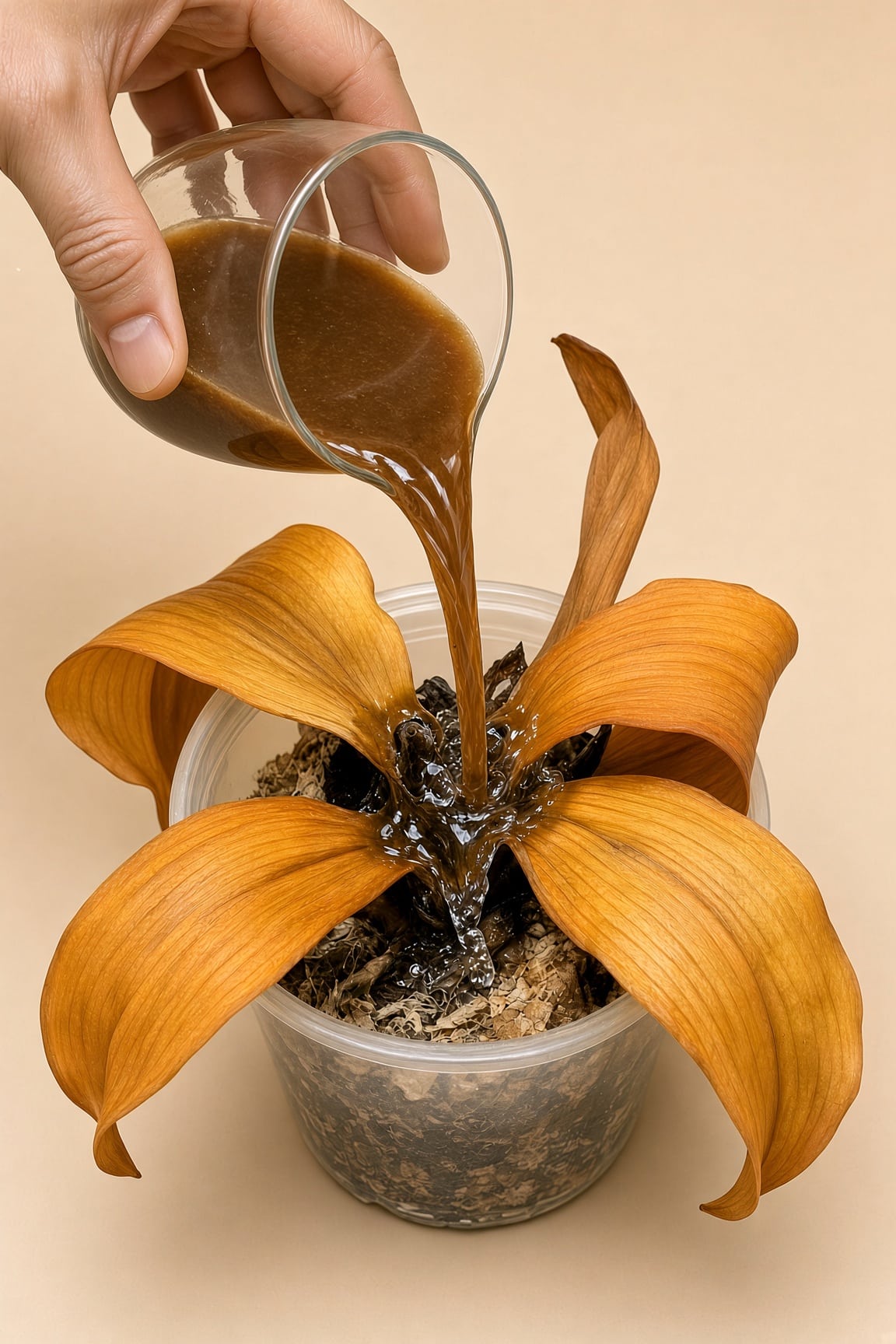
The images show a dramatic before-and-after comparison of a Phalaenopsis orchid, commonly known as the Moth Orchid. In the first image, the plant has severely yellowed, collapsed leaves and appears to be in serious distress. A thick brown liquid is being poured around its base. In the second image, a healthy-looking orchid displays dark green leaves and multiple pink-and-white blooms while a similar brown liquid is applied to the growing medium.
The contrast raises an important question: Can a brown liquid treatment really revive a dying orchid and encourage beautiful flowers?
The answer depends entirely on what the liquid contains, the condition of the roots, and whether the plant still has living tissue capable of recovery. A properly diluted orchid fertilizer may support an otherwise healthy plant, but an unidentified brown mixture cannot be assumed to cure root rot or restore dead leaves.
More importantly, an orchid with completely dead roots and a destroyed crown cannot be revived simply by adding fertilizer.
Understanding the difference between proper orchid nutrition and genuine plant recovery is essential for achieving lasting results.
This guide explains how to evaluate a struggling orchid, identify the causes of yellow leaves, restore healthy growing conditions, choose premium orchid potting media, compare commercial fertilizers and rooting products, prevent root rot, and encourage beautiful future blooms.
1. What the Before-and-After Orchid Images Show
The first photograph presents a Phalaenopsis orchid in a transparent plastic container filled with organic growing material.
Its leaves are golden yellow to brown, drooping heavily, and appear severely damaged.
A brown liquid is being poured into the center of the plant and surrounding medium.
The second image shows a visually healthy orchid with broad, dark green leaves and several pink-and-white flowers.
The plant appears vigorous and well established.
Although the two photographs suggest a dramatic recovery, they do not establish that the same plant recovered or that the brown liquid caused the improvement.
Important Observations
The damaged orchid may be suffering from:
- Severe root deterioration
- Crown or stem damage
- Prolonged overwatering
- Dehydration caused by nonfunctional roots
- Temperature injury
- Advanced leaf senescence
- Disease or environmental stress
The healthy orchid displays:
- Firm green foliage
- A flowering stem
- Multiple open flowers
- A decorative transparent growing container
- Organic orchid potting medium
The photographs illustrate the importance of distinguishing between a cosmetic treatment and the underlying biological processes responsible for orchid recovery.
2. Identifying the Plant: Phalaenopsis Orchid
The plant shown is a Phalaenopsis-type orchid, commonly called the Moth Orchid.
Phalaenopsis orchids are among the most popular flowering houseplants because they offer long-lasting blooms and an elegant appearance.
Their flowers are available in numerous colors, including white, pink, purple, yellow, and patterned combinations.
Main Characteristics
| Feature | Description |
|---|---|
| Common name | Moth Orchid |
| Botanical genus | Phalaenopsis |
| Plant family | Orchidaceae |
| Growth habit | Epiphytic |
| Leaves | Broad, thick, leathery |
| Roots | Thick roots with velamen |
| Flowers | Long-lasting, showy blooms |
| Light | Bright indirect light |
| Growing medium | Airy orchid bark or similar mix |
| Main risk | Root and crown rot |
| Indoor use | Decorative flowering houseplant |
Unlike ordinary terrestrial houseplants, many Phalaenopsis orchids naturally grow attached to trees.
Their roots require air as well as moisture.
This makes their potting requirements fundamentally different from those of plants grown in dense garden soil.
3. What Is the Brown Liquid Being Poured on the Orchid?
The photographs show a thick brown liquid being poured from a glass container.
Its exact composition cannot be determined visually.
Possible substances include diluted organic fertilizer, a commercial nutrient solution, compost-based liquid, or another homemade mixture.
However, the appearance of a liquid does not establish its nutritional value or safety.
Could It Be Organic Liquid Fertilizer?
Yes. Some commercial organic fertilizers have a dark brown appearance because they contain processed organic materials.
These products may supply nutrients when used according to their instructions.
Could It Be a Homemade Plant Tonic?
Possibly, but there is no reliable way to identify the ingredients from the photographs.
Is Brown Liquid Automatically Good for Orchids?
No.
An unknown liquid may contain excessive nutrients, dissolved salts, sugars, or decomposing organic material.
These substances can damage sensitive roots or encourage unwanted microbial growth.
The Safest Recommendation
Use a fertilizer specifically suitable for orchids or other container-grown plants, with a known nutrient analysis and clear dilution instructions.
Never assume that an unidentified brown mixture can reverse severe orchid damage.
4. Why Pouring Liquid Into the Orchid Crown Can Be Dangerous
One of the most important details in the photographs is where the liquid is being applied.
It appears to flow directly toward the center of the orchid, where the leaves meet.
This area is called the crown.
In a Phalaenopsis orchid, the crown contains the central growing point.
Prolonged moisture trapped in this area can contribute to crown rot.
Why Crown Rot Is Serious
The crown is responsible for producing new leaves.
If the growing point is destroyed, the plant may be unable to resume normal growth.
Better Application Method
Apply water or diluted fertilizer to the growing medium and roots.
Avoid allowing liquid to remain pooled between the leaves.
If water accidentally collects in the crown, gently remove it with absorbent paper.
Good air circulation also helps reduce prolonged surface moisture.
5. Why Orchid Leaves Turn Yellow and Collapse
Yellow leaves are not always a sign that an orchid needs fertilizer.
In many cases, they indicate problems involving roots, watering, or environmental conditions.
Overwatering and Root Rot
Roots exposed to continuously wet, poorly aerated media may deteriorate.
When the roots stop functioning, the orchid can no longer absorb enough water.
Ironically, an overwatered orchid may display symptoms resembling severe dehydration.
Severe Underwatering
Orchids deprived of sufficient moisture can develop wrinkled or limp leaves.
Natural Leaf Aging
An older lower leaf may gradually turn yellow and fall away.
This is different from several leaves collapsing simultaneously.
Crown Rot
Damage to the central growing point can cause serious decline.
Excessive Fertilizer
High concentrations of dissolved salts may damage roots.
Temperature Stress
Cold injury and excessive heat can damage orchid tissues.
Disease
Some fungal and bacterial problems can cause rapid deterioration.
Correct diagnosis is more important than applying a random treatment.
6. Can a Completely Yellow Orchid Recover?
The answer depends on the condition of its living tissues.
An orchid with one or two aging leaves may continue growing normally.
An orchid with damaged roots but a healthy crown may recover after appropriate care.
However, leaves that have completely turned yellow or brown generally do not become green again.
Signs Recovery May Be Possible
- Firm central stem
- Healthy crown
- Living roots
- Some remaining green tissue
- No widespread mushy rot
- Potential for new root development
Signs Recovery Is Unlikely
- Completely rotten crown
- All roots dead
- Entire stem soft or decomposed
- No viable growing tissue
- Extensive spreading decay
A severely damaged orchid may require months of recovery before producing new leaves.
Flowering should not be the immediate priority.
7. How to Check Whether Orchid Roots Are Alive
Healthy orchid roots are essential for long-term survival.
Phalaenopsis roots are covered by a specialized tissue called velamen.
This tissue helps absorb water and protects the roots.
Healthy Roots
Healthy roots are typically firm.
They may appear silvery when dry and green after watering, although color can vary.
Dead Roots
Dead roots may be:
- Mushy
- Hollow
- Slimy
- Completely collapsed
- Dark and decomposing
Important Distinction
A brown or stained root is not automatically dead.
Firmness and tissue integrity are more reliable indicators than color alone.
8. Step-by-Step Guide to Saving a Struggling Phalaenopsis Orchid
Step 1: Stop Applying Unknown Liquids
Discontinue homemade mixtures or unidentified fertilizers.
Do not add more substances until the problem is understood.
Step 2: Remove the Orchid From Its Container
Carefully take the plant out of the pot.
Avoid pulling forcefully on the leaves.
Step 3: Inspect the Growing Medium
Look for compacted bark, decomposing organic material, excessive moisture, and unpleasant odors.
Step 4: Examine the Roots
Identify firm, living roots and severely damaged tissue.
Step 5: Remove Rotten Roots
Use clean, sanitized scissors to trim roots that are clearly dead or decomposed.
Preserve healthy tissue.
Step 6: Inspect the Crown
Check for softness, discoloration, or decay around the central growing point.
Step 7: Choose Fresh Orchid Potting Mix
Use a coarse, airy medium suitable for Phalaenopsis orchids.
Step 8: Select a Ventilated Orchid Pot
Choose a container with drainage and adequate root aeration.
Step 9: Repot Carefully
Position the plant so the crown remains above the growing medium.
Step 10: Adjust Watering
Water according to root condition, medium moisture, and environmental conditions.
Step 11: Provide Bright Indirect Light
Avoid strong direct sunlight while the plant is recovering.
Step 12: Delay Fertilizer Until Recovery Begins
A severely stressed orchid should not receive heavy fertilizer.
Allow the root system to stabilize before resuming gentle feeding.
9. Best Orchid Potting Mix for Root Recovery
One of the most important investments in orchid care is choosing the correct growing medium.
Ordinary garden soil is usually unsuitable for Phalaenopsis orchids because it can restrict airflow around the roots.
Premium Orchid Bark
Orchid bark provides structural support and air spaces.
It allows water to drain while retaining some moisture on its surfaces.
Sphagnum Moss
Sphagnum moss holds more water than coarse bark.
It can be useful in dry environments but requires careful watering.
Perlite
Perlite improves aeration and drainage.
Pumice
Pumice is a durable mineral amendment that helps maintain air spaces.
Horticultural Charcoal
Charcoal may be included in some orchid mixes, although it is not essential.
Best General-Purpose Combination
A bark-dominant mix with a modest amount of moisture-retaining material is often appropriate for indoor Phalaenopsis orchids.
The ideal composition depends on humidity, temperature, pot ventilation, and watering habits.
10. Premium Orchid Potting Media Compared
| Growing medium | Advantages | Limitations |
|---|---|---|
| Pine bark | Excellent aeration | Dries relatively quickly |
| Sphagnum moss | Strong moisture retention | Can remain too wet |
| Perlite | Improves drainage | Lightweight |
| Pumice | Stable and durable | Heavier |
| Coconut husk chips | Holds some moisture | Quality varies |
| Horticultural charcoal | Structural component | Not a cure for rot |
| Dense potting soil | Suitable for many terrestrial plants | Usually inappropriate for Phalaenopsis |
Best Choice for Beginners
A commercial Phalaenopsis orchid potting mix with coarse bark is generally a practical starting point.
11. Best Orchid Pots for Healthy Roots
The images show a transparent plastic orchid container.
Transparent pots are popular because they allow growers to observe roots and moisture conditions.
Clear Plastic Orchid Pots
Advantages include:
- Visible root system
- Lightweight construction
- Easy moisture monitoring
- Affordable replacement
- Compatibility with decorative outer pots
Slotted Orchid Pots
These improve airflow and drainage.
Ceramic Orchid Planters
Ceramic containers provide an elegant appearance.
However, drainage and ventilation must remain adequate.
Decorative Cachepots
A clear nursery pot can be placed inside a decorative outer planter.
Remove the inner pot for watering and allow it to drain before returning it.
Choosing the Correct Size
Select a pot that fits the existing root system without leaving excessive unused wet medium.
An oversized container can increase the risk of prolonged moisture retention.
12. Liquid Orchid Fertilizer vs. Organic Brown Plant Food
The brown liquid shown in the photographs makes fertilizer selection particularly relevant.
Different fertilizer products vary in nutrient composition, concentration, and application requirements.
| Product type | Main benefit | Important caution |
|---|---|---|
| Complete liquid orchid fertilizer | Predictable nutrition | Follow dilution instructions |
| Balanced water-soluble fertilizer | Convenient nutrient supply | Avoid excessive concentration |
| Organic liquid fertilizer | Alternative nutrient source | Composition varies |
| Controlled-release fertilizer | Gradual nutrient delivery | Use carefully in small pots |
| Homemade brown liquid | Uncertain | May be unsuitable or harmful |
Which Fertilizer Is Best?
A complete fertilizer with a known nutrient analysis is preferable to an unidentified homemade mixture.
Phalaenopsis orchids generally benefit from modest, regular nutrition during active growth rather than heavy feeding.
13. Understanding NPK Fertilizer for Orchids
Commercial fertilizers commonly display three numbers.
These represent nitrogen, phosphorus, and potassium.
Nitrogen
Supports normal vegetative growth.
Phosphorus
Participates in energy transfer and root development.
Potassium
Supports important metabolic processes and water regulation.
Do Orchids Need Special Bloom Booster Fertilizer?
A very high-phosphorus fertilizer is not automatically necessary for flowering.
When nutrient availability is already adequate, extra phosphorus may provide no additional benefit.
Healthy roots, appropriate light, normal seasonal development, and balanced nutrition are generally more important.
14. How to Fertilize a Phalaenopsis Orchid Correctly
Choose a Suitable Product
Use a complete orchid fertilizer or another appropriate balanced fertilizer.
Prepare the Correct Dilution
Follow the product label.
Some growers use weaker solutions more frequently, but total nutrient application should remain moderate.
Check Root Health
Avoid feeding an orchid with severely compromised roots.
Apply to the Growing Medium
Distribute the solution through the root zone.
Avoid leaving liquid in the crown.
Allow Complete Drainage
Do not leave the orchid standing in fertilizer solution.
Monitor the Plant
Watch for healthy roots, new leaves, and signs of salt accumulation.
Adjust During Slow Growth
Reduce feeding when the orchid is not actively growing.
15. Can Coffee Water Revive an Orchid?
Coffee-related gardening treatments are often promoted as homemade plant fertilizers.
However, coffee water is not a reliable substitute for a complete orchid fertilizer.
Its nutrient composition and concentration are unpredictable.
Potential Problems
- Excessive organic residue
- Microbial growth
- Unbalanced nutrition
- Unpleasant odors
- Changes in growing-medium conditions
Coffee-colored liquid should not be assumed to be beneficial.
For sensitive Phalaenopsis roots, a known commercial fertilizer is generally the safer option.
16. Can Compost Tea Help Orchids?
Compost tea is another brown liquid sometimes used in gardening.
Its properties depend on how it is prepared and what materials are included.
Possible Limitations
Compost-based liquids can vary widely in nutrient concentration and microbial content.
Poorly prepared solutions may introduce unwanted microorganisms.
They can also leave residues in orchid growing media.
Practical Recommendation
For indoor Phalaenopsis orchids, a properly formulated commercial fertilizer is easier to measure and manage.
Compost tea should not be used as an emergency treatment for crown rot or severe root damage.
17. Rooting Hormone vs. Orchid Root Recovery Products
Rooting hormones are commonly marketed for plant propagation.
However, they are not a universal solution for damaged orchid roots.
Rooting Hormone
May influence root formation in certain propagation situations.
Orchid Fertilizer
Provides mineral nutrients.
Root Supplements
Some products contain seaweed extracts or other ingredients marketed for root support.
Evidence and effectiveness vary by formulation.
Fungicides
May be appropriate for specific diagnosed diseases when labeled for the plant and application.
Important Difference
Fertilizer feeds a plant.
Rooting hormones influence certain growth processes.
Fungicides target particular fungal problems.
None of these products can restore dead tissue.
18. How to Encourage New Orchid Roots
A recovering orchid needs conditions that support healthy root development.
Bright Indirect Light
Adequate light supports photosynthesis and energy production.
Appropriate Humidity
Moderate humidity helps reduce excessive moisture loss.
Good Air Circulation
Air movement reduces prolonged surface wetness.
Suitable Growing Medium
Coarse bark allows oxygen to reach roots.
Careful Watering
Avoid prolonged saturation.
Stable Temperatures
Protect the plant from cold drafts and extreme heat.
Patience
New roots may take weeks or months to develop.
19. Orchid Root Rot: Causes and Prevention
Root rot often develops when roots remain in conditions that are too wet and poorly aerated.
Main Risk Factors
- Decomposed potting medium
- Poor drainage
- Excessive watering
- Dense soil
- Oversized containers
- Poor airflow
- Root pathogens
Prevention
Use a suitable orchid pot.
Replace deteriorated potting medium.
Allow appropriate drying between waterings.
Avoid leaving water in decorative containers.
Inspect roots periodically.
20. How to Water Phalaenopsis Orchids
Watering is one of the most important parts of orchid care.
When to Water
Water when the growing medium has approached the appropriate level of dryness for the plant and environment.
How to Water
Use room-temperature water.
Wet the growing medium thoroughly.
Allow excess water to drain.
Avoid Crown Saturation
Do not leave water trapped between the leaves.
Do Not Follow a Rigid Calendar
Watering needs vary according to temperature, humidity, pot size, and growing medium.
21. Best Water for Orchids
Water quality can affect long-term orchid health.
Tap Water
Often suitable when mineral and salt concentrations are moderate.
Rainwater
May be useful when collected and stored safely.
Filtered Water
Can be appropriate depending on the filtration method.
Reverse Osmosis Water
Provides low-mineral water but may require appropriate fertilizer supplementation.
Important Consideration
Excessively mineralized water can contribute to salt accumulation in orchid media.
22. How to Recognize Fertilizer Burn in Orchids
Fertilizer burn occurs when excessive soluble salts injure roots.
Warning Signs
- Brown root tips
- Damaged root surfaces
- Leaf tip discoloration
- Poor growth
- Mineral deposits
- Decline following feeding
Corrective Action
Stop fertilizer application.
Evaluate the root system.
Check the growing medium.
Replace heavily degraded or salt-contaminated medium when necessary.
Resume gentle nutrition only after the plant stabilizes.
23. Why a Healthy Orchid May Not Bloom
An orchid can have beautiful leaves and healthy roots without producing flowers.
Insufficient Light
Low light is a common reason for poor flowering.
Immature Plant
Young orchids may not be ready to bloom.
Environmental Conditions
Temperature patterns can influence flowering.
Root Problems
Damaged roots reduce the plant’s ability to support flowers.
Excessive Fertilizer
Heavy feeding is not a substitute for proper environmental conditions.
Natural Flowering Cycle
Phalaenopsis orchids do not necessarily flower continuously.
24. How to Encourage Phalaenopsis Orchids to Rebloom
Provide Adequate Light
Bright indirect light supports healthy growth.
Maintain Healthy Roots
A strong root system is essential.
Use Balanced Fertilizer
Feed modestly during active growth.
Maintain Suitable Temperatures
Some Phalaenopsis hybrids respond to a period of moderately cooler nighttime temperatures.
Avoid Extreme Stress
Cold damage, drought, and root rot do not promote healthy flowering.
Allow Time
Flower spikes and buds develop gradually.
25. How Long Does Orchid Recovery Take?
Recovery depends on the severity of the original damage.
| Recovery stage | Possible timeline |
|---|---|
| Initial stabilization | Several weeks |
| New root growth | Weeks to months |
| New leaf development | Several months |
| Stronger root system | Several months or longer |
| Return to flowering | Often many months or more |
These are broad estimates, not guaranteed results.
An orchid with extensive crown or stem damage may not recover.
26. How Long Do Phalaenopsis Flowers Last?
Healthy Phalaenopsis flowers can remain attractive for several weeks or even months under favorable conditions.
Flower longevity depends on:
- Cultivar
- Temperature
- Humidity
- Light exposure
- Watering
- Plant health
- Environmental stability
Avoid placing blooming orchids near heating vents, cold drafts, or intense direct sunlight.
27. Common Orchid Pests and Their Treatments
Orchids may occasionally develop pest problems.
Mealybugs
White cotton-like insects may collect around leaf joints.
Scale Insects
These pests attach to leaves and stems.
Spider Mites
May cause stippling and discoloration.
Thrips
Can damage flowers and developing buds.
Fungus Gnats
May become more noticeable in persistently wet growing media.
Treatment Options
Isolate affected plants.
Inspect leaf surfaces and joints.
Remove pests manually where practical.
Use insecticidal soap or horticultural oil only when the product label permits orchid use.
Avoid spraying open flowers with products that may damage delicate petals.
28. Professional Orchid Grow Lights
Supplemental LED lighting can improve orchid growing conditions in homes with limited natural light.
Benefits
- Consistent light exposure
- Greater placement flexibility
- Support for healthy foliage
- Improved indoor growing conditions
What to Consider
Choose a grow light with suitable intensity, coverage, and adjustable positioning.
Avoid placing powerful lights too close to the foliage.
Use a consistent daily lighting period and monitor the orchid for stress.
29. Best Orchid Care Tools and Accessories
A well-maintained orchid collection benefits from practical equipment.
Clear Orchid Pots
Allow easier root observation.
Premium Orchid Bark
Provides an airy growing environment.
Precision Pruning Shears
Useful for removing dead roots and old flower spikes.
Balanced Orchid Fertilizer
Supplies nutrients when appropriate.
LED Grow Lights
Support plants in darker indoor locations.
Hygrometer
Helps monitor room humidity.
Decorative Ceramic Cachepots
Improve presentation while allowing the inner pot to drain.
Plant Stands
Create attractive arrangements and improve placement flexibility.
30. Where to Place This Indoor and Outdoor Plant: Advanced Interior Styling & Architectural Placement
Phalaenopsis orchids are exceptionally well suited to luxury interior decoration.
Their elegant flowers and sculptural leaves create a sophisticated focal point.
Luxury Living Room Styling
Place a blooming orchid on a marble or wooden side table.
Choose a neutral ceramic planter to complement the flower color.
Modern Minimalist Interiors
White and pale pink orchids pair beautifully with clean lines and understated furniture.
Elegant Dining Rooms
A single blooming orchid can serve as a refined centerpiece.
Contemporary Home Offices
Orchids add color and natural beauty to desks and shelving.
Bedroom Decoration
A healthy orchid can complement soft fabrics, neutral walls, and warm lighting.
Luxury Bathroom Design
Bright bathrooms with suitable ventilation can accommodate orchids.
Boutique Hotel Interiors
Phalaenopsis orchids are widely appreciated for their refined appearance.
Reception Areas
A coordinated orchid display creates a welcoming atmosphere.
Sheltered Outdoor Spaces
Orchids can spend time outdoors in suitable warm conditions, protected from direct sun and extreme weather.
Architectural Window Placement
Bright east-facing windows are often particularly suitable.
31. Choosing Premium Decorative Orchid Planters
The second image shows a transparent orchid pot, which is practical for observing the root system.
For a more luxurious appearance, the nursery pot can be placed inside a decorative outer container.
White Ceramic
Creates a clean, timeless appearance.
Matte Black
Offers a contemporary contrast against pink or white flowers.
Textured Stoneware
Adds warmth and visual interest.
Glazed Porcelain
Suitable for elegant interiors.
Natural Woven Baskets
Can complement relaxed, organic interior styles when used as an outer cover.
Important Rule
Decorative containers must not trap standing water around the orchid roots.
32. Orchid Care Troubleshooting Table
| Symptom | Possible cause | Recommended action |
|---|---|---|
| Yellow lower leaf | Natural aging | Monitor |
| Multiple yellow leaves | Root or environmental stress | Inspect roots |
| Mushy roots | Root rot | Remove dead tissue |
| Limp leaves | Water uptake problem | Check root health |
| Brown leaf patches | Sun or temperature damage | Adjust placement |
| No flowers | Light or seasonal factors | Improve conditions |
| Falling buds | Environmental stress | Stabilize care |
| White deposits | Mineral accumulation | Review water and fertilizer |
| Blackened crown | Possible crown rot | Inspect urgently |
| Slow recovery | Severe root loss | Maintain stable conditions |
33. Common Orchid Recovery Mistakes
Applying Fertilizer to Rotten Roots
Fertilizer cannot repair decomposed root tissue.
Using Unidentified Brown Liquids
Unknown mixtures can introduce additional problems.
Pouring Liquid Into the Crown
Standing moisture can contribute to crown rot.
Using Ordinary Garden Soil
Dense soil restricts airflow around epiphytic orchid roots.
Overwatering
Persistent saturation is a major risk.
Removing Every Discolored Root
Some stained roots remain alive and functional.
Repotting Repeatedly
Excessive disturbance can delay recovery.
Expecting Dead Leaves to Turn Green
Fully dead leaf tissue cannot regenerate.
Trying to Force Immediate Flowering
Recovery should focus on roots and leaves first.
Keeping Orchids in Complete Darkness
Orchids require adequate light for photosynthesis.
34. Frequently Asked Questions About Orchid Recovery
Can Brown Liquid Revive a Dying Orchid?
Only if it is an appropriate treatment for an identified problem. An unidentified brown liquid is not a proven orchid revival method.
What Is the Brown Liquid in the Images?
Its ingredients cannot be determined from appearance alone.
Can an Orchid With Yellow Leaves Recover?
Possibly, if healthy roots, crown, and stem tissue remain.
Will Yellow Orchid Leaves Become Green Again?
Leaves that are fully yellow or dead generally do not return to green.
What Is the Best Fertilizer for Phalaenopsis Orchids?
A complete, appropriately diluted orchid fertilizer.
Can I Use Coffee Water on Orchids?
Coffee water is not a reliable substitute for balanced orchid nutrition.
Can Compost Tea Help Orchid Roots?
Its composition varies, and it should not be treated as a cure for root rot.
Should I Fertilize an Orchid With No Roots?
Heavy fertilization is inappropriate. Focus on restoring suitable conditions for new root growth.
How Do I Know Whether Orchid Roots Are Healthy?
Healthy roots are generally firm. Dead roots may be mushy or hollow.
Why Are My Orchid Leaves Wrinkled?
Wrinkling often indicates inadequate water uptake, which can result from either dehydration or damaged roots.
What Is the Best Pot for an Orchid?
A well-draining, ventilated orchid pot suited to the root system.
Is a Clear Orchid Pot Better?
It can make root and moisture monitoring easier.
What Is the Best Orchid Potting Mix?
A coarse, airy medium, often based on orchid bark.
How Often Should I Water My Orchid?
Water according to the moisture level of the medium and the growing environment.
Can Orchids Grow in Sphagnum Moss?
Yes, but watering must be adjusted because moss retains substantial moisture.
Can I Grow an Orchid in Water Permanently?
Some growers experiment with water culture, but it requires specialized management and is not the easiest option for beginners.
How Do I Prevent Crown Rot?
Avoid leaving water trapped in the crown and maintain suitable airflow.
How Long Does It Take for Orchid Roots to Grow Back?
Several weeks to months or longer, depending on plant condition.
Can an Orchid Bloom Again After Losing Its Flowers?
Yes, a healthy Phalaenopsis orchid can rebloom.
Why Is My Orchid Not Flowering?
Possible causes include insufficient light, immature growth, root problems, and normal flowering cycles.
Does Orchid Fertilizer Make Flowers Bigger?
Adequate nutrition supports normal development, but excessive fertilizer does not guarantee larger flowers.
Can I Use Rooting Hormone on Orchids?
Some products may be appropriate for particular propagation methods, but rooting hormone is not generally necessary for routine Phalaenopsis recovery.
Are Orchids Good for Luxury Home Decoration?
Yes. Their elegant flowers make them suitable for contemporary and traditional interiors.
35. Quick Orchid Care Notes
| Care category | Recommendation |
|---|---|
| Plant | Phalaenopsis Orchid |
| Common name | Moth Orchid |
| Light | Bright indirect |
| Watering | According to medium dryness |
| Soil | Coarse orchid bark mix |
| Pot | Ventilated with drainage |
| Fertilizer | Complete orchid fertilizer |
| Brown liquid treatment | Only if composition is known and suitable |
| Root health | Firm, living roots |
| Crown care | Avoid standing moisture |
| Humidity | Moderate |
| Temperature | Warm indoor conditions |
| Flowering | Seasonal or cultivar-dependent |
| Propagation | Usually through keikis or specialized methods |
| Main concern | Root and crown rot |
| Decorative use | Premium indoor floral displays |
| Recovery period | Weeks to months or longer |
36. Final Thoughts: What Really Brings a Struggling Orchid Back to Life?
The transformation from a severely damaged orchid with yellow leaves to a healthy flowering Phalaenopsis is visually impressive.
However, successful orchid recovery is not achieved through a mysterious brown liquid alone.
A struggling orchid needs an accurate diagnosis, viable roots or growing tissue, suitable growing medium, appropriate watering, sufficient light, and stable environmental conditions.
Commercial orchid fertilizers can support healthy growth when applied correctly, but they cannot restore dead leaves, repair completely rotten roots, or reverse destruction of the crown.
The best approach begins with inspecting the plant and correcting the underlying problem.
For root recovery, premium orchid bark, well-ventilated containers, and careful moisture management are especially important.
Once the orchid develops healthy new roots and leaves, balanced nutrition can support normal growth.
With patience and appropriate conditions, many stressed Phalaenopsis orchids can eventually produce new flower spikes and beautiful blooms.
Beyond their horticultural appeal, orchids remain among the most elegant flowering plants for luxury homes, modern apartments, offices, and decorative interior arrangements.
Their long-lasting flowers, glossy foliage, and graceful appearance make them timeless additions to indoor spaces.
The real secret to orchid recovery is protecting living roots and the crown—not relying on an unidentified brown liquid.
A healthy root system, careful watering, appropriate fertilizer, and bright indirect light provide the foundation for a beautiful orchid that can thrive and bloom again.