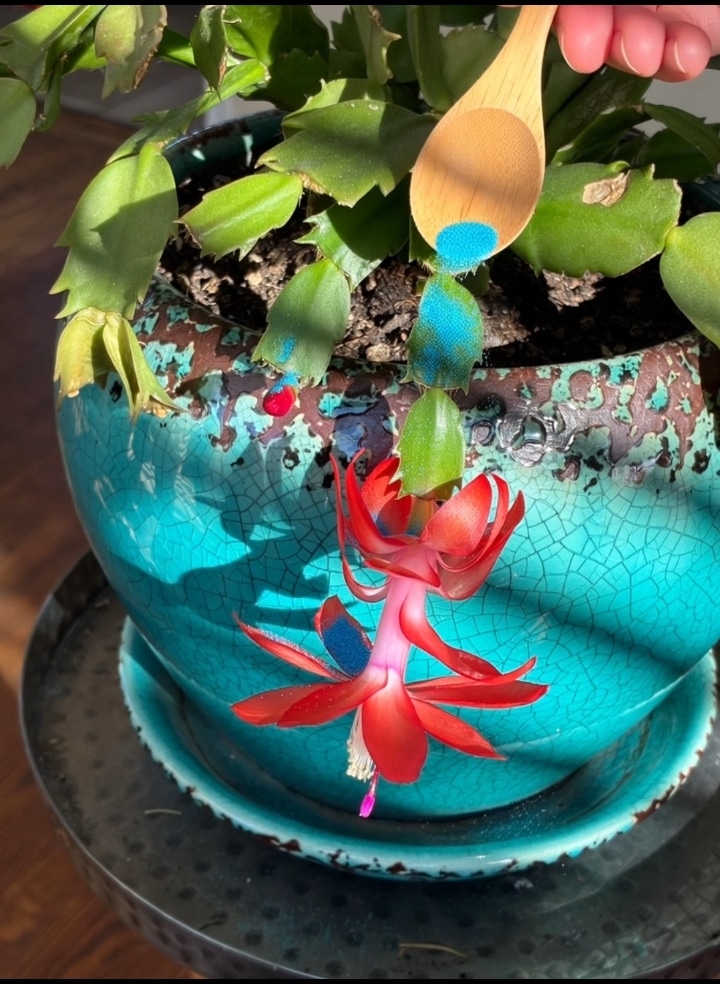
A Christmas Cactus covered in vibrant red flowers is one of the most beautiful additions to an indoor garden. Its cascading green stems, colorful seasonal blossoms, and elegant appearance make it a popular choice for holiday decorating.
The image shows a flowering holiday cactus growing in a striking turquoise ceramic planter with a textured, crackled finish. A wooden spoon is sprinkling bright blue powder directly over a green stem segment near the flowers.
Can blue powder fertilizer help Christmas Cactus develop stronger roots, healthier stems, and more beautiful seasonal blooms?
The answer depends on the powder’s composition, concentration, and application method. Some commercial fertilizers contain blue-colored water-soluble granules, but color alone does not indicate which nutrients are present.
This guide explains how to use blue fertilizer powder appropriately, choose the best Christmas Cactus potting mix, prevent bud drop, and encourage healthy seasonal flowering.
1. Understanding Christmas Cactus and Its Flowering Needs
Christmas Cactus belongs to the genus Schlumbergera, a group of tropical forest cacti native to Brazil.
Unlike desert cacti, Christmas Cactus naturally grows in environments with filtered sunlight, moderate moisture, and excellent root aeration.
The plant in the image has flattened, segmented green stems and colorful flowers characteristic of holiday cacti.
Its pointed stem segments resemble those commonly found on Thanksgiving Cactus (Schlumbergera truncata), a close relative frequently sold as Christmas Cactus.
Both plants have similar care requirements.
Ideal Growing Conditions
| Care factor | Recommended conditions |
|---|---|
| Light | Bright, indirect sunlight |
| Temperature | 60–75°F (16–24°C) during active growth |
| Soil | Loose, well-draining potting mix |
| Watering | When the upper soil begins to dry |
| Humidity | Moderate indoor humidity |
| Fertilizer | Light feeding during active growth |
| Flowering | Influenced by seasonal light and temperature |
2. What Is the Blue Powder Used on Christmas Cactus?
The image shows bright blue granular powder falling from a wooden spoon onto the plant.
Blue-colored powders are sometimes found in commercial water-soluble fertilizers and plant nutrient products.
However, the exact ingredients cannot be identified from appearance alone.
Common Types of Blue Plant Fertilizer
| Product type | Main purpose | Important consideration |
|---|---|---|
| Water-soluble NPK fertilizer | Supplies essential nutrients | Must be correctly diluted |
| Blue crystalline plant food | Provides nutrients depending on formulation | Follow label instructions |
| Micronutrient powder | Addresses specific nutrient needs | Use only when appropriate |
| Soluble flowering plant fertilizer | Supports normal plant development | Check nutrient analysis |
| Copper-based treatment | Used for certain plant diseases | Not a general fertilizer |
| Unidentified blue powder | Unknown | Avoid applying until identified |
Why Some Fertilizers Are Blue
Manufacturers may add coloring to fertilizers to improve product identification or make prepared solutions easier to recognize.
The color does not determine fertilizer effectiveness.
For accurate dosing, always check the product’s NPK analysis and recommended dilution.
3. How to Use Blue Powder Fertilizer Correctly
Many blue crystalline fertilizers are designed to dissolve in water before application.
Sprinkling concentrated water-soluble fertilizer directly onto succulent stems or delicate flowers may cause tissue damage.
Step-by-Step Application
- Select a fertilizer labeled for indoor flowering plants or holiday cacti.
- Read the recommended mixing instructions.
- Measure the specified amount of powder.
- Add it to the appropriate volume of clean water.
- Stir until the fertilizer dissolves.
- Apply the solution evenly to the potting mix.
- Allow excess liquid to drain completely.
- Avoid leaving fertilizer residue on leaves or flowers.
Never assume that a full spoonful of concentrated blue fertilizer is appropriate for one small planter.
When Should You Fertilize?
Christmas Cactus generally benefits from light feeding during active growth in spring and summer.
Feeding can be reduced when the plant enters its seasonal resting period.
Avoid heavy fertilization while the plant is producing delicate flower buds.
4. Best Fertilizer for Christmas Cactus Blooms
Christmas Cactus needs essential nutrients for healthy growth, but excessive fertilizer is not beneficial.
A complete, balanced houseplant fertilizer is a practical choice.
Understanding NPK Nutrients
Nitrogen (N): Supports healthy green stem growth.
Phosphorus (P): Contributes to root development and energy transfer.
Potassium (K): Supports water regulation and normal plant metabolism.
Fertilizer Comparison
| Fertilizer type | Main advantage | Suitable use |
|---|---|---|
| Balanced 10-10-10 | General plant nutrition | Active growth |
| Balanced 20-20-20 | Complete water-soluble feeding | Properly diluted |
| Cactus fertilizer | Convenient formulation | Label-directed feeding |
| Organic liquid fertilizer | Alternative nutrient source | Light seasonal feeding |
| Slow-release fertilizer | Gradual nutrient supply | Established plants |
| Bloom fertilizer | Specialized nutrient formulation | Only when appropriate |
Can Extra Phosphorus Produce More Flowers?
Adding phosphorus beyond the plant’s needs does not automatically increase blooming.
Flower formation depends strongly on the seasonal environment, particularly uninterrupted nighttime darkness and suitable temperatures.
The right fertilizer supports healthy growth, but it cannot replace proper root care. Next, discover how premium potting soil and balanced watering create the foundation for strong Christmas Cactus stems and beautiful seasonal flowers.