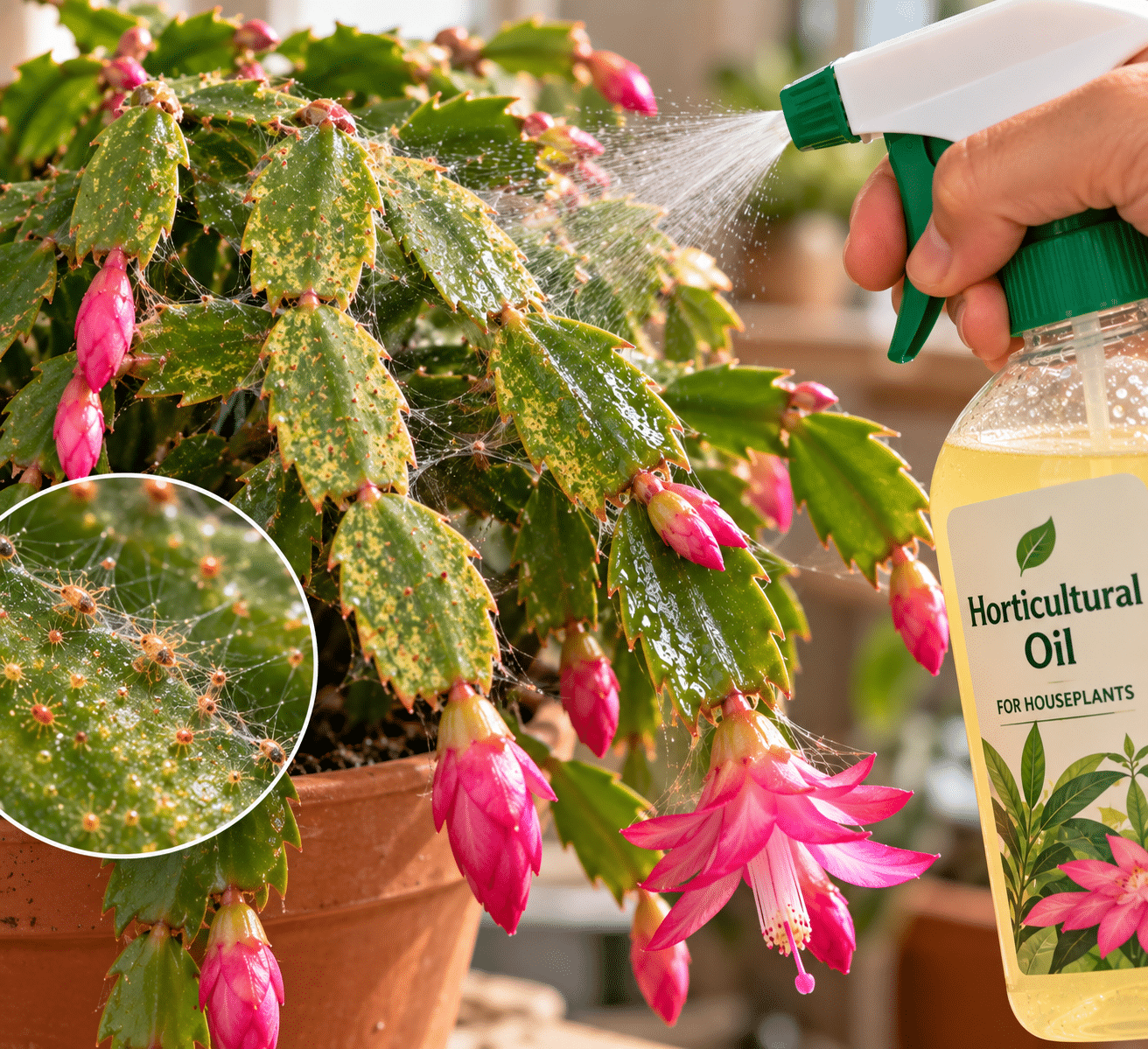
A Christmas Cactus covered in tiny spider mites can begin losing its healthy green appearance long before the infestation becomes obvious. Yellow speckles appear across the flattened stem segments, delicate webbing develops between the joints, and once-vibrant foliage may become dull, discolored, or weakened.
For indoor plant owners, this is particularly frustrating when the plant is already producing beautiful pink flower buds.
The image shows a flowering holiday cactus with visible yellow stippling, fine webbing, and numerous tiny orange-red mite-like pests. A spray bottle labeled Horticultural Oil for Houseplants is directed toward the affected stems.
This represents a common houseplant pest management method: using a properly formulated horticultural oil to help control spider mites through direct contact.
However, horticultural oil is not a miracle cure. It must be suitable for the plant, applied according to the product label, and combined with careful monitoring and proper growing conditions.
This comprehensive guide explains how to identify spider mites on Christmas Cactus, select appropriate horticultural oil products, apply treatment safely, protect flowers and roots, compare pest control methods, and help a damaged plant recover.
Quick Answer: Can Horticultural Oil Kill Spider Mites on Christmas Cactus?
Yes. Certain horticultural oil products can help control spider mites when applied correctly and when their labels permit use on the affected ornamental plant.
Horticultural oils work primarily by coating susceptible pests and interfering with their normal biological functions.
Direct contact and thorough coverage are important.
However, Christmas Cactus can be sensitive to inappropriate pesticide applications, especially when flowering or exposed to environmental stress.
The safest approach is to:
- Isolate the affected plant from other houseplants.
- Confirm that spider mites are present.
- Inspect the undersides and joints of the green segments.
- Remove visible webbing and rinse the plant gently when practical.
- Select a horticultural oil labeled for the intended ornamental use.
- Test the product on a small section first.
- Apply the oil according to the manufacturer’s instructions.
- Avoid intense sunlight, extreme temperatures, and unnecessary flower exposure.
- Reinspect the plant regularly.
- Repeat treatment only when permitted by the product label.
Successful spider mite control often requires more than one intervention because mites reproduce quickly and may remain hidden in protected areas.
What Plant Is Shown in the Image?
The plant belongs to the Schlumbergera group, commonly known as Christmas Cactus or holiday cactus.
The flattened green stem segments, pointed edges, hanging growth habit, and bright pink flowers are characteristic of these tropical ornamental plants.
The pointed segment margins suggest a Thanksgiving Cactus, Schlumbergera truncata, which is frequently marketed as Christmas Cactus.
Traditional Christmas Cactus, Schlumbergera × buckleyi, generally has more rounded segment edges.
Both plants require similar general care and may experience spider mite infestations.
Unlike desert cacti, these tropical forest cacti prefer bright indirect light, an airy growing medium, and moderate moisture.
What Are Spider Mites?
Spider mites are tiny arachnids closely related to spiders and ticks.
They are not insects.
Many species feed on ornamental plants, including indoor flowering plants and foliage houseplants.
One of the most common pest species is the two-spotted spider mite, Tetranychus urticae.
Spider mites use specialized mouthparts to feed on plant cells, producing characteristic pale speckles on affected foliage.
As feeding continues, these small marks may merge into larger discolored areas.
Severe infestations can cause substantial plant stress.
Common Signs of Spider Mites
- Tiny yellow or pale dots on green segments
- Fine webbing between stems
- Small moving mites
- Bronze or dull-looking plant tissue
- Increased discoloration
- Reduced plant vigor
- Premature deterioration of damaged segments
- Heavy pest populations around sheltered joints
The image shows several of these classic warning signs.
However, the exact mite species cannot be established from the image alone.
How to Identify Spider Mites on Christmas Cactus
Spider mites are extremely small, making early infestations easy to overlook.
1. Yellow Speckles on Green Segments
One of the earliest signs is fine yellow stippling.
Individual feeding marks may be difficult to distinguish without magnification.
2. Fine Spider-Like Webbing
Some spider mite species produce delicate webbing.
This webbing may become visible between stem segments when populations increase.
3. Tiny Red, Orange, or Green Moving Dots
Spider mites vary in color depending on species and life stage.
4. Dull or Bronzed Tissue
Heavy feeding can cause green segments to lose their normal appearance.
5. Clusters Near Segment Joints
Protected areas may harbor mites and eggs.
6. Damage That Continues Spreading
When infestations remain untreated, new feeding damage may appear on previously healthy tissue.
Spider Mites vs. Scale Insects vs. Mealybugs
Different houseplant pests require different control strategies.
| Feature | Spider mites | Scale insects | Mealybugs |
|---|---|---|---|
| Appearance | Tiny moving dots | Attached bumps | White cottony insects |
| Webbing | Often present | Usually absent | Usually absent |
| Typical damage | Yellow stippling | Yellowing and weakening | Yellowing and weakening |
| Movement | Mobile | Limited in adults | Mobile |
| Common hiding areas | Segment joints and protected surfaces | Stem joints and surfaces | Stem joints and sheltered areas |
| Horticultural oil | Some labeled products are effective | Some labeled products are effective | Some labeled products are effective |
Correct pest identification prevents unnecessary treatments and improves the chances of success.
Why Spider Mites Attack Christmas Cactus
Spider mites may infest plants when introduced from other plants, contaminated plant material, or nearby vegetation.
Warm conditions can accelerate the reproduction of certain spider mite species.
Dry indoor environments may also favor some infestations, although humidity alone does not determine whether spider mites will appear.
Common Contributing Conditions
Warm indoor temperatures: Some spider mite populations develop rapidly in warm environments.
Infested neighboring plants: Mites can spread from nearby foliage.
Delayed inspection: Small populations may grow before they are noticed.
Plant stress: Stressed plants may be less able to tolerate feeding damage.
Dense foliage: Sheltered areas can make pests difficult to detect and treat.
Spider mites are not caused simply by poor watering or a lack of fertilizer.
What Is Horticultural Oil?
Horticultural oil is a pesticide formulation designed for use on certain plants and pests.
Products may contain highly refined mineral oils or plant-derived oils.
Some are formulated for use during active plant growth, while others have different seasonal or application restrictions.
Horticultural oils can help manage certain mites, scale insects, whiteflies, and other pests, depending on the product label.
How Horticultural Oil Works
Horticultural oils primarily act through direct physical contact.
They can coat susceptible pests and interfere with respiration and other essential functions.
Some products may also affect mite eggs.
Effectiveness depends on the formulation, pest species, application coverage, and life stage.
Why Horticultural Oil Is Different From Ordinary Cooking Oil
Commercial horticultural oils are formulated for pesticide use.
Household cooking oils are not equivalent products.
Applying vegetable oil, olive oil, or other kitchen oils directly to houseplant foliage can damage plant tissue.
Use only an appropriate, properly labeled product.
Is Horticultural Oil Safe for Christmas Cactus?
Horticultural oil may be useful for pest management, but not every formulation is appropriate for every ornamental plant.
Christmas Cactus has fleshy segmented stems and delicate seasonal flowers.
Some pesticide oils can cause phytotoxicity, meaning injury to plant tissue.
Possible symptoms include discoloration, spotting, tissue damage, or deterioration of sensitive flowers.
Important Safety Rules
- Confirm that the product is labeled for the intended ornamental use.
- Follow all dilution and application instructions.
- Test a small section before widespread treatment.
- Avoid spraying during extreme heat or cold.
- Do not apply to severely drought-stressed plants.
- Avoid intense sunlight during and immediately after application.
- Protect delicate flowers and buds where possible.
- Do not combine oil with other pesticides unless the labels permit it.
- Follow any restrictions involving sulfur-containing products.
- Keep pesticides away from children and pets.
A small-area test is particularly important when treating an unfamiliar plant variety.
How to Apply Horticultural Oil to Christmas Cactus
The image shows a spray bottle applying a fine mist toward spider mite-infested stem segments.
The following procedure explains how to approach this treatment safely.
Step 1: Isolate the Infested Plant
Move the Christmas Cactus away from other houseplants.
Check nearby plants for signs of mite activity.
Step 2: Examine the Stems
Inspect the front and back of the flattened segments.
Pay attention to the joints and sheltered growth areas.
Step 3: Remove Visible Webbing
Use a gentle stream of water or a soft, damp cloth where practical.
Avoid breaking delicate stems or damaging flowers.
Step 4: Choose an Appropriate Horticultural Oil
Select a product whose label permits the intended pest and ornamental plant application.
Do not substitute an unidentified oil.
Step 5: Test a Small Area
Apply the product to a limited section according to label directions.
Wait the recommended period and observe for signs of injury.
Step 6: Prepare the Product
Ready-to-use sprays should be used as supplied.
Concentrates must be diluted exactly according to their labels.
Never assume that a stronger concentration will work better.
Step 7: Apply the Spray
Cover the infested surfaces according to the product instructions.
Focus on areas where mites are present.
Avoid excessive runoff.
Step 8: Protect Flowers and Buds
Direct treatment toward infested green segments rather than unnecessarily soaking flowers.
Step 9: Allow the Plant to Dry
Keep the plant in a suitable location away from harsh direct sunlight.
Step 10: Monitor for Surviving Mites
Inspect regularly.
Repeat treatment only as directed by the manufacturer.
How Often Should You Spray Horticultural Oil?
There is no universal application interval for all horticultural oil products.
The correct schedule depends on the formulation, pest species, temperature, and label directions.
Spider mites reproduce rapidly under favorable conditions, so follow-up monitoring is essential.
Practical Inspection Schedule
| Period | What to do |
|---|---|
| Day 1 | Inspect, isolate, clean, and treat if appropriate |
| Days 2–3 | Check for plant sensitivity |
| Days 4–7 | Inspect for active mites and new webbing |
| Following weeks | Continue monitoring and follow labeled treatment intervals |
| After control | Inspect periodically for recurrence |
This is a monitoring schedule, not an instruction to spray on every listed date.
Why Spider Mites Keep Returning
Recurring spider mite infestations are common.
Eggs Survive
Some eggs may remain after an initial treatment.
Hidden Mites Escape Contact
Mites can shelter beneath overlapping segments.
Incomplete Spray Coverage
Contact treatments depend on reaching the pests.
Nearby Plants Remain Infested
Untreated houseplants may serve as a source of reinfestation.
Favorable Growing Conditions
Warm environments can support rapid population development.
Monitoring Stops Too Early
Small surviving populations may increase again.
Horticultural Oil vs. Insecticidal Soap vs. Neem Oil
Several pest control products may be suitable for certain spider mite infestations.
Their effectiveness depends on the formulation and label.
| Treatment | Main advantage | Main limitation |
|---|---|---|
| Horticultural oil | Can control susceptible mites and some eggs | Potential plant injury |
| Insecticidal soap | Contact control of susceptible mites | Limited residual action |
| Registered neem-based pesticide | Some products are labeled for mites | Effectiveness varies |
| Water rinsing | Helps physically remove mites and webbing | May not eliminate infestation |
| Manual cleaning | Useful for small plants | Difficult with dense growth |
| Specialized miticide | May target particular mite species | Must be labeled for the intended use |
For a valuable indoor plant collection, selecting an appropriate product is more important than applying multiple products indiscriminately.
What to Look for When Buying Horticultural Oil
Not all horticultural oils are identical.
1. Ornamental Plant Labeling
Verify that the product is suitable for the intended plant category.
2. Spider Mite Control Claims
Check whether the product is labeled for spider mites.
3. Ready-to-Use vs. Concentrate
Ready-to-use products reduce the need for dilution.
Concentrates require careful measurement.
4. Temperature Restrictions
Some oils have specific application temperature limits.
5. Plant Sensitivity Warnings
Read warnings for sensitive ornamental species.
6. Indoor Application Instructions
Check whether indoor use is permitted.
7. Compatibility Restrictions
Avoid prohibited combinations with other pesticides.
8. Manufacturer Instructions
Clear labeling is essential for safe application.
Ready-to-Use Spray vs. Concentrated Horticultural Oil
| Feature | Ready-to-use spray | Concentrate |
|---|---|---|
| Preparation | Usually none | Requires dilution |
| Convenience | High | Moderate |
| Measuring | Minimal | Essential |
| Storage | Product-dependent | Product-dependent |
| Application errors | Fewer dilution errors | Greater risk if mixed incorrectly |
| Suitable use | Small collections when labeled | Larger treatment needs when labeled |
The best choice depends on the number of plants, the application instructions, and the gardener’s experience.
Can Neem Oil Replace Horticultural Oil?
Some neem-based products are formulated for mite management.
However, neem oil products differ significantly.
Some contain clarified hydrophobic extract of neem oil, while others contain different active ingredients.
A product’s actual formulation and registered uses matter more than the word “neem” on the label.
Do not assume that every neem product is appropriate for Christmas Cactus.
Do not mix neem oil with horticultural oil unless the product labels specifically permit the combination.
Can You Use Dish Soap Against Spider Mites?
Household dish detergent is not equivalent to insecticidal soap.
Detergents may contain fragrances, degreasers, preservatives, and other ingredients that can injure plant tissue.
Christmas Cactus segments may be sensitive to inappropriate mixtures.
A properly formulated and labeled insecticidal soap is preferable to a homemade detergent spray.
Can You Use Rubbing Alcohol on Spider Mites?
Rubbing alcohol is sometimes discussed as a houseplant pest treatment.
However, direct application can injure sensitive plant tissue.
It is not a substitute for a properly labeled pesticide.
For Christmas Cactus, gentle physical removal and appropriate labeled treatments are more predictable approaches.
Avoid experimenting with strong alcohol mixtures on flowering plants.
Should You Remove Spider Mite Webbing Before Spraying?
Removing visible webbing can make inspection easier and physically dislodge some mites.
However, webbing removal alone will not necessarily eliminate eggs or mites.
Gentle Cleaning Method
- Move the plant to an appropriate cleaning area.
- Support fragile stems.
- Use a gentle water rinse if the plant can tolerate it.
- Avoid excessive pressure.
- Allow excess water to drain.
- Inspect for remaining mites.
- Apply any labeled treatment separately as directed.
Do not use high-pressure water that could damage the segmented stems.
How to Check Whether Spider Mites Are Still Alive
A magnifying glass can be useful.
Another simple inspection method is the white-paper test.
White-Paper Test
Hold a sheet of white paper beneath a suspicious stem.
Gently tap the segment.
Tiny moving specks on the paper may indicate mites.
Use magnification when possible.
Not every moving speck is necessarily a harmful spider mite, so identification remains important.
Why Christmas Cactus Turns Yellow After Spider Mite Damage
Yellowing can result from several causes.
Spider Mite Feeding
Cell damage can produce fine pale speckles.
Excessive Sunlight
Strong direct light can injure holiday cactus segments.
Overwatering
Poor drainage can damage roots.
Underwatering
Prolonged dryness can cause stress.
Pesticide Injury
Unsuitable oil applications may damage tissue.
Nutrient Imbalance
Inappropriate fertilization may contribute to discoloration.
The correct solution depends on identifying the underlying problem.
Can Spider Mites Cause Christmas Cactus Bud Drop?
Severe infestations may contribute to plant stress and bud deterioration.
However, bud drop can also result from:
- Sudden temperature changes
- Inconsistent watering
- Root problems
- Environmental changes
- Excessive heat
- Low light
- Moving the plant during bud development
Spider mite control may reduce one source of stress, but it cannot guarantee that every flower bud will survive.
How to Protect Christmas Cactus Flowers During Treatment
Flowers are among the most delicate parts of the plant.
Avoid Unnecessary Spray Contact
Focus treatment on infested green segments where possible.
Keep the Plant Out of Harsh Sun
Strong light can increase stress after certain pesticide applications.
Maintain Stable Temperatures
Avoid sudden changes during flowering.
Water Appropriately
Do not overwater in an attempt to accelerate recovery.
Avoid Excessive Handling
Fragile buds and flowers can detach when disturbed.
Follow Product Restrictions
Some products may not be appropriate for use on flowering ornamental plants.
How to Help Christmas Cactus Recover After Spider Mites
Once pest activity is reduced, focus on restoring stable growing conditions.
Bright Indirect Light
Place the plant near a bright window without intense direct sunlight.
Appropriate Watering
Allow the growing medium to dry partially before watering again.
Good Drainage
Use a pot with drainage holes.
Gentle Air Circulation
Provide normal room airflow without harsh drafts.
Limited Fertilizer
Avoid heavy feeding while the plant is severely stressed.
Regular Inspection
Check for new webbing and moving mites.
Patience
Damaged stem tissue may not return to its original green color.
Healthy new growth is a better sign of recovery.
Best Potting Soil for Christmas Cactus Recovery
Christmas Cactus is a tropical forest cactus rather than a typical desert cactus.
It benefits from a growing medium that combines drainage, airflow, and moderate moisture retention.
Premium Indoor Potting Mix
A quality indoor potting mix provides a useful foundation.
Fine Orchid Bark
Improves structure and root aeration.
Perlite
Reduces compaction and improves drainage.
Pumice
Adds durable structure to the growing medium.
Coco Coir
Can help retain moisture when used appropriately.
Suggested Potting Mix
A practical starting mixture is:
- 2 parts quality indoor potting mix
- 1 part fine orchid bark
- 1 part perlite or pumice
Adjust the proportions according to the container, environment, and watering habits.
Premium Potting Soil Comparison
| Material | Main benefit | Main limitation |
|---|---|---|
| Indoor potting mix | Moisture and nutrient support | May compact over time |
| Orchid bark | Root aeration | Dries more quickly |
| Perlite | Improved drainage | Low nutrient contribution |
| Pumice | Long-lasting structure | Adds weight |
| Coco coir | Moisture retention | Excess may retain too much water |
| Dense garden soil | Readily available | Often unsuitable for indoor pots |
Changing soil does not directly eliminate spider mites, which primarily live and feed on aboveground plant surfaces.
Should You Repot Christmas Cactus After Spider Mites?
Repotting is not automatically necessary.
Spider mites primarily affect aboveground plant tissue.
Unnecessary repotting may add stress to an already weakened plant.
Repot when there is a separate reason, such as:
- Root rot
- Severely compacted soil
- Poor drainage
- A damaged container
- A deteriorated growing medium
If the roots are healthy, maintaining stable conditions may be preferable to disturbing the plant.
Best Fertilizer for Christmas Cactus After Pest Damage
A recovering plant should not automatically receive fertilizer.
Wait until the infestation is controlled and the plant shows healthy growth.
Balanced Liquid Houseplant Fertilizer
Can provide essential nutrients during active growth.
Organic Houseplant Fertilizer
May be suitable when used according to the product label.
Controlled-Release Fertilizer
Can supply nutrients gradually to established plants.
Blooming Plant Fertilizer
May be appropriate for healthy flowering plants, depending on the formulation.
Avoid excessive fertilizer because soluble salts can damage roots.
Fertilizer Comparison
| Fertilizer type | Main advantage | Appropriate situation |
|---|---|---|
| Balanced liquid fertilizer | Adjustable feeding | Healthy active growth |
| Organic houseplant fertilizer | Alternative nutrient sources | Established plants |
| Controlled-release granules | Gradual nutrient delivery | Healthy potted plants |
| Blooming plant fertilizer | Formulated for flowering ornamentals | When nutrients are needed |
| Unknown homemade mixture | No predictable nutrient balance | Not recommended |
Fertilizer cannot replace spider mite treatment.
Best Watering Schedule for Christmas Cactus
Christmas Cactus generally prefers more moisture than desert cacti.
However, its roots should not remain waterlogged.
Check Before Watering
Feel the upper portion of the growing medium.
Water Thoroughly When Needed
Allow excess water to drain.
Empty the Saucer
Do not leave the container standing in water.
Adjust for Indoor Conditions
Water use varies with temperature, light, pot size, and season.
Avoid Fixed Calendar Rules
Soil moisture is a better guide than watering on the same day every week.
Best LED Grow Lights for Christmas Cactus
Supplemental lighting may benefit Christmas Cactus growing in dim apartments or home offices.
LED grow lights can support healthy growth when natural daylight is insufficient.
Useful Features
- Adjustable light intensity
- Suitable coverage area
- Timer functionality
- Low heat output
- Adjustable mounting height
- Energy-efficient operation
- Reliable manufacturer specifications
Lighting Comparison
| Lighting source | Main advantage | Potential concern |
|---|---|---|
| Bright indirect window light | Natural lighting | Depends on exposure |
| Basic LED grow light | Supplemental illumination | Requires correct positioning |
| Adjustable LED grow light | Better control | Higher purchase cost |
| Timer-controlled LED | Consistent schedule | Must match plant needs |
| Strong direct sunlight | High intensity | Risk of scorching |
Avoid placing a recently oil-treated plant under intense lighting conditions contrary to the pesticide label.
How to Prevent Spider Mites in an Indoor Plant Collection
Prevention begins with regular inspection and sensible plant care.
Inspect New Plants
Check plants before placing them near an established collection.
Separate Infested Specimens
Isolation can reduce the risk of spread.
Examine Stem Joints
Mites may remain in protected areas.
Maintain Appropriate Growing Conditions
Healthy plants are generally better able to tolerate stress.
Avoid Excessive Heat
Warm conditions can favor rapid mite development.
Clean Plant Displays
Remove plant debris and inspect surrounding surfaces.
Monitor Regularly
Early detection makes infestations easier to manage.
Spider Mite Treatment Troubleshooting
| Problem | Possible cause | Recommended response |
|---|---|---|
| Webbing returns | Surviving mites | Reinspect and follow label |
| New yellow speckles appear | Continued feeding | Check for active mites |
| Segments develop dark spots | Possible spray injury or disease | Stop and investigate |
| Buds fall after spraying | Plant stress or treatment sensitivity | Review application conditions |
| Plant remains weak | Severe damage or root problems | Inspect overall plant health |
| Nearby plants show mites | Spread from infested plants | Isolate and inspect |
| Mites persist after treatment | Incomplete contact or surviving eggs | Reassess control strategy |
| Leaves appear dull | Existing damage | Monitor healthy new growth |
How Long Does Spider Mite Recovery Take?
Recovery varies depending on infestation severity and plant condition.
A lightly affected plant may resume healthy growth relatively quickly.
A severely damaged plant may need several weeks or longer to show meaningful improvement.
General Recovery Timeline
| Period | Main focus |
|---|---|
| First week | Pest control and plant safety |
| Weeks 2–3 | Continued mite monitoring |
| Weeks 3–6 | Evaluate plant stability and new damage |
| Following months | Support healthy new growth |
| Future flowering season | Maintain suitable blooming conditions |
These periods are approximate and do not guarantee recovery.
Can You Propagate Christmas Cactus After Spider Mite Damage?
Yes, healthy segments may be propagated once they are free of active pests.
Step 1: Select Healthy Material
Choose firm green segments without visible mites or webbing.
Step 2: Separate the Cutting
Remove a section containing several connected segments.
Step 3: Inspect Carefully
Do not transfer mites to new plants.
Step 4: Allow the Cut End to Heal
Let the cutting rest briefly in a clean, shaded location.
Step 5: Prepare an Airy Propagation Mix
Use a suitable growing medium.
Step 6: Plant Shallowly
Insert the base into the mix.
Step 7: Provide Indirect Light
Avoid intense sunlight.
Step 8: Maintain Moderate Moisture
Do not saturate the medium.
Step 9: Monitor Root Development
Rooting time depends on conditions.
Luxury Indoor Plant Decor After Recovery
A healthy Christmas Cactus can become a beautiful decorative feature in a modern home.
Its cascading segmented stems and vibrant flowers complement many interior styles.
Premium Ceramic Planters
Neutral ceramic containers highlight the bright flowers.
Modern Living Room Displays
Place the plant near a bright window with filtered light.
Luxury Apartment Styling
A mature flowering holiday cactus can become a seasonal focal point.
Hanging Planters
Hanging containers allow the stems to cascade naturally.
Home Office Plant Decor
Smaller holiday cacti can add color to workspaces with suitable lighting.
Elegant Indoor Garden Shelves
Group healthy plants with complementary foliage textures.
Premium Garden Decor
In suitable climates, holiday cacti can be displayed outdoors in sheltered, shaded locations.
Avoid returning an actively infested plant to a shared decorative display.
Choosing Professional Houseplant Care Products
Quality plant care equipment can simplify maintenance.
However, the most useful purchases address specific problems.
Horticultural Oil
Choose a labeled product appropriate for the plant and pest.
Insecticidal Soap
A possible alternative for susceptible spider mites.
Magnifying Glass
Useful for identifying tiny pests.
Premium Potting Mix
Supports healthy roots.
Containers With Drainage
Help prevent prolonged waterlogging.
LED Grow Lights
Useful when natural light is insufficient.
Clean Pruning Tools
Allow damaged segments to be removed carefully.
Moisture Monitoring Tools
Can assist with watering decisions, although direct inspection remains important.
Christmas Cactus Care Table
| Care factor | Recommended approach |
|---|---|
| Plant | Christmas Cactus / Thanksgiving Cactus |
| Botanical group | Schlumbergera |
| Main pest | Spider mites |
| Visible symptoms | Yellow stippling and webbing |
| Treatment option | Properly labeled horticultural oil |
| Alternative control | Labeled insecticidal soap or physical removal |
| Light | Bright indirect light |
| Soil | Airy, well-draining tropical cactus mix |
| Watering | Moderate, based on soil moisture |
| Fertilizer | Resume when healthy growth returns |
| Container | Pot with drainage holes |
| Pest inspection | Regular monitoring |
| Flower protection | Avoid unnecessary pesticide contact |
| Decorative placement | Bright indoor rooms and sheltered displays |
Frequently Asked Questions
Does Horticultural Oil Kill Spider Mites on Christmas Cactus?
Certain labeled horticultural oil products can control spider mites through direct contact.
Is Horticultural Oil Safe for Christmas Cactus?
Safety depends on the formulation, plant sensitivity, and application conditions. Always follow the label and test a small area first.
How Often Should I Spray Horticultural Oil?
Follow the manufacturer’s application interval and restrictions.
Can Spider Mites Kill a Christmas Cactus?
Severe infestations can cause significant stress and damage, especially when combined with other growing problems.
Why Are There Tiny Webs on My Christmas Cactus?
Fine webbing accompanied by yellow stippling and moving mites may indicate a spider mite infestation.
Can I Use Neem Oil Instead?
Some registered neem-based products are labeled for mite control. Check the specific product’s instructions.
Will Spider Mite Damage Disappear?
Existing damaged tissue may remain discolored. Healthy new growth is a better indicator of recovery.
Should I Remove All Damaged Segments?
No. Remove only severely damaged material when necessary. Healthy green segments remain valuable for the plant.
Can I Spray Horticultural Oil on Pink Flowers?
Avoid unnecessary contact with delicate flowers unless the label specifically permits it.
Do Spider Mites Spread to Other Houseplants?
Yes. They can spread to nearby susceptible plants.
Does Increasing Humidity Eliminate Spider Mites?
No. Humidity management alone is not a reliable spider mite treatment.
Can I Mix Horticultural Oil With Insecticidal Soap?
Do not combine products unless their labels explicitly permit the mixture.
Should I Fertilize Immediately After Treatment?
Wait until the plant is stable and producing healthy growth before resuming appropriate feeding.
Can Christmas Cactus Bloom Again After Spider Mites?
Yes. A recovered plant may flower again when healthy and provided with suitable seasonal conditions.
What Is the Best Way to Prevent Spider Mites?
Inspect plants regularly, isolate new additions, and respond promptly when pests are detected.
Final Thoughts
The image shows a flowering Christmas Cactus with visible spider mite-like pests, fine webbing, yellow stippling, and a horticultural oil spray directed toward the affected stems.
This illustrates a common challenge in indoor plant care: spider mites can multiply quickly and damage ornamental plants before the infestation becomes obvious.
Horticultural oil can be a useful treatment when the product is appropriately labeled and applied correctly.
However, successful control depends on pest identification, careful spray coverage, plant sensitivity, repeated monitoring, and proper environmental care.
High-quality pest control products, premium indoor potting mixes, suitable drainage containers, appropriate fertilizer, and professional LED grow lights can each support different aspects of long-term houseplant maintenance.
The priority is always to control the active infestation without creating additional plant stress.
With patience, appropriate treatment, and consistent care, a Christmas Cactus can recover from spider mite damage, produce healthy new segments, and continue providing colorful seasonal flowers in beautiful indoor and outdoor displays.