African Violets are among the most attractive flowering houseplants for bright windows, elegant indoor gardens, and small decorative spaces. Their velvety green leaves, compact growth habit, and vibrant purple flowers make them especially popular with gardeners who want colorful indoor plants without needing a large growing area.
But keeping an African Violet healthy requires more than simply placing it near a window and watering it occasionally.
The right balance of soil moisture, root aeration, nutrients, lighting, and container size plays an important role in long-term growth and flowering.
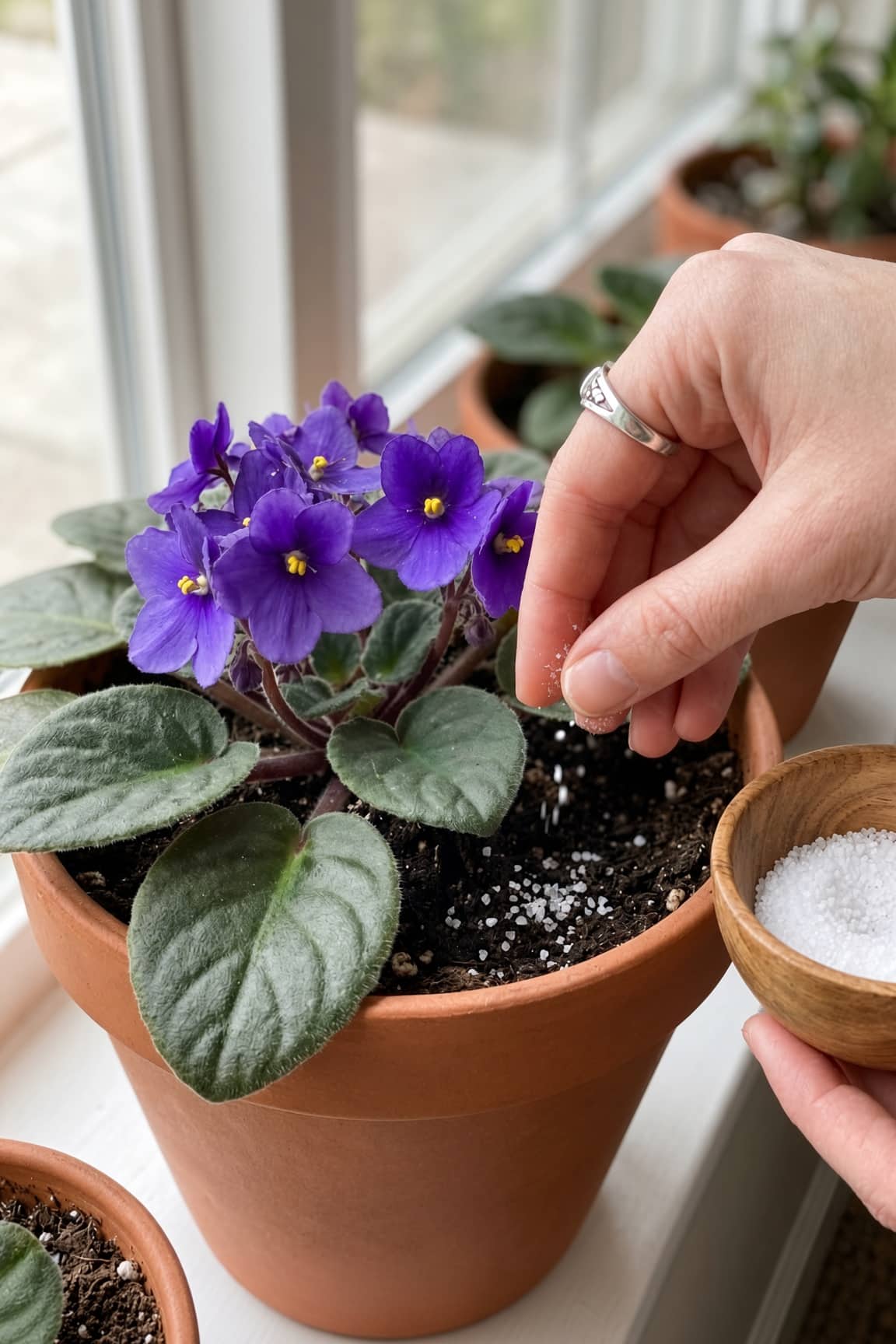
The image shows a beautiful African Violet with deep purple flowers and soft, rounded green leaves growing in a terracotta pot. A hand is sprinkling small white granules onto the soil, while another hand holds a wooden bowl containing the same material.
These granules resemble several common household or gardening substances, including Epsom salt, coarse salt, and certain granular fertilizers.
Their exact identity cannot be determined from the image alone.
This distinction is important because some white granules can be useful plant nutrients when properly formulated, while others can damage sensitive roots.
This guide explains how to evaluate white granular treatments, whether Epsom salt is appropriate for African Violets, how to choose premium indoor plant fertilizers, and how to maintain healthy roots, lush foliage, and long-lasting purple flowers.
Quick Answer: Should You Sprinkle White Granules on African Violet Soil?
Only if the material is positively identified and labeled or otherwise confirmed as suitable for the plant.
African Violets are sensitive to excessive fertilizer salts, making unknown granular treatments especially risky.
If the white material is Epsom salt, it contains magnesium sulfate. Magnesium is an essential plant nutrient, but additional magnesium is not automatically beneficial.
If the granules are a commercial fertilizer, the correct application depends on the product’s nutrient concentration and instructions.
If the material is ordinary table salt, it should not be applied to African Violet soil.
Important Rules
- Never apply unidentified white granules.
- Do not use table salt as fertilizer.
- Use Epsom salt only when a magnesium deficiency or another justified need has been established.
- Follow commercial fertilizer label directions.
- Avoid placing concentrated fertilizer against the crown.
- Maintain a well-draining potting mix.
- Avoid overfertilization.
- Monitor the plant for signs of root stress.
For most healthy African Violets, a properly diluted, balanced fertilizer formulated for flowering houseplants is a more predictable choice than experimenting with household powders.
What Plant Is Shown in the Image?
The plant is an African Violet, belonging to the genus Streptocarpus, section Saintpaulia.
African Violets were traditionally classified under the botanical genus Saintpaulia, a name still widely used in gardening.
The plant in the image has several recognizable characteristics:
- Rounded, softly textured green leaves
- Fine hairs covering the leaf surfaces
- Compact rosette-like growth
- Deep purple flowers
- Small yellow centers
- Multiple flower stalks rising above the foliage
These characteristics are typical of African Violets.
Unlike many outdoor flowering plants, African Violets prefer relatively stable indoor conditions and are especially sensitive to prolonged soil saturation.
Their compact roots benefit from a light growing medium with adequate airflow.
What Are the White Granules in the Image?
The material looks like coarse white crystals or granules.
Several substances can have this appearance.
1. Epsom Salt
Epsom salt is magnesium sulfate, commonly sold as white crystals.
It can supply magnesium and sulfur, but it should not be used routinely without a demonstrated need.
2. Granular Houseplant Fertilizer
Some commercial fertilizers contain pale or white granules.
Their nutrient composition varies by product.
3. Controlled-Release Fertilizer
Certain controlled-release fertilizers appear as small pale pellets or coated granules.
They are designed to release nutrients gradually.
4. Perlite
Perlite is a lightweight white mineral material used to improve potting-medium aeration.
It is not a fertilizer.
5. Table Salt
Ordinary salt may look similar to Epsom salt but is unsuitable for routine houseplant fertilization.
6. Other Household Crystals
Sugar, cleaning products, and other crystalline materials can resemble plant amendments but may be harmful.
The correct treatment cannot be established from color or appearance alone.
Is Epsom Salt Good for African Violets?
Epsom salt contains magnesium sulfate.
Magnesium is essential for chlorophyll production and other plant functions.
However, African Violets growing in a quality potting mix and receiving appropriate fertilizer may already obtain sufficient magnesium.
Adding more magnesium does not necessarily improve flowering.
When Magnesium May Be Useful
Magnesium supplementation may be appropriate when a genuine deficiency is identified.
Possible deficiency symptoms include yellowing between leaf veins, particularly on older leaves.
However, similar symptoms can result from root damage, nutrient imbalance, and other growing problems.
When Epsom Salt Can Be Harmful
Excessive magnesium supplementation can increase soluble salt levels and interfere with nutrient balance.
Sensitive roots may be damaged by inappropriate concentrations.
Avoid placing dry Epsom salt crystals directly against African Violet roots or the central crown.
Does Epsom Salt Make African Violets Bloom More?
There is no reliable basis for expecting Epsom salt to increase flowering in an African Violet that already receives adequate magnesium.
Healthy blooms depend on appropriate lighting, root health, watering, and balanced nutrition.
Why African Violets Are Sensitive to Fertilizer Salts
African Violets have relatively fine root systems and are commonly grown in small containers.
Small pots contain limited growing-medium volume, so excessive fertilizer can accumulate more easily.
When soluble salt concentrations become too high, roots may struggle to absorb water.
This can contribute to plant stress.
Possible Signs of Excess Fertilizer
- Brown or damaged leaf margins
- Wilting despite moist soil
- Poor root growth
- White mineral deposits on the soil
- Slower growth
- Leaf discoloration
- Reduced flowering
- Damaged roots
Not every symptom is caused by fertilizer, so the plant’s overall condition should be evaluated before changing its feeding routine.
How to Use Granular Fertilizer Safely
The image shows white granules being sprinkled over the soil surface.
If the material is a confirmed commercial fertilizer suitable for African Violets, the following approach can help reduce application mistakes.
Step 1: Identify the Fertilizer
Read the product label.
Confirm that it is suitable for indoor flowering plants and container use.
Step 2: Check the Nutrient Analysis
Look for the nitrogen, phosphorus, and potassium values listed on the package.
These are commonly presented as N-P-K numbers.
Step 3: Examine the Plant
A healthy, actively flowering plant may not require additional feeding immediately.
Check whether fertilizer has already been applied recently.
Step 4: Inspect Soil Moisture
Avoid applying concentrated fertilizer to severely dry or stressed roots unless the product directions specifically address those conditions.
Step 5: Measure Carefully
Use the exact amount recommended by the manufacturer.
Do not assume that a larger quantity will produce more flowers.
Step 6: Apply Away From the Crown
If the fertilizer is designed for soil application, distribute it according to the label.
Keep concentrated granules away from the central growing point.
Step 7: Water According to Directions
Some fertilizers require watering after application.
Follow the product instructions while avoiding waterlogged soil.
Step 8: Monitor Plant Response
Watch for leaf discoloration, root stress, or mineral buildup.
Stop unnecessary feeding if problems appear.
Best Fertilizer for African Violets
African Violets generally benefit from balanced nutrition during active growth.
A suitable fertilizer should provide essential nutrients without creating excessive salt concentrations.
African Violet Liquid Fertilizer
Specialized liquid fertilizers are designed for flowering houseplants.
They can be convenient because the concentration is controlled through dilution.
Balanced Houseplant Fertilizer
A complete fertilizer containing essential macro- and micronutrients may also be suitable.
Controlled-Release Fertilizer
Certain products release nutrients gradually.
However, their suitability depends on the formulation, pot size, and application instructions.
Organic Houseplant Fertilizer
Organic products can supply nutrients, but their composition and release rates vary.
Fertilizer Comparison
| Fertilizer type | Main advantage | Main concern |
|---|---|---|
| African Violet liquid fertilizer | Formulated for flowering houseplants | Must be diluted correctly |
| Balanced liquid fertilizer | Flexible feeding | Excess concentration |
| Controlled-release fertilizer | Gradual nutrient delivery | Overapplication in small pots |
| Organic liquid fertilizer | Alternative nutrient source | Variable composition |
| Epsom salt | Supplies magnesium | Unnecessary without deficiency |
| Unknown white granules | No established benefit | Potential root damage |
For most indoor growers, a complete, properly diluted liquid fertilizer offers straightforward control over feeding.
Understanding N-P-K Fertilizer Numbers
Commercial fertilizers often display three numbers.
These represent:
- Nitrogen (N)
- Phosphate (P₂O₅)
- Potash (K₂O)
Nitrogen supports vegetative growth.
Phosphorus is involved in energy transfer and plant development.
Potassium contributes to numerous physiological processes.
African Violets need balanced nutrition rather than extremely high concentrations of a single nutrient.
A fertilizer marketed as a bloom booster is not automatically superior to a complete balanced product.
Excess phosphorus does not guarantee additional flowers.
How Often Should You Fertilize African Violets?
Fertilizer frequency depends on the product, growing medium, plant condition, and growing environment.
Many growers use diluted liquid fertilizer during periods of active growth.
However, there is no universal schedule appropriate for every African Violet.
Feeding Considerations
| Plant condition | Feeding approach |
|---|---|
| Healthy active growth | Follow suitable fertilizer directions |
| Heavy flowering | Maintain balanced nutrition without overfeeding |
| Newly repotted | Consider existing nutrients in fresh mix |
| Root damage | Address root problems before feeding |
| Low-light conditions | Reduce unnecessary fertilizer |
| Severe plant stress | Avoid aggressive feeding |
| Salt accumulation | Reassess fertilizer and water quality |
Best Premium Potting Soil for African Violets
African Violets prefer a light, airy growing medium that retains moderate moisture without becoming compacted.
Ordinary dense garden soil is usually unsuitable for indoor containers.
Peat-Based African Violet Mix
Many specialized mixes contain peat moss combined with aeration materials.
Coco Coir
Can provide moisture retention in appropriate proportions.
Perlite
Improves air spaces and drainage.
Vermiculite
Can help retain moisture and nutrients.
Fine Bark
May improve structure in some formulations.
Example African Violet Potting Mix
A practical starting blend is:
- 2 parts quality African Violet potting mix
- 1 part perlite
Adjust the blend according to container size, humidity, and watering habits.
Avoid excessively dense or waterlogged media.
Premium Potting Mix Comparison
| Growing medium | Moisture retention | Root aeration | Suitability |
|---|---|---|---|
| Specialized African Violet mix | Moderate | Good | Excellent starting option |
| Peat and perlite blend | Moderate | Good | Suitable |
| Coco coir and perlite | Moderate | Good | Suitable when balanced |
| Dense garden soil | Variable | Often poor | Generally unsuitable |
| Heavy compost blend | Often high | Variable | Requires caution |
| Pure perlite | Low nutrient capacity | High | Better as an amendment |
Why Drainage Matters for African Violet Roots
Roots require oxygen as well as moisture.
When a container remains saturated, oxygen availability decreases.
This can contribute to root deterioration.
A pot with drainage holes allows excess water to escape.
The growing medium should also contain sufficient air spaces.
A decorative pot without drainage may be used as an outer container, but the inner nursery pot should be allowed to drain.
Never leave an African Violet standing in water for extended periods.
Terracotta Pots vs. Plastic Pots
The African Violet in the image is growing in a terracotta container.
Terracotta can provide an attractive, natural appearance.
However, the best pot material depends on the growing environment.
| Feature | Terracotta pot | Plastic pot |
|---|---|---|
| Appearance | Natural and classic | Wide range of styles |
| Moisture loss | Faster | Slower |
| Weight | Heavier | Lightweight |
| Cleaning | Porous material | Usually easy |
| Watering frequency | May be more frequent | May be less frequent |
| Decorative options | Traditional and premium | Modern and practical |
African Violets generally prefer pots that are not excessively large relative to their root systems.
An oversized pot may retain too much moisture.
How to Water African Violets Correctly
African Violets prefer consistent but moderate moisture.
They should not remain completely dry for prolonged periods, nor should their roots remain waterlogged.
Top Watering
Apply water carefully to the growing medium rather than directly into the central crown.
Bottom Watering
Place the pot in a shallow container of water for a limited period, allowing moisture to move upward through the growing medium.
Remove the pot and allow excess water to drain.
Self-Watering Containers
Some African Violet growers use wick-watering systems.
These can work well when paired with an appropriate airy potting mix.
Water Temperature
Use water near room temperature.
Very cold water can contribute to spotting on sensitive foliage.
Avoid Standing Water
Never leave the pot permanently submerged.
African Violet Watering Comparison
| Method | Advantage | Important consideration |
|---|---|---|
| Careful top watering | Direct moisture control | Avoid soaking crown |
| Bottom watering | Keeps foliage drier | Do not leave submerged |
| Wick watering | More consistent moisture | Requires suitable potting mix |
| Self-watering planter | Convenient | Monitor moisture |
| Overhead misting | Adds temporary surface moisture | Not recommended as routine watering |
Best Light for African Violet Flowering
The image shows an African Violet positioned near a bright window.
Bright indirect light is generally ideal.
East-Facing Windows
Often provide gentle morning light.
North-Facing Windows
May be suitable in bright environments, although supplemental lighting may be needed.
South-Facing Windows
Can work when direct sunlight is filtered.
West-Facing Windows
May require protection from strong afternoon sunlight.
Signs of Too Much Light
- Bleached or pale foliage
- Scorched patches
- Leaves becoming stressed or distorted
Signs of Too Little Light
- Weak growth
- Long leaf stalks
- Reduced flowering
- Slow development
Professional LED Grow Lights for African Violets
African Violets are well suited to indoor growing under artificial lighting.
Quality LED grow lights can provide consistent illumination in apartments, offices, and rooms with limited window light.
Useful Features
- Adjustable intensity
- Timer control
- Even coverage
- Low heat output
- Appropriate mounting height
- Reliable manufacturer specifications
Lighting Comparison
| Lighting option | Main benefit | Limitation |
|---|---|---|
| Bright indirect window | Natural light | Seasonal variation |
| Basic LED grow light | Supplemental light | Positioning required |
| Adjustable LED panel | Better intensity control | Higher cost |
| Timer-controlled LED | Consistent photoperiod | Requires correct setup |
| Strong direct sunlight | High intensity | Risk of leaf damage |
African Violets often perform well under consistent daily lighting, but the ideal duration and intensity depend on the fixture and growing environment.
How to Encourage More Purple Flowers
Flowering depends on the plant’s overall growing conditions.
1. Provide Sufficient Light
Inadequate light is a common reason for poor flowering.
2. Maintain Healthy Roots
Use an airy growing medium and appropriate watering.
3. Feed Moderately
Use a complete fertilizer when needed.
4. Avoid Oversized Pots
African Violets often perform well in relatively compact containers.
5. Maintain Stable Temperatures
Avoid extreme heat, cold drafts, and sudden temperature changes.
6. Remove Spent Flowers
Carefully remove faded blooms to maintain the plant’s appearance.
7. Monitor for Pests
Inspect for mealybugs, thrips, and mites.
8. Avoid Unnecessary Treatments
Do not add unidentified substances to the soil.
Why African Violet Leaves Turn Yellow
Yellow leaves can have several causes.
Excessive Watering
Prolonged saturation may damage roots.
Nutrient Problems
Deficiencies or excesses can affect foliage color.
Insufficient Light
Low light may contribute to weak growth.
Excessive Sunlight
Strong direct sun can damage leaves.
Aging Leaves
Older outer leaves naturally decline over time.
Root Disease
Damaged roots may interfere with nutrient and water uptake.
Fertilizer Salt Accumulation
Excess soluble salts can cause stress.
Correct diagnosis is essential before adding fertilizer.
White Crystals on African Violet Soil: Fertilizer or Salt Buildup?
White material on the soil surface is not always a fertilizer that someone has intentionally applied.
It may be mineral residue from irrigation water or accumulated fertilizer salts.
Perlite particles can also appear as white flecks.
Signs of Possible Salt Buildup
- White crust around the pot rim
- Mineral deposits on the soil
- Brown leaf edges
- Reduced growth
- Root stress
What to Do
Review fertilizer concentration and watering practices.
If appropriate, flush the growing medium carefully with suitable water while allowing thorough drainage.
Severely deteriorated soil may require replacement.
Do not add more fertilizer until the cause is understood.
Can You Use Epsom Salt to Fix Yellow Leaves?
Only when magnesium deficiency is the actual problem.
Yellow leaves alone do not confirm magnesium deficiency.
Excess water, root damage, poor lighting, and nutrient imbalance can produce similar symptoms.
Unnecessary magnesium supplementation may worsen the nutrient balance.
A complete fertilizer and suitable growing conditions are generally more appropriate than treating every yellow leaf with Epsom salt.
Common African Violet Fertilizer Mistakes
Using Table Salt
Table salt is not a plant fertilizer.
Applying Unknown Crystals
Unidentified substances may contain harmful ingredients.
Adding Too Much Fertilizer
Excess nutrients can damage sensitive roots.
Feeding a Severely Stressed Plant
Fertilizer does not repair root rot.
Applying Granules Against the Crown
Concentrated materials may damage sensitive tissues.
Ignoring Pot Drainage
Poor drainage can make fertilizer problems worse.
Expecting Instant Flowering
Flowers depend on light, plant maturity, and overall care.
Combining Multiple Fertilizers
Unnecessary combinations can increase soluble salt concentrations.
African Violet Troubleshooting Table
| Problem | Possible cause | Recommended response |
|---|---|---|
| Yellow leaves | Watering or nutrient imbalance | Inspect roots and conditions |
| Brown leaf edges | Fertilizer salts or environmental stress | Review feeding and watering |
| No flowers | Insufficient light | Improve lighting |
| Soft crown | Excess moisture or disease | Reduce crown wetness and inspect |
| Wilting with wet soil | Root damage | Check root condition |
| White soil crust | Mineral accumulation | Review water and fertilizer |
| Pale new leaves | Nutrient or root issue | Assess overall care |
| Drooping flowers | Aging blooms or stress | Maintain stable conditions |
| Slow growth | Low light or root problems | Review environment |
| Distorted flowers | Possible pests or other stress | Inspect closely |
Should You Repot an African Violet While It Is Blooming?
A healthy flowering African Violet does not automatically need repotting.
The plant in the image appears to have attractive foliage and numerous flowers.
If the potting medium is functioning well and the roots are healthy, immediate repotting may be unnecessary.
Repotting may be appropriate when:
- Soil becomes compacted
- Drainage deteriorates
- Roots are unhealthy
- The plant outgrows its container
- Mineral buildup becomes severe
- The potting medium breaks down
Choose an appropriately sized pot rather than a much larger container.
How to Repot an African Violet
Step 1: Prepare Fresh Potting Mix
Use a light African Violet mix.
Step 2: Choose a Suitable Container
Select a pot with drainage holes.
Step 3: Remove the Plant Carefully
Support the crown and avoid crushing leaves.
Step 4: Inspect the Roots
Remove clearly dead or rotting material with clean tools when necessary.
Step 5: Position the Plant
Keep the central crown above the soil surface.
Step 6: Fill Around the Roots
Use fresh growing medium without excessive compaction.
Step 7: Water Carefully
Moisten the soil appropriately.
Step 8: Provide Stable Light
Keep the plant in bright indirect light while it adjusts.
African Violet Propagation From Leaves
African Violets can be propagated from healthy leaf cuttings.
Step 1: Select a Healthy Leaf
Choose a mature, undamaged leaf.
Step 2: Cut the Leaf Stalk
Use clean scissors or a sharp blade.
Step 3: Prepare a Light Propagation Mix
Use an airy, moisture-retentive medium.
Step 4: Insert the Leaf Stalk
Plant the stalk shallowly.
Step 5: Maintain Moderate Moisture
Avoid saturation.
Step 6: Provide Bright Indirect Light
Protect the cutting from strong direct sunlight.
Step 7: Wait for Plantlets
Small new plants may develop near the base.
Step 8: Separate When Established
Transfer plantlets carefully after sufficient development.
Strong fertilizer or Epsom salt is not necessary for initiating leaf propagation.
Rooting Powder vs. Fertilizer for African Violet Cuttings
Rooting products and fertilizers serve different purposes.
| Product | Main purpose | Use for leaf cuttings |
|---|---|---|
| Rooting hormone | May stimulate rooting in suitable species | Usually unnecessary |
| Balanced fertilizer | Supplies nutrients | Not needed before rooting |
| Epsom salt | Supplies magnesium | Not routinely recommended |
| Perlite | Improves aeration | Useful |
| Propagation mix | Supports rooting environment | Recommended |
| Unknown white granules | Unclear | Avoid |
African Violet leaves often root successfully without additional rooting hormones.
Common African Violet Pests
Indoor African Violets may experience several pest problems.
Thrips
Can damage flowers and tender growth.
Mealybugs
May appear as white cottony clusters.
Cyclamen Mites
Can cause distorted, stunted central growth.
Spider Mites
May produce stippling on susceptible foliage.
Fungus Gnats
Often become troublesome in persistently wet potting media.
Use appropriate pest identification and treatments labeled for the intended plant and pest.
African Violet foliage can be sensitive to some pesticide applications, so test carefully and follow label instructions.
Premium African Violet Care Products
A well-maintained indoor plant collection benefits from products selected for specific needs.
African Violet Potting Mix
Provides a suitable growing medium.
Complete Liquid Fertilizer
Supplies nutrients when needed.
Small Decorative Planters
Support attractive displays without excessive soil volume.
LED Grow Lights
Help compensate for insufficient natural light.
Moisture Monitoring Tools
Can assist with watering decisions.
Clean Pruning Scissors
Useful for removing damaged leaves and faded flowers.
Plant Inspection Magnifier
Helps identify tiny pests.
Appropriate Pest Control Products
Useful when infestations are confirmed.
Buying more products does not necessarily improve plant health. Correct application matters most.
Luxury Indoor Plant Decor With African Violets
African Violets are especially attractive in elegant indoor spaces because their compact size allows them to fit on shelves, windowsills, and decorative tables.
Their purple flowers provide a striking contrast against green foliage.
Premium Ceramic Planters
White or cream ceramic containers highlight the flowers.
Natural Terracotta Displays
Terracotta provides a warm, traditional appearance.
Modern Apartment Windows
A collection of small flowering plants can brighten a window area.
Luxury Living Room Styling
African Violets can add color to side tables near suitable natural light.
Home Office Decor
Compact plants fit well on desks and shelving.
Minimalist Interior Design
A single flowering African Violet can create a simple decorative accent.
Decorative Indoor Garden Shelves
Group plants with similar lighting needs while leaving enough room for airflow.
Choosing Luxury Planters for African Violets
Decorative containers should balance appearance and practicality.
Size
Avoid excessively large pots.
Drainage
Choose containers with drainage holes or use a removable inner nursery pot.
Material
Ceramic, terracotta, and plastic can all work when managed correctly.
Stability
The pot should remain secure on shelves or windowsills.
Interior Style
Select colors that complement the flowers and surrounding furniture.
Maintenance
Choose containers that are easy to clean.
Advanced Indoor Plant Care: Creating a Consistent Growing Environment
African Violets generally respond well to stable conditions.
Avoid frequent changes in watering, light, and fertilizer concentration.
Light
Provide sufficient indirect illumination.
Water
Maintain moderate moisture without saturation.
Nutrients
Use a complete fertilizer when needed.
Soil
Keep the growing medium airy.
Temperature
Protect the plant from extreme heat and cold.
Humidity
Maintain comfortable indoor humidity without leaving foliage constantly wet.
Airflow
Provide gentle air movement without harsh drafts.
Monitoring
Inspect leaves, flowers, and the growing medium regularly.
African Violet Seasonal Care Guide
| Season | Main priority | Important consideration |
|---|---|---|
| Spring | Support active growth | Monitor nutrient needs |
| Summer | Protect from excessive heat | Adjust watering |
| Autumn | Maintain adequate light | Review indoor placement |
| Winter | Prevent cold stress | Avoid overwatering |
African Violets can bloom during multiple seasons when conditions remain suitable.
How to Tell Whether Your African Violet Needs Fertilizer
Before feeding, evaluate the plant’s condition.
Ask the following questions:
- Is the plant producing healthy new leaves?
- Is the growing medium relatively fresh?
- Has fertilizer already been applied?
- Is the plant receiving enough light?
- Are the roots healthy?
- Is the pot draining properly?
- Are pests present?
- Is there visible mineral buildup?
A plant that is already flowering well may not need immediate additional nutrients.
The goal is balanced growth rather than maximum fertilizer application.
Frequently Asked Questions
Can I Put Epsom Salt on African Violet Soil?
Only when magnesium supplementation is justified. Routine application is not recommended for healthy plants receiving balanced nutrition.
Will Epsom Salt Make African Violets Bloom More?
Not necessarily. Additional magnesium does not improve flowering when the plant already has enough.
What Are the White Granules in the Image?
They resemble several materials, including Epsom salt and granular fertilizer. Their exact identity is unknown.
Can I Use Table Salt as Fertilizer?
No. Table salt can harm plants and should not be used as a fertilizer.
What Is the Best Fertilizer for African Violets?
A complete, appropriately diluted fertilizer formulated for African Violets or flowering houseplants is a practical choice.
How Often Should I Feed African Violets?
Follow the product instructions and adjust feeding according to growth conditions.
Why Are My African Violet Leaves Turning Yellow?
Possible causes include watering problems, root stress, nutrient imbalance, and unsuitable lighting.
Can Too Much Fertilizer Kill African Violets?
Severe overfertilization can damage roots and cause plant decline.
Should I Sprinkle Fertilizer on the Leaves?
No. Apply fertilizer according to its label, generally to the growing medium or through irrigation water.
Why Is My African Violet Not Blooming?
Insufficient light, root problems, and other environmental conditions may reduce flowering.
Do African Violets Prefer Small Pots?
They generally perform well in containers proportionate to their relatively compact root systems.
Can African Violets Grow Under LED Lights?
Yes. Suitable LED grow lights can support healthy growth and flowering.
Are Terracotta Pots Good for African Violets?
Yes, provided watering is adjusted to their faster moisture loss.
Can I Use Coffee Grounds?
Directly adding coffee grounds to African Violet soil is not recommended as a routine fertilizer method.
Should I Remove Dead Flowers?
Yes. Carefully removing faded flowers helps maintain the plant’s appearance.
Can African Violets Bloom All Year?
They may flower repeatedly under favorable indoor conditions, although individual flowering cycles vary.
Quick African Violet Care Reference
| Care category | Recommended approach |
|---|---|
| Plant | African Violet |
| Botanical classification | Streptocarpus, section Saintpaulia |
| Flower color shown | Purple |
| Visible treatment | White granules |
| Material identity | Unconfirmed |
| Epsom salt | Only when magnesium is needed |
| Best fertilizer | Complete, appropriately diluted houseplant fertilizer |
| Light | Bright indirect |
| Soil | Airy African Violet potting mix |
| Watering | Moderate and consistent |
| Container | Small pot with drainage |
| Propagation | Leaf cuttings |
| Common pests | Thrips, mealybugs, mites |
| Indoor placement | Bright windows and plant shelves |
| Main risk | Excess fertilizer salts and waterlogged roots |
Final Thoughts
The image shows a healthy-looking African Violet with rich purple flowers while white granules are being sprinkled onto its potting soil.
Although the material resembles Epsom salt or granular fertilizer, its identity cannot be confirmed from the image alone.
This is an important reminder that successful indoor plant care depends on understanding what is being applied rather than relying on the appearance of a household ingredient.
Epsom salt can supply magnesium, but it is not a universal flowering booster. Commercial granular fertilizers can provide useful nutrients, but only when their composition and application rates are appropriate.
For gardeners interested in premium indoor plant soil mixes, African Violet fertilizers, professional LED grow lights, decorative ceramic planters, and elegant indoor garden displays, the most effective approach is to prioritize products that address real plant needs.
Healthy roots, balanced nutrition, proper watering, bright indirect light, and stable indoor conditions remain the foundation of successful African Violet care.
With thoughtful maintenance, this compact flowering houseplant can continue producing beautiful purple blooms and remain a striking feature of windowsills, home offices, luxury living rooms, and modern indoor plant collections.