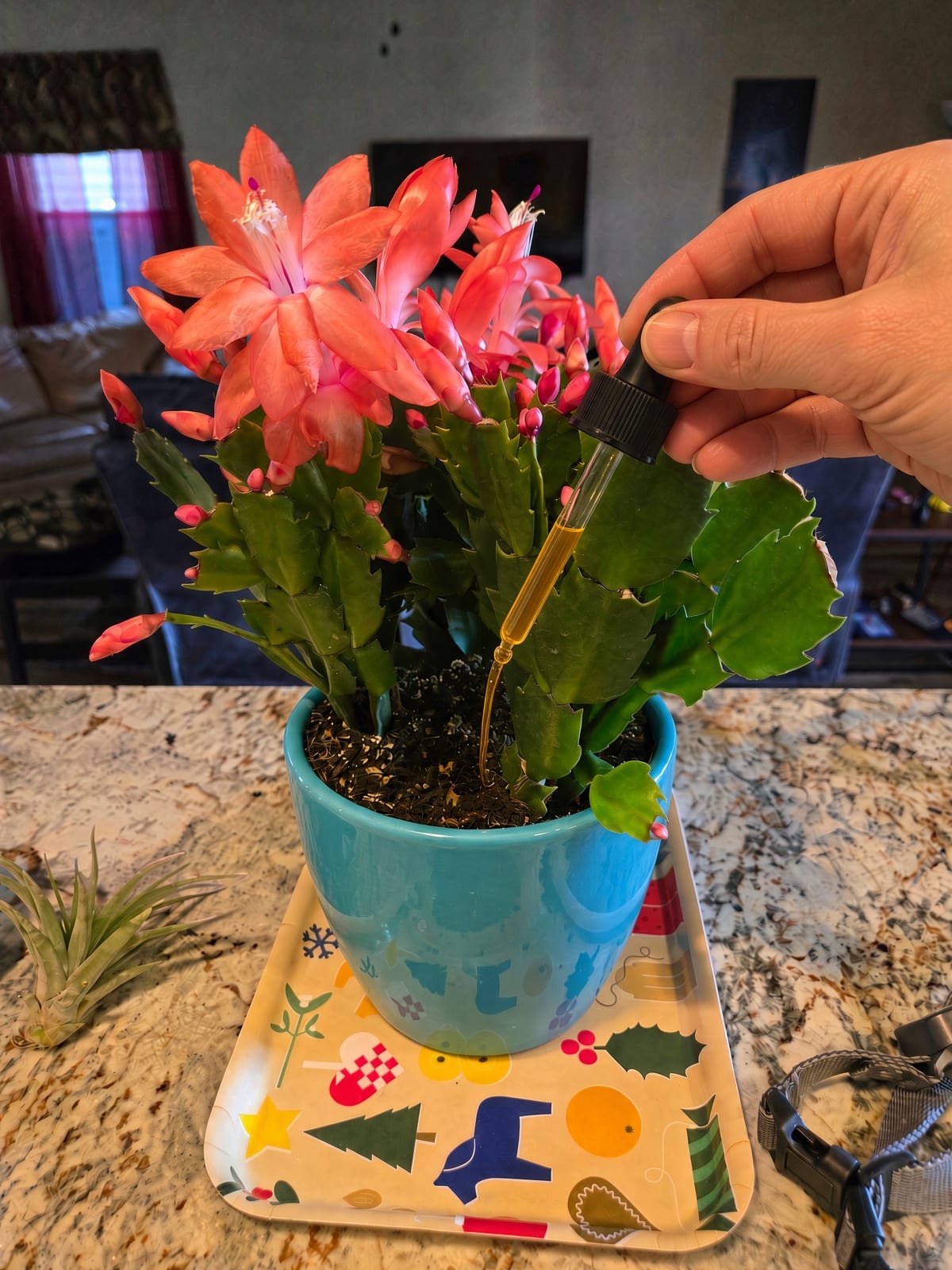
A Thanksgiving Cactus covered in vibrant coral-orange flowers can become one of the most beautiful houseplants in your home. With its glossy green segmented stems, colorful buds, and cascading blooms, this holiday cactus brings warmth and elegance to indoor spaces.
The image shows a flowering Thanksgiving Cactus (Schlumbergera truncata) in a turquoise decorative planter. A glass dropper containing golden liquid is being used near the soil, suggesting a concentrated plant nutrient or liquid fertilizer treatment.
But does golden liquid fertilizer really help a Thanksgiving Cactus produce more flowers?
The answer depends on the fertilizer ingredients, application method, and growing conditions. Proper feeding can support healthy growth and future flowering, but successful blooms also depend on light, temperature, watering, and seasonal bud development.
1. What Is the Golden Liquid Used on Thanksgiving Cactus?
The amber-colored liquid in the dropper resembles a concentrated houseplant fertilizer or liquid plant supplement.
Several gardening products have a similar golden appearance, including:
- Liquid houseplant fertilizers
- Organic liquid plant nutrients
- Seaweed-based plant supplements
- Liquid micronutrient solutions
- Concentrated cactus fertilizers
However, the exact substance cannot be identified from its appearance alone.
Can Golden Liquid Increase Flowering?
A suitable fertilizer helps supply nutrients that support plant health and flower development.
Three important nutrients include:
Nitrogen (N): Supports healthy green stem growth.
Phosphorus (P): Contributes to root function and normal flowering processes.
Potassium (K): Supports water regulation and overall plant health.
A balanced nutrient supply is generally more useful than applying excessive amounts of a single nutrient.
Important: Never apply an unidentified golden liquid or concentrated fertilizer directly to the roots. Always follow the product label and dilute concentrated nutrients when required.
2. Best Fertilizer for Thanksgiving Cactus Blooms
Thanksgiving Cactus is a tropical forest cactus, not a desert cactus. It prefers somewhat different growing conditions from traditional succulents.
Choosing an appropriate fertilizer can help maintain healthy stems and support future blooming.
Balanced Liquid Houseplant Fertilizer
A complete, balanced fertilizer is a reliable option during active growth.
Common examples include:
- 10-10-10 liquid fertilizer
- 20-20-20 water-soluble fertilizer
- Balanced indoor flowering plant fertilizer
Use a diluted solution according to the manufacturer’s directions.
Liquid Cactus Fertilizer
Some commercial cactus fertilizers provide nutrients suitable for Thanksgiving Cactus.
Look for a complete formulation rather than relying only on products marketed as bloom boosters.
Organic Liquid Fertilizer
Organic liquid fertilizers may be suitable when clearly labeled for container-grown houseplants.
Their nutrient concentrations and application requirements vary considerably.
Seaweed-Based Plant Supplements
Seaweed extracts are sometimes marketed for root support and stress management.
However, they should not automatically replace a complete fertilizer.
Fertilizer Comparison
| Fertilizer | Best Use | Main Benefit |
|---|---|---|
| Balanced liquid fertilizer | Active growth | Complete nutrition |
| Liquid cactus fertilizer | Routine feeding | Convenient formulation |
| Organic liquid fertilizer | Container gardening | Alternative nutrient source |
| Seaweed extract | Supplemental care | May provide additional compounds |
| High-phosphorus bloom booster | Specific nutrient needs | Not routinely necessary |
Best choice: A complete liquid houseplant fertilizer, used conservatively during active growth, is usually sufficient.
3. How to Apply Golden Liquid Fertilizer With a Dropper
The image highlights a dropper applying golden liquid close to the potting mix.
A dropper can help measure small quantities of concentrated fertilizer, but the liquid must be used correctly.
Step-by-Step Method
- Check the fertilizer label. Confirm that the product is suitable for indoor flowering plants.
- Measure the recommended amount. Use the dropper only for accurate measuring.
- Dilute the fertilizer. Mix it with water according to the manufacturer’s instructions.
- Check soil moisture. Avoid fertilizing a severely dehydrated plant.
- Apply around the root zone. Pour the diluted solution evenly over the potting mix rather than onto the stems or flowers.
- Allow excess water to drain. Never leave the roots standing in accumulated fertilizer solution.
- Monitor the plant. Watch for unusual yellowing, stem damage, or salt accumulation.
How Often Should You Fertilize?
During spring and summer, Thanksgiving Cactus can generally be fed every two to four weeks with an appropriately diluted fertilizer, depending on the product and growing conditions.
Reduce or stop feeding when growth slows and during the cool, short-day period used to encourage bud formation.
Avoid heavy fertilization while the plant is flowering.
4. Best Potting Soil for Thanksgiving Cactus
Healthy roots are essential for strong growth and reliable flowering.
Unlike desert cacti, Thanksgiving Cactus naturally grows in environments where organic material provides moisture while allowing air to circulate around the roots.
The ideal potting mix should be:
- Loose and airy
- Moderately moisture-retentive
- Well-draining
- Rich in suitable organic material
- Resistant to compaction
Recommended Potting Mix
A practical homemade mixture includes:
- 40% premium indoor potting mix
- 30% fine orchid bark
- 20% perlite or pumice
- 10% coco coir
This combination provides moisture retention without keeping the roots continuously saturated.
Why Orchid Bark Helps
Fine orchid bark creates air spaces and improves drainage.
Why Perlite Matters
Perlite helps reduce compaction and encourages root aeration.
Why Premium Potting Mix Is Useful
A quality indoor potting mix provides a convenient foundation for healthy container growth.
5. How to Encourage More Thanksgiving Cactus Flowers
The beautiful coral-orange flowers in the image are characteristic of a healthy flowering holiday cactus.
However, fertilizer alone cannot guarantee blooms.
Several environmental factors play an important role.
Provide Bright Indirect Light
Place your Thanksgiving Cactus near an east-facing window or another location with bright, filtered light.
Avoid prolonged exposure to intense afternoon sunlight.
Maintain Suitable Temperatures
During active growth, temperatures around 60–75°F (16–24°C) are generally comfortable.
Encourage Seasonal Bud Formation
Thanksgiving Cactus typically develops flower buds when it experiences shorter days and longer uninterrupted nights.
Cooler temperatures, often around 55–65°F (13–18°C), can also encourage bud development.
Avoid Excessive Nitrogen
Too much nitrogen may encourage vegetative growth without improving flowering.
Keep Watering Consistent
Allow the upper portion of the potting mix to become slightly dry before watering again.
Avoid letting the entire root ball remain waterlogged.
Avoid Moving the Plant Frequently
Once buds form, sudden changes in temperature, light, or moisture can contribute to bud drop.
6. Thanksgiving Cactus Watering Guide
Correct watering is one of the most important parts of holiday cactus care.
During Active Growth
Water when the upper inch of potting mix begins to feel dry.
During Bud Formation
Maintain relatively consistent moisture without saturating the roots.
During Flowering
Avoid severe drying or prolonged wetness.
After Flowering
Allow a short period of reduced watering while the plant rests.
Signs of Overwatering
- Soft, weakened stems
- Yellowing segments
- Persistent wet soil
- Unpleasant odor from the root zone
- Root rot
Signs of Underwatering
- Wrinkled segments
- Limp growth
- Excessively dry potting mix
- Reduced vigor
Always adjust watering to the plant’s actual conditions rather than following a rigid calendar.
7. Best Planters for Thanksgiving Cactus
The turquoise ceramic planter in the image creates a beautiful contrast with the coral-orange flowers.
Choosing the right container can improve both appearance and plant health.
Ceramic Planters
Ceramic pots provide an elegant appearance and come in many decorative finishes.
Choose a model with drainage holes or use a separate nursery pot inside a decorative outer container.
Terracotta Pots
Terracotta allows moisture to evaporate through its porous walls, making it useful for gardeners who tend to overwater.
Self-Watering Planters
Some self-watering systems can work, but Thanksgiving Cactus roots should never remain constantly saturated.
Hanging Planters
Hanging baskets allow the segmented stems to cascade naturally.
Premium Decorative Cachepots
Decorative outer planters can create a luxurious display while concealing a practical drainage pot.
8. Common Thanksgiving Cactus Problems and Solutions
| Problem | Possible Cause | Recommended Solution |
|---|---|---|
| Buds falling off | Environmental changes | Stabilize light, temperature, and watering |
| No flowers | Inadequate seasonal cues | Provide cooler conditions and long nights |
| Wrinkled segments | Water stress or root damage | Check soil moisture and roots |
| Yellowing stems | Excess water or nutrient stress | Improve drainage and review feeding |
| Weak growth | Insufficient light or root problems | Provide brighter indirect light |
| White residue on soil | Mineral or fertilizer salts | Review water quality and fertilizer strength |
| Soft stems | Possible root or stem rot | Inspect roots and remove damaged tissue |
Watch for Common Pests
Thanksgiving Cactus may occasionally develop mealybugs, scale insects, or spider mites.
Inspect stem joints regularly.
For infestations, use a houseplant-safe insecticidal soap or another appropriately labeled treatment, following directions carefully.
9. Best Gardening Products for Thanksgiving Cactus
A few well-chosen supplies can make caring for a holiday cactus easier.
Complete Liquid Houseplant Fertilizer
Provides essential nutrients during active growth.
Premium Orchid Bark Potting Mix
Improves aeration when blended with indoor potting soil.
Perlite or Pumice
Supports drainage and healthy root conditions.
Decorative Ceramic Planters
Combine attractive styling with practical container gardening.
Full-Spectrum LED Grow Lights
Useful in homes with limited natural daylight.
Moisture Meters
Can provide an additional reference for soil moisture, although checking the potting mix directly is often more reliable.
Precision Fertilizer Droppers
Useful for measuring small amounts of concentrated liquid fertilizer before dilution.
Indoor Plant Pest Treatments
Help manage common pests when used according to their labels.
10. Luxury Home Decor Ideas With Thanksgiving Cactus
Thanksgiving Cactus is especially attractive during fall and the holiday season.
Its colorful flowers and graceful stems make it a natural decorative centerpiece.
Elegant Holiday Table Centerpiece
Place a flowering Thanksgiving Cactus in a glazed ceramic planter surrounded by neutral candles and seasonal greenery.
Modern Living Room Styling
Pair coral-orange blooms with cream furniture, natural wood, and warm metallic accents.
Luxury Window Display
Arrange several Thanksgiving Cactus plants in coordinated ceramic containers along a bright windowsill.
Thanksgiving Dining Room Decor
Use a flowering cactus as a living alternative to cut flowers.
Designer Plant Stand
Elevate a cascading Thanksgiving Cactus on a minimalist metal or wooden plant stand.
Styling tip: Turquoise, ivory, champagne, and soft gold planters create beautiful contrast with coral, pink, and orange holiday cactus flowers.
11. Thanksgiving Cactus vs. Christmas Cactus
These two popular holiday plants are closely related but have noticeable differences.
| Feature | Thanksgiving Cactus | Christmas Cactus |
|---|---|---|
| Botanical name | Schlumbergera truncata | Schlumbergera × buckleyi |
| Stem edges | Pointed, claw-like projections | Rounded, scalloped edges |
| Typical flowering | Fall to early winter | Winter |
| Flower appearance | Often more upright or outward-facing | Often more pendulous |
| Basic care | Bright indirect light, airy soil | Similar requirements |
The plant in the image has pointed stem segments consistent with Thanksgiving Cactus.
12. Frequently Asked Questions
Does golden liquid fertilizer make Thanksgiving Cactus bloom faster?
A suitable fertilizer supports plant nutrition but does not instantly produce flowers. Blooming depends strongly on seasonal light and temperature conditions.
What is the best fertilizer for Thanksgiving Cactus?
A complete, balanced liquid houseplant fertilizer is usually a practical choice during active growth.
Can I apply fertilizer directly with a dropper?
A dropper can measure concentrated fertilizer, but the product should be diluted as directed before application.
How often should I fertilize Thanksgiving Cactus?
Many growers fertilize every two to four weeks during active growth, adjusting for the fertilizer formulation and plant condition.
Why is my Thanksgiving Cactus not blooming?
Insufficient darkness, warm nights, poor lighting, or inconsistent care can interfere with bud formation.
Can Thanksgiving Cactus grow indoors year-round?
Yes. It is well suited to indoor cultivation when provided with suitable light, temperatures, and moisture.
Should I fertilize when flowers are open?
Heavy feeding is unnecessary during flowering. Focus on stable growing conditions and avoid excessive fertilizer.
Does Thanksgiving Cactus need succulent soil?
It needs a well-draining mixture, but a blend containing organic potting material, orchid bark, and perlite is often more suitable than a very gritty desert cactus mix.
Why are my flower buds falling off?
Sudden temperature changes, inconsistent watering, drafts, or major environmental changes may cause bud drop.
How long do Thanksgiving Cactus flowers last?
Individual flowers commonly last several days, while a healthy plant with many buds may remain colorful for several weeks.
Final Thoughts
A flowering Thanksgiving Cactus is a wonderful way to bring seasonal color and natural elegance into the home.
The golden liquid shown in the image may resemble a concentrated plant fertilizer, but its actual composition cannot be confirmed from appearance alone.
For healthy growth and beautiful future blooms, focus on balanced fertilizer, premium well-draining potting soil, consistent watering, bright indirect light, and the cool, long-night conditions that encourage flower buds.
With the right care, a Thanksgiving Cactus can become a long-lived houseplant that produces beautiful seasonal flowers year after year.