The Spider Plant (Chlorophytum comosum) is one of the most popular indoor houseplants, admired for its long, arching green-and-cream leaves, graceful hanging runners, and clusters of baby plants.
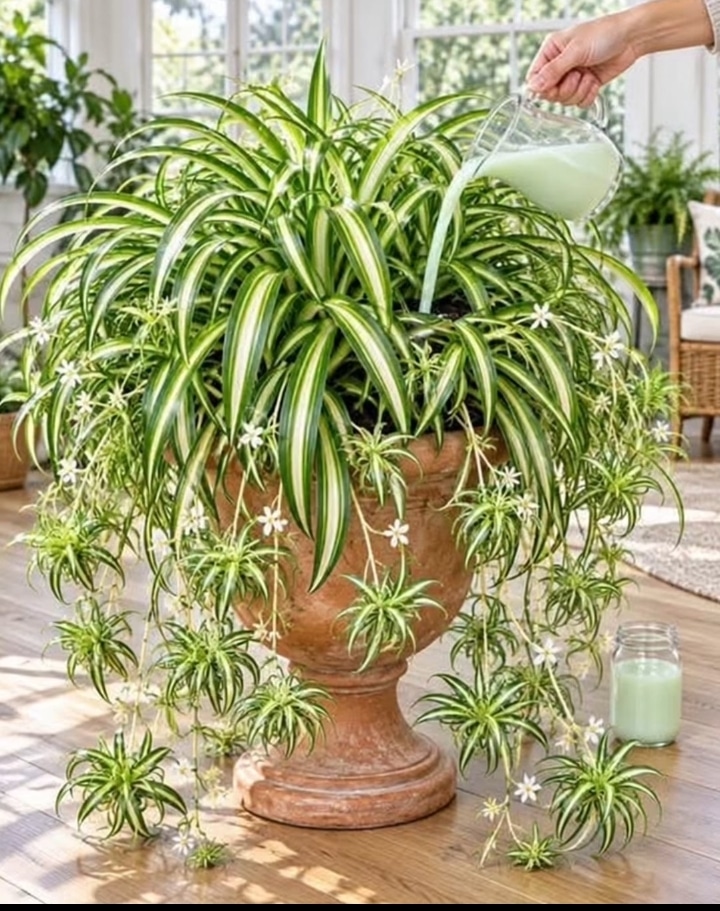
The image shows a spectacular variegated Spider Plant overflowing from a large terracotta-style planter. Its foliage forms a lush fountain of striped leaves, while numerous baby spider plants cascade down the sides alongside delicate white flowers.
A pale, milky-white liquid is being poured into the growing medium.
But can this type of liquid help Spider Plants develop longer leaves and produce more babies?
The answer depends on what the liquid contains. Some gardeners use diluted liquid fertilizer, while others experiment with rice water or other homemade mixtures. However, not every milky liquid is beneficial, and some can damage roots or encourage unwanted microbial growth.
This guide explains the best fertilizers for Spider Plants, safe feeding methods, premium potting mixes, and practical ways to encourage healthy runners and spiderettes.
1. What Is the Milky White Liquid Used on Spider Plants?
The pale liquid shown in the image cannot be identified by appearance alone.
Several gardening mixtures may look similar.
Diluted Liquid Houseplant Fertilizer
Some liquid plant foods become cloudy when mixed with water.
A properly diluted complete fertilizer can provide essential nutrients that support leaf growth and overall plant health.
Rice Water
Water used to rinse or cook plain rice may appear milky because it contains suspended starch.
Although rice water is sometimes promoted as a homemade plant tonic, there is limited reliable evidence that it improves Spider Plant growth.
Starchy water may also encourage microbial growth, odors, or fungus gnats when used excessively.
Homemade Organic Plant Tonics
Certain homemade mixtures contain suspended organic ingredients that create a cloudy appearance.
Their nutrient content is unpredictable, making them less reliable than labeled houseplant fertilizers.
Important Safety Note
Never pour unidentified liquids onto your Spider Plant.
Avoid using milk, sugary mixtures, or concentrated homemade solutions as fertilizer substitutes. These can create unpleasant odors and undesirable growing conditions.
For consistent results, use a complete houseplant fertilizer according to its label.
2. Best Fertilizer for Spider Plant Growth
Spider Plants are relatively light feeders. They generally grow well with modest amounts of fertilizer during active growth.
Overfertilizing can cause brown leaf tips, salt buildup, and root damage.
Balanced Liquid Houseplant Fertilizer
A balanced liquid fertilizer is one of the easiest options for indoor Spider Plants.
Suitable formulations may include:
- 10-10-10 liquid fertilizer
- 20-20-20 water-soluble fertilizer
- Complete indoor foliage plant food with micronutrients
The numbers represent nitrogen, phosphorus, and potassium.
Organic Liquid Fertilizer
Commercial organic fertilizers can supply nutrients, although their release rates depend on their ingredients.
Slow-Release Fertilizer
Controlled-release granules offer convenient feeding over several months.
Use only the recommended quantity for the pot size.
Fertilizer Comparison
| Fertilizer Type | Main Benefit | Best Use |
|---|---|---|
| Balanced liquid fertilizer | Convenient complete nutrition | Active growth |
| Water-soluble fertilizer | Adjustable concentration | Diluted feeding |
| Organic houseplant fertilizer | Alternative nutrient source | Routine care |
| Controlled-release granules | Extended nutrient supply | Established plants |
| Rice water | Uncertain nutritional benefit | Not a fertilizer replacement |
Best overall choice: A complete liquid houseplant fertilizer with micronutrients, used at the manufacturer’s recommended strength.
3. How to Apply Liquid Fertilizer Safely
Proper feeding supports healthy foliage without overwhelming the root system.
Step 1: Inspect the Plant
Check the leaves, roots, and growing medium.
Avoid fertilizing a severely stressed plant until the underlying problem has been addressed.
Step 2: Check Soil Moisture
The soil should not be completely waterlogged.
Step 3: Prepare the Fertilizer
Measure and dilute a labeled houseplant fertilizer according to the manufacturer’s instructions.
Step 4: Apply to the Soil
Pour the solution slowly around the growing medium rather than directly into the center of the foliage.
Step 5: Allow Drainage
Let excess liquid drain completely.
Never allow the decorative planter to hold standing water around the roots.
Step 6: Observe New Growth
Healthy new leaves and steady runner development are useful signs of favorable growing conditions.
Remember that fertilizer does not cause an instant transformation. Leaf growth and spiderette production occur gradually.
4. Best Potting Soil for Spider Plants
A good Spider Plant potting mix should retain moderate moisture while allowing air to reach the roots.
Spider Plants develop thick, fleshy roots that can store water.
However, these roots can still suffer in constantly saturated soil.
Recommended Spider Plant Potting Mix
A practical mixture is:
- 60% premium indoor potting mix
- 25% perlite
- 15% fine orchid bark or pumice
This combination provides a balance of moisture retention and drainage.
Why Perlite Helps
Perlite improves aeration and reduces soil compaction.
Why Orchid Bark Is Useful
Fine orchid bark creates additional air spaces within the growing medium.
Why Premium Potting Soil Matters
Quality potting mixes offer consistent texture and may contain starter nutrients.
Avoid dense garden soil in indoor containers.
5. How to Grow Longer, Fuller Spider Plant Leaves
The long, arching leaves in the image are a defining feature of a mature Spider Plant.
To encourage healthy foliage, focus on light, moisture, nutrition, and root space.
Provide Bright Indirect Light
Place your Spider Plant near a bright window with filtered sunlight.
Too little light can slow growth and reduce variegation.
Excessive direct sunlight can scorch the foliage.
Water Consistently
Water when the upper 1–2 inches of potting mix feel dry, adjusting for container size and indoor conditions.
Feed During Active Growth
Use a balanced fertilizer moderately during spring and summer or whenever the plant is actively growing.
Maintain Comfortable Temperatures
Spider Plants generally prefer temperatures around 60–80°F (16–27°C).
Avoid Severe Root Crowding
Spider Plants tolerate somewhat snug containers, but extreme root crowding can limit water availability and growth.
Repot when roots become excessively crowded or watering becomes difficult.
Remove Damaged Leaves
Trim brown tips or severely damaged foliage with clean scissors.
Existing leaves will not repair damaged tissue, but healthy new leaves can improve the plant’s overall appearance.
6. How to Encourage More Spider Plant Babies
Spider Plant babies, also called spiderettes or plantlets, develop on long flowering stems known as runners.
A mature, healthy Spider Plant may produce many runners under favorable conditions.
Give the Plant Enough Light
Bright indirect light helps support active growth.
Allow the Plant to Mature
Young Spider Plants may need time before producing flowering stems and baby plants.
Avoid Excessive Nitrogen
Heavy nitrogen feeding can favor foliage growth without necessarily improving runner production.
Maintain Consistent Care
Avoid repeated drought stress, overwatering, and major temperature fluctuations.
Understand Daylength
Spider Plant flowering and runner development can respond to daylength, although the response varies by cultivar and growing conditions.
Don’t Expect Fertilizer Alone to Create Babies
Fertilizer supports general growth but cannot guarantee spiderette production.
Plant maturity, genetics, lighting, and environmental conditions are also important.
7. How to Propagate Spider Plant Babies
One of the greatest advantages of Spider Plants is their easy propagation.
Method 1: Rooting Babies in Water
- Select a healthy spiderette with small root initials.
- Cut it from the runner using clean scissors.
- Place the base in a small glass of water.
- Keep the leaves above the waterline.
- Position it in bright indirect light.
- Change the water regularly.
- Transfer it to potting mix once suitable roots develop.
Method 2: Rooting Babies in Soil
- Fill a small pot with lightly moist potting mix.
- Position the spiderette against the soil surface.
- Secure it gently if necessary.
- Keep the medium slightly moist.
- Allow roots to establish.
- Separate it from the parent runner if it is still attached.
Soil propagation is convenient because it avoids an additional transition from water to potting mix.
8. Why Do Spider Plant Leaves Develop Brown Tips?
Brown tips are a common concern, even on otherwise healthy plants.
Possible causes include:
- Fertilizer salt buildup
- Inconsistent watering
- Low humidity
- Mineral accumulation
- Fluoride sensitivity
- Excessive direct sunlight
- Root stress
How to Reduce Brown Tips
Use a balanced fertilizer without exceeding the recommended dose.
If your tap water has high mineral content, consider rainwater or suitable filtered water.
Flush the growing medium occasionally when appropriate, allowing water to drain freely.
Avoid leaving fertilizer residue in the pot.
Trim damaged tips for appearance, following the natural shape of the leaf.
9. Best LED Grow Lights for Spider Plants
Spider Plants can adapt to a range of indoor lighting conditions, but growth may slow in darker rooms.
A full-spectrum LED grow light can help maintain healthier foliage.
Features Worth Considering
Look for:
- Full-spectrum LED output
- Adjustable brightness
- A programmable timer
- Low heat emission
- Suitable coverage for larger plants
A daily lighting period of approximately 10–12 hours can be a starting point for supplemental lighting, depending on intensity and existing daylight.
Follow the manufacturer’s placement recommendations.
10. Choosing the Best Planter for Spider Plants
The impressive planter shown in the image creates an elegant cascading display.
However, decorative appearance should not come at the expense of root health.
Terracotta Planters
Terracotta is porous and allows moisture to evaporate more readily.
It works particularly well for gardeners who tend to overwater.
Ceramic Planters
Glazed ceramic pots provide a refined appearance but may retain moisture longer.
Hanging Planters
Hanging baskets allow runners and baby plants to cascade naturally.
Self-Watering Planters
These may be convenient when properly managed, but the growing medium should not remain continuously saturated.
Large Decorative Urns
A mature Spider Plant can look spectacular in a statement urn.
Choose a container with adequate drainage, or keep the plant in a separate draining nursery pot inside the urn.
11. Common Spider Plant Problems and Solutions
| Problem | Possible Cause | Recommended Solution |
|---|---|---|
| Brown leaf tips | Salts, water quality, or stress | Review water and feeding |
| Yellow leaves | Excess moisture or aging | Check soil and roots |
| Pale foliage | Low light or nutrient issues | Improve growing conditions |
| No baby plants | Immaturity or environmental factors | Maintain consistent care |
| Drooping leaves | Water stress | Check soil moisture |
| Slow growth | Low light or cool temperatures | Improve growing environment |
| Soft roots | Excessive moisture | Repot into fresh, airy soil |
| Brown leaf patches | Sun scorch | Reduce direct sunlight |
Pest Control
Spider Plants may occasionally develop spider mites, mealybugs, or scale insects.
Inspect the undersides of leaves and the base of the plant.
If treatment is necessary, use a pest-control product labeled for indoor ornamental plants and follow its instructions.
12. Luxury Indoor Decor With Cascading Spider Plants
A mature Spider Plant can become an impressive architectural feature in a well-designed interior.
The plant in the image demonstrates how long striped foliage and cascading runners can create a dramatic natural display.
Statement Terracotta Urn
Place a large Spider Plant in a decorative terracotta urn beside a bright living room window.
Luxury Conservatory Styling
Combine Spider Plants with premium ceramic planters, natural wood furniture, and neutral fabrics.
Elevated Plant Stand
Use a tall stand to give the hanging runners enough room to develop.
Modern Minimalist Interior
Choose a matte white or charcoal planter to highlight the plant’s green-and-cream variegation.
Elegant Sunroom Display
Position a mature Spider Plant near filtered natural light, allowing its leaves and spiderettes to form a flowing arrangement.
Design tip: For a fuller appearance, group several established Spider Plants in a sufficiently large, well-draining container rather than relying on fertilizer to create instant growth.
13. Frequently Asked Questions
What is the milky white liquid used on Spider Plants?
It may resemble diluted fertilizer, rice water, or another homemade mixture. Its exact composition cannot be determined from the image.
Is rice water good for Spider Plants?
Rice water has limited evidence of benefit and may encourage microbial growth. A complete houseplant fertilizer is a more reliable nutrient source.
Can milky liquid make Spider Plants grow faster?
Appropriate nutrition can support growth, but no unidentified liquid can guarantee faster development.
What is the best fertilizer for Spider Plants?
A balanced, complete liquid houseplant fertilizer with micronutrients is a practical option.
How do I encourage more Spider Plant babies?
Provide bright indirect light, allow the plant to mature, and maintain consistent watering and nutrition.
How often should I fertilize a Spider Plant?
Follow the fertilizer label and adjust according to the plant’s growth and season.
Why is my Spider Plant not producing runners?
It may be immature, receiving insufficient light, or growing under conditions that do not favor flowering and runner development.
What is the best soil for Spider Plants?
A well-draining indoor potting mix amended with perlite and other aerating materials works well.
Can Spider Plants grow in large decorative pots?
Yes, but the container should provide adequate drainage and should not be excessively large for the root system.
Are Spider Plants safe for cats and dogs?
Spider Plants are generally considered non-toxic to cats and dogs, although chewing plant material may still cause mild digestive upset.
How long does it take Spider Plant babies to root?
Healthy spiderettes often begin establishing roots within a few weeks under suitable conditions.
Can Spider Plants flower indoors?
Yes. Mature plants may produce small white flowers along their runners when growing conditions are favorable.
Final Thoughts
Spider Plants are beautiful, adaptable houseplants that can produce long striped leaves, delicate white flowers, and numerous hanging baby plants.
Although the milky-white liquid shown in the image may look like a special gardening treatment, its identity and effectiveness cannot be confirmed from appearance alone.
For reliable results, focus on balanced Spider Plant fertilizer, premium well-draining potting soil, bright indirect light, consistent watering, and proper planter drainage.
With time and good care, a mature Spider Plant can develop into an impressive cascading centerpiece, bringing natural beauty to a living room, sunroom, or luxury indoor garden.