A healthy Christmas Cactus can transform an ordinary windowsill, patio, or living room into a beautiful display of cascading greenery and colorful seasonal flowers. With its distinctive segmented stems, graceful arching branches, and spectacular winter blooms, this tropical cactus has become one of the most popular flowering houseplants.
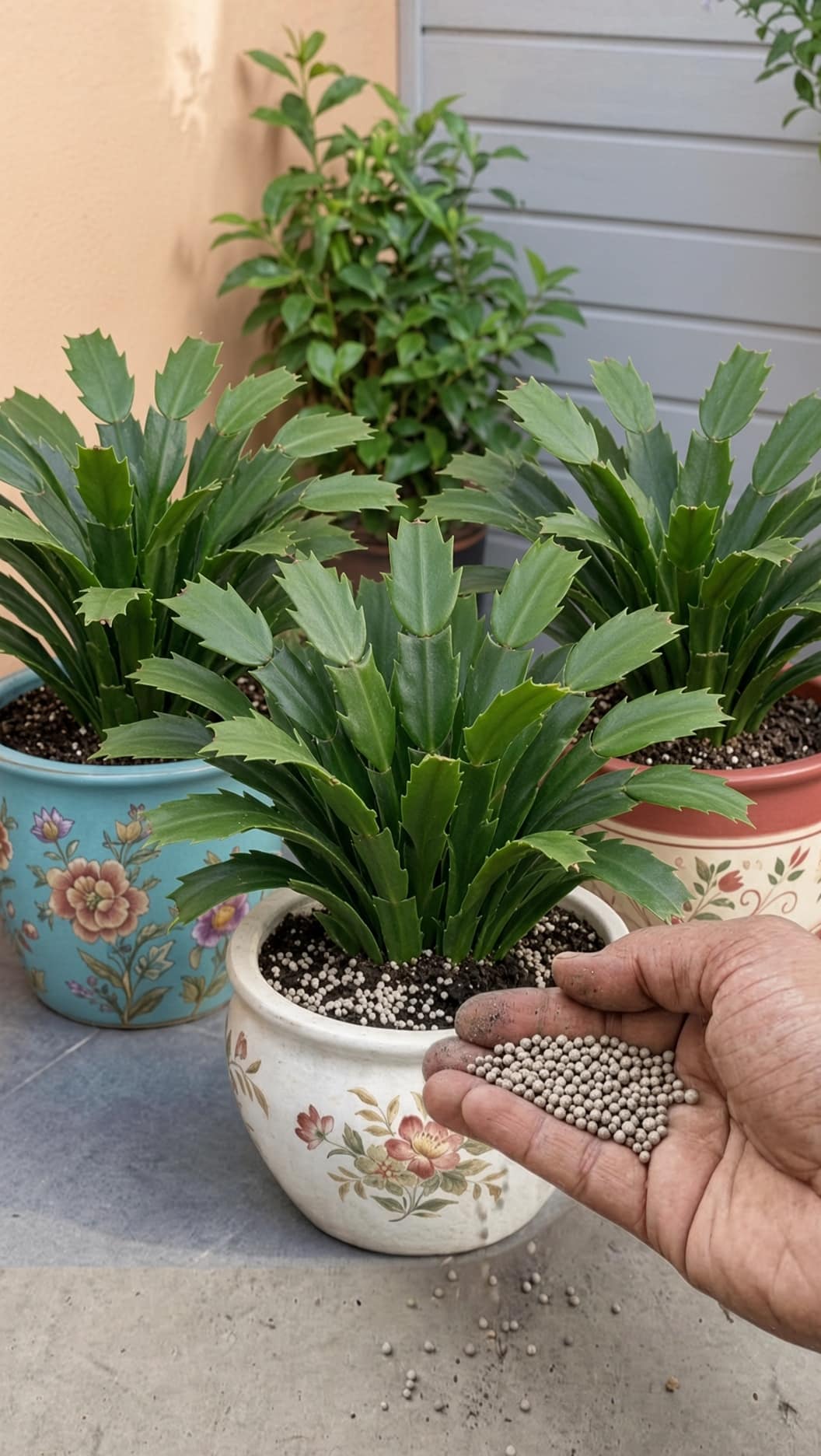
The image shows three lush Christmas Cactus-type plants growing in decorative ceramic containers. Each plant has numerous flat, green, segmented stems with pointed edges, forming a dense, upright-to-arching canopy.
In the foreground, a gardener holds a handful of small white fertilizer-like granules. Similar granules are visible across the surface of the potting mix.
This scene illustrates a common gardening technique: applying granular nutrients around the root zone of a flowering cactus.
But an important question remains: Can white slow-release fertilizer granules help a Christmas Cactus develop stronger roots, produce more branches, and bloom more beautifully?
The answer depends on the fertilizer formulation, dosage, soil conditions, light exposure, and overall plant health.
When properly selected and applied, a suitable fertilizer can support healthy growth and flowering. However, excessive fertilizer can damage roots, increase salt accumulation, and reduce plant performance.
This complete guide explains how to choose the best Christmas Cactus fertilizer, apply granular nutrients safely, improve root development, select premium potting soil, encourage seasonal flowering, and create beautiful indoor and outdoor decorative arrangements.
1. Understanding the Christmas Cactus
Christmas Cactus belongs to the genus Schlumbergera, a group of tropical epiphytic cacti native to Brazil.
Unlike desert cacti, these plants naturally grow in humid forest environments, often in organic material collected around tree branches and rocky surfaces.
They are adapted to bright filtered light, good root aeration, and periodic moisture.
Christmas Cactus vs. Thanksgiving Cactus
The plants in the photograph have sharply pointed segment margins, suggesting they may be Thanksgiving Cactus (Schlumbergera truncata) or related hybrids rather than the traditional Christmas Cactus (Schlumbergera × buckleyi).
Both are commonly marketed as Christmas Cactus and have broadly similar care requirements.
Traditional Christmas Cactus generally has more rounded segment edges, while Thanksgiving Cactus has more prominent pointed projections.
The exact species or hybrid cannot be confirmed from the image alone.
Main Characteristics
- Flat, jointed green stems
- Arching or cascading growth
- Seasonal flower buds
- Pink, red, white, purple, or orange flowers
- Relatively shallow root systems
- Preference for well-draining organic potting media
- Sensitivity to prolonged waterlogging
- Long lifespan under suitable conditions
Mature plants can become impressive hanging baskets or large flowering specimens.
2. What Are the White Granules in the Image?
The photograph shows a gardener holding small, pale, spherical granules above the potting medium.
These resemble commercially available granular fertilizer pellets or other horticultural amendments.
However, their exact composition cannot be identified visually.
Possible materials include controlled-release fertilizer, mineral soil amendments, or decorative horticultural granules.
The appearance of white granules does not prove they contain fertilizer or reveal their nutrient concentration.
Before applying any product, identify it from its packaging and instructions.
Why Controlled-Release Fertilizer Is Popular
Certain controlled-release fertilizers deliver nutrients gradually through specially formulated coatings.
Nutrient release depends on the product and environmental conditions.
This approach can reduce the need for frequent liquid feeding.
However, it does not eliminate the possibility of overfertilization.
3. Quick Answer: Best Fertilizer for Christmas Cactus
A balanced, complete fertilizer used moderately during active growth is generally suitable for Christmas Cactus.
The most important characteristics are:
- Complete nutrient composition
- Appropriate concentration
- Compatibility with container-grown flowering plants
- Safe application instructions
- Controlled salt accumulation
- Suitable feeding intervals
A fertilizer labeled for flowering houseplants, epiphytic cacti, or general container plants may be appropriate.
Specialized bloom fertilizers are not automatically better than balanced fertilizers.
The plant’s actual nutrient requirements matter more than marketing claims.
4. How Fertilizer Supports Christmas Cactus Growth
Christmas Cactus requires essential nutrients for healthy stem development, root function, and flowering.
Nitrogen: Supporting Green Stem Growth
Nitrogen contributes to chlorophyll production and normal tissue development.
Adequate nitrogen helps maintain healthy green segments.
Excessive nitrogen may encourage vegetative growth without improving flowering.
Phosphorus: Supporting Energy Transfer
Phosphorus contributes to important metabolic processes, including energy transfer and normal root development.
Additional phosphorus is not necessarily beneficial when the potting medium already contains enough.
Potassium: Supporting Plant Function
Potassium helps regulate water balance and supports normal plant metabolism.
Calcium and Magnesium
Calcium contributes to cellular structure, while magnesium is essential for chlorophyll.
Micronutrients
Iron, manganese, zinc, boron, and other micronutrients are needed in small amounts.
A complete fertilizer can help supply these elements.
5. Slow-Release Granular Fertilizer vs. Liquid Fertilizer
Both options can work well for Christmas Cactus.
| Fertilizer type | Advantages | Important considerations |
|---|---|---|
| Controlled-release granules | Gradual nutrient delivery | Release varies with conditions |
| Liquid houseplant fertilizer | Easy dosage adjustment | Requires repeat applications |
| Organic granular fertilizer | Alternative nutrient source | Nutrient availability varies |
| Water-soluble fertilizer | Flexible feeding | Can accumulate salts |
| Flowering plant fertilizer | Convenient formulation | High phosphorus is not always needed |
Which Fertilizer Is Best?
For gardeners who prefer control over feeding concentration, a diluted liquid fertilizer can be convenient.
For established plants in stable conditions, a suitable controlled-release fertilizer may simplify maintenance.
Neither method guarantees flowering.
6. How to Apply White Granular Fertilizer Safely
The photograph shows white granules being distributed around the root zone.
This technique is called top-dressing when a product is applied to the soil surface.
Step 1: Inspect the Plant
Check the stems for firmness and healthy color.
Avoid feeding plants with suspected root rot or severe environmental stress.
Step 2: Identify the Fertilizer
Read the package label.
Confirm the product is suitable for flowering houseplants or container plants.
Step 3: Check the Recommended Dosage
Use the manufacturer’s instructions for the pot size and growing conditions.
Do not copy the amount shown in a photograph.
Step 4: Examine the Potting Mix
Make sure the soil is not waterlogged or severely compacted.
Step 5: Apply the Granules Evenly
If surface application is permitted, distribute the measured amount across the recommended soil area.
Keep granules away from concentrated contact with stems.
Step 6: Avoid the Plant Crown
Do not pile fertilizer against the base of the stems.
Step 7: Water According to Instructions
Some controlled-release fertilizers require watering after application.
Follow the specific product directions.
Step 8: Monitor Plant Response
Observe stem condition, new growth, and signs of fertilizer stress.
Step 9: Wait Before Reapplying
Respect the manufacturer’s feeding interval.
Step 10: Adjust for Seasonal Growth
Reduce feeding when the plant is not actively growing.
7. Why Too Much Fertilizer Can Harm Christmas Cactus
Christmas Cactus has roots that can be damaged by excessive soluble salts.
Overfertilization can interfere with water uptake and contribute to root injury.
Warning Signs
- Brown stem edges
- Weak or distorted growth
- Sudden segment drop
- Poor root development
- White mineral crust on the soil
- Unexplained decline after feeding
These symptoms are not exclusive to fertilizer damage.
What to Do
Stop fertilizing.
Inspect the roots and potting medium.
Check drainage and watering practices.
If excessive salts are suspected, corrective watering or repotting may be appropriate depending on the plant’s condition.
8. Best Soil for Christmas Cactus: The Foundation of Healthy Roots
Christmas Cactus does not naturally grow in the same conditions as many desert cacti.
It prefers a potting medium that combines moisture retention with excellent aeration.
Ideal Soil Characteristics
- Loose structure
- Reliable drainage
- Moderate moisture retention
- Organic components
- Good oxygen availability
- Resistance to compaction
Recommended Potting Mix
A practical starting mixture includes:
- Two parts quality houseplant potting mix
- One part fine orchid bark
- One part perlite or pumice
Adjust the blend according to the moisture-retention properties of the ingredients and the local growing environment.
Why Orchid Bark Helps
Fine orchid bark creates air spaces and adds structure.
Why Perlite Is Useful
Perlite improves drainage and aeration.
Why Organic Matter Matters
Organic components help retain enough moisture for the roots between waterings.
9. Premium Potting Soil Mixes Compared
| Soil component | Main benefit | Potential limitation |
|---|---|---|
| Premium indoor potting mix | Balanced moisture retention | May need added aeration |
| Fine orchid bark | Improves structure | Breaks down over time |
| Perlite | Creates air spaces | May float upward |
| Pumice | Long-lasting aeration | Adds weight |
| Coco coir | Retains moisture | Can stay too wet if excessive |
| Compost | Adds organic material | Must be used carefully |
| Coarse horticultural sand | Mineral structure | Fine sand may compact |
Best Overall Approach
Use a well-aerated potting mix that retains moderate moisture without remaining saturated.
Avoid relying on dense garden soil in containers.
10. How Soil Drainage Affects Christmas Cactus Roots
Christmas Cactus roots need both moisture and oxygen.
When the potting medium stays saturated for extended periods, oxygen availability decreases.
This can damage roots and create conditions favorable to rot.
Signs of Poor Drainage
- Soil stays wet for too long
- Stems become limp
- Roots darken or soften
- Growth slows
- Segments detach unexpectedly
How to Improve Drainage
Use containers with drainage holes.
Choose an airy potting medium.
Avoid oversized pots.
Empty drainage saucers.
Check moisture before watering.
11. How to Water Christmas Cactus Correctly
Christmas Cactus requires a different watering approach from drought-adapted desert cacti.
It generally prefers more regular moisture during active growth.
However, its roots should never remain waterlogged.
Recommended Watering Method
Allow the upper portion of the potting medium to dry before watering again.
When watering, thoroughly moisten the mix until excess water drains away.
Discard standing water.
Spring and Summer
Water according to active growth, light, and temperature.
Autumn
Monitor moisture carefully as growth and bud development change.
Winter
Adjust watering according to flowering and indoor conditions.
Important Rule
Do not follow a rigid watering calendar without checking the actual soil moisture.
12. Why Christmas Cactus Segments Become Limp
Limp stems can indicate several problems.
Underwatering
Prolonged dryness can reduce stem firmness.
Overwatering
Damaged roots may struggle to absorb water.
Root Rot
Root decay can cause severe wilting.
Excessive Heat
High temperatures can increase water stress.
Fertilizer Injury
Excessive salts can interfere with water uptake.
How to Diagnose the Problem
Check the moisture level.
Inspect roots when necessary.
Evaluate light and temperature.
Avoid automatically adding more water or fertilizer.
13. Best Light for Christmas Cactus
Christmas Cactus performs well in bright, filtered light.
Unlike many desert cacti, it does not generally require intense direct sunlight throughout the day.
Bright Indirect Light
A bright window is often suitable.
Morning Sun
Gentle morning sunlight can be beneficial.
Strong Afternoon Sun
Intense sunlight may scorch the segments.
Low Light
Insufficient light can reduce growth and flowering performance.
Outdoor Placement
Choose a protected location with bright shade or filtered sunlight.
14. How to Encourage Fuller Christmas Cactus Growth
The plants in the photograph have dense clusters of green segments.
This full appearance develops through branching and healthy new growth.
Provide Adequate Light
Bright filtered light supports normal development.
Maintain Healthy Roots
Healthy roots support new stem production.
Fertilize Moderately
Nutrients can support growth when needed.
Prune After Flowering
Removing selected terminal segments can encourage branching.
Avoid Excessive Watering
Waterlogged roots can reduce growth.
Allow Time
A fuller plant develops over multiple growing periods.
15. How to Prune Christmas Cactus for More Branches
Pruning is one of the most useful methods for improving plant shape.
When to Prune
Pruning is often performed after flowering, when active growth is expected to resume.
Step 1: Inspect the Plant
Identify long, uneven branches.
Step 2: Choose a Segment Joint
Christmas Cactus stems consist of connected segments.
Step 3: Remove Selected Segments
Gently twist off one or two segments at a joint or use clean tools.
Step 4: Maintain Balance
Avoid removing too much growth at once.
Step 5: Allow New Branches to Develop
Additional growth may emerge from the remaining segments.
Step 6: Maintain Good Care
Provide appropriate light, moisture, and nutrition.
16. How to Make Christmas Cactus Bloom
Christmas Cactus flowering is strongly influenced by environmental conditions.
Fertilizer supports plant health, but it is not the primary trigger for flower bud formation.
Important Blooming Factors
- Adequate plant maturity
- Suitable light exposure
- Seasonal night length
- Appropriate temperatures
- Stable watering
- Healthy roots
Short-Day Conditions
Many Schlumbergera varieties initiate buds when exposed to sufficiently long, uninterrupted nights.
Cooler Temperatures
Cooler conditions can also promote bud development in some cultivars.
Avoid Excessive Night Lighting
Bright artificial light during the night may interfere with bud initiation.
Maintain Stable Conditions
Once buds form, avoid abrupt changes in temperature, watering, and placement.
17. Christmas Cactus Flower Bud Development
Flower buds usually appear near the ends of mature stem segments.
Early Stage
Small buds begin forming.
Development Stage
Buds enlarge and become more noticeable.
Color Development
The buds gradually show their mature flower color.
Flower Opening
The flowers open when conditions are suitable.
Flowering Duration
Individual flowers may last several days, while the overall blooming period can extend longer.
Does Fertilizer Make Buds Open Faster?
Not reliably.
Bud development depends on environmental and physiological factors.
18. Why Christmas Cactus Drops Flower Buds
Bud drop is a common frustration.
Possible Causes
- Sudden temperature changes
- Excessively dry soil
- Waterlogged roots
- Abrupt relocation
- Environmental stress
- Insufficient light
- Root damage
How to Prevent Bud Drop
Keep growing conditions stable.
Avoid unnecessary movement.
Water appropriately.
Protect the plant from drafts and temperature extremes.
Do not overfertilize during bud development.
19. Best Temperature for Christmas Cactus
Christmas Cactus prefers moderate temperatures.
Active Growth
Comfortable indoor temperatures are generally suitable.
Bud Formation
Cooler nighttime conditions can help encourage flowering.
Cold Protection
Protect the plant from freezing temperatures.
Heat Stress
Excessive heat can cause dehydration and interfere with flowering.
Indoor Temperature Stability
Avoid placing the plant directly beside heating vents, fireplaces, or cold drafts.
20. How to Repot Christmas Cactus
Christmas Cactus does not require frequent repotting.
Many specimens flower well when moderately root-bound.
Signs Repotting May Be Needed
- Severely degraded soil
- Poor drainage
- Root disease
- Excessive root crowding
- Unstable container
- Persistent moisture problems
Repotting Steps
- Choose a container with drainage holes.
- Prepare an airy potting mix.
- Carefully remove the plant.
- Inspect the root system.
- Remove damaged roots if necessary.
- Position the plant at the correct depth.
- Fill around the roots.
- Water appropriately according to root condition.
- Allow the plant to recover.
Best Time
Repotting is generally easiest after flowering or during the beginning of active growth.
21. Ceramic vs. Terracotta vs. Plastic Planters
The photograph features attractive ceramic containers decorated with floral patterns.
These planters can make Christmas Cactus especially appealing in decorative settings.
| Planter type | Advantages | Considerations |
|---|---|---|
| Glazed ceramic | Elegant appearance | May retain moisture longer |
| Terracotta | Porous and traditional | Dries faster |
| Plastic | Lightweight and affordable | Moisture retention varies |
| Hanging basket | Displays cascading stems | May dry more quickly |
| Premium resin | Decorative and lightweight | Requires drainage |
Choosing the Best Pot
Drainage and appropriate size are more important than appearance alone.
Decorative outer containers should not trap standing water around the roots.
22. How to Propagate Christmas Cactus From Cuttings
Christmas Cactus is relatively easy to propagate.
Step 1: Select a Healthy Stem
Choose a firm, mature stem.
Step 2: Remove Several Segments
A cutting containing two or three connected segments is often suitable.
Step 3: Allow the Cut Surface to Dry
Let the cutting dry briefly in a shaded location.
Step 4: Prepare the Potting Medium
Use an airy, lightly moist propagation mix.
Step 5: Insert the Cutting
Place the base shallowly into the medium.
Step 6: Provide Bright Indirect Light
Avoid harsh direct sunlight.
Step 7: Maintain Moderate Moisture
Do not saturate the growing medium.
Step 8: Wait for Root Formation
Roots may develop over several weeks.
23. Rooting Powder vs. Natural Propagation
Commercial rooting hormones are sometimes used for houseplant propagation.
However, Christmas Cactus cuttings often root successfully without them.
| Method | Benefit | Consideration |
|---|---|---|
| Natural propagation | Simple and inexpensive | Requires appropriate conditions |
| Rooting powder | May help some cuttings | Not usually essential |
| Rooting gel | Convenient application | Follow instructions |
| Water propagation | Easy to observe roots | Transfer requires care |
Best Recommendation
Start with healthy cuttings and a suitable growing medium.
Rooting hormone is optional rather than mandatory.
24. Christmas Cactus Root Rot: Causes and Treatment
Root rot can develop when the potting medium remains excessively wet.
Common Causes
- Poor drainage
- Overwatering
- Compacted soil
- Containers without drainage holes
- Excessive pot size
- Root pathogens
Warning Signs
- Limp segments
- Dark or mushy roots
- Weak growth
- Stem base deterioration
- Unpleasant soil odor
Treatment
Remove the plant carefully.
Inspect the roots.
Trim rotten tissue with clean tools.
Repot in fresh, suitable medium if enough healthy roots remain.
Reduce excessive moisture.
For severe cases, healthy stem cuttings may be the best way to preserve the plant.
25. Common Christmas Cactus Pests
Christmas Cactus can attract several houseplant pests.
Mealybugs
Appear as white cotton-like clusters.
Scale Insects
Attach to stems and feed on plant sap.
Spider Mites
May cause fine stippling and webbing.
Fungus Gnats
Often associated with persistently moist potting media.
Pest Management
Inspect plants regularly.
Isolate affected specimens.
Remove pests manually when practical.
Use appropriate insecticidal soap or horticultural oil according to the label.
Test treatments on a small area first.
26. Why Christmas Cactus Turns Red or Purple
Reddish or purplish segments can develop in response to environmental conditions.
Possible Causes
- Strong sunlight
- Temperature stress
- Nutrient imbalance
- Water stress
- Natural pigmentation
What to Do
Evaluate the overall growing environment.
Move the plant away from excessive direct sunlight if scorching is suspected.
Check watering and root health.
Do not automatically apply more fertilizer.
27. Why Christmas Cactus Segments Turn Yellow
Yellowing segments may indicate stress.
Common Causes
- Excessive watering
- Root damage
- Strong sunlight
- Nutrient problems
- Natural aging
- Pest infestation
Recommended Action
Inspect the soil and roots.
Check light exposure.
Look for pests.
Correct the underlying problem rather than treating yellowing as proof of nutrient deficiency.
28. Professional LED Grow Lights for Christmas Cactus
Supplemental lighting can be useful in rooms with insufficient natural light.
Benefits
- More consistent light exposure
- Flexible indoor placement
- Support for healthy vegetative growth
- Useful during darker months
Important Considerations
Christmas Cactus flowering can depend on uninterrupted darkness.
An LED grow light left on late into the night may interfere with bud formation.
Choosing a Grow Light
Consider light intensity, coverage, efficiency, adjustable height, and timer functionality.
A timer can help maintain a predictable light schedule.
29. Best Indoor Placement for Christmas Cactus
Christmas Cactus is an attractive choice for bright indoor spaces.
Living Room Windows
A bright window with filtered light can be suitable.
Sunrooms
Sunrooms often provide excellent growing conditions when temperatures remain moderate.
Home Offices
Smaller plants can decorate shelves near suitable windows.
Kitchens
Bright kitchens may offer useful humidity, provided temperatures are stable.
Conservatories
A controlled conservatory can support large, mature specimens.
Hanging Planters
Hanging containers display the plant’s cascading stems beautifully.
30. Where to Place This Indoor and Outdoor Plant: Advanced Interior Styling & Architectural Placement
Christmas Cactus offers exceptional decorative flexibility.
Its segmented stems create a distinctive texture, while seasonal flowers introduce dramatic color.
Luxury Living Rooms
Use a mature Christmas Cactus in a premium ceramic planter near a bright window.
Mediterranean Patios
Combine flowering plants with terracotta containers and natural stone surfaces.
Covered Outdoor Terraces
Position plants where they receive bright shade and protection from freezing temperatures.
Contemporary Balconies
Arrange several specimens at different heights to create layered greenery.
Hanging Garden Displays
Suspend plants in secure baskets to emphasize their cascading growth.
Architectural Entryways
Place flowering specimens near sheltered entrances with adequate light.
Boutique Hotel Interiors
Large Christmas Cactus plants can complement wood, stone, and neutral interior palettes.
Professional Interior Landscaping
Group plants with similar care requirements for easier maintenance.
Decorative Ceramic Collections
The floral-patterned pots shown in the photograph illustrate how ornamental containers can complement the plant’s foliage.
Premium Residential Styling
A mature flowering Christmas Cactus can serve as a seasonal centerpiece without requiring elaborate floral arrangements.
31. Creating a Luxury Christmas Cactus Display
A carefully designed arrangement can transform a collection of Christmas Cactus plants into a decorative feature.
Materials
- Healthy Christmas Cactus plants
- Premium ceramic planters
- Well-draining potting mix
- Fine orchid bark
- Perlite or pumice
- Optional decorative stands
- Suitable fertilizer
- Clean pruning tools
Arrangement Method
Select containers of complementary colors.
Choose plants with healthy stems.
Provide reliable drainage.
Arrange containers at different heights.
Position the display in bright filtered light.
Maintain consistent watering.
Avoid overcrowding the plants.
32. Best Gardening Products for Christmas Cactus
High-quality gardening products can simplify plant maintenance when chosen for specific needs.
Premium Indoor Plant Soil Mix
A suitable mix supports root aeration and moisture management.
Orchid Bark
Fine bark helps improve the structure of potting media.
Controlled-Release Fertilizer
Can provide gradual nutrition when properly formulated and applied.
Balanced Liquid Fertilizer
Allows flexible feeding.
Professional LED Grow Lights
Useful in low-light interiors.
Ceramic Decorative Planters
Provide attractive styling for mature plants.
Hanging Basket Systems
Suitable for cascading stems.
Moisture Monitoring Tools
Can supplement manual soil checks.
Precision Pruning Tools
Useful for maintaining plant shape and collecting propagation cuttings.
Pest Control Products
Appropriate insecticidal soap or horticultural oil can help manage certain pests when used correctly.
33. Common Christmas Cactus Fertilizer Mistakes
Using Too Many Granules
Excess fertilizer can damage roots.
Fertilizing a Sick Plant
Root problems should be addressed before feeding.
Using Unidentified Products
Granules should never be applied without knowing their composition.
Ignoring Product Instructions
Different fertilizers require different dosages.
Applying Fertilizer Directly Against Stems
Concentrated contact may cause injury.
Overwatering After Fertilizing
Water only as directed and according to plant needs.
Feeding During Slow Growth
Nutrient demand may be reduced.
Expecting Immediate Flowers
Flowering requires suitable environmental conditions.
34. Christmas Cactus Seasonal Care Schedule
| Season | Watering | Fertilizer | Light | Main goal |
|---|---|---|---|---|
| Spring | Moderate | Light feeding during growth | Bright indirect | New growth |
| Summer | Monitor regularly | Feed as needed | Filtered light | Healthy stems |
| Autumn | Maintain appropriate moisture | Reduce if growth slows | Suitable short-day conditions | Bud initiation |
| Winter | Avoid extremes | Usually minimal | Bright daytime light | Flowering |
The schedule should be adjusted to the plant’s actual growth cycle and environment.
35. Christmas Cactus Growth and Bloom Timeline
First Two Weeks After Fertilizing
Visible changes may be minimal.
Three to Six Weeks
Healthy plants may continue producing new stem segments during active growth.
Two to Three Months
The canopy may become fuller under suitable conditions.
Autumn
Seasonal environmental changes may encourage bud formation.
Winter
Many varieties flower during the cooler months.
Following Growing Seasons
Continued branching can create a larger and more impressive plant.
Fertilizer does not guarantee these outcomes.
36. Troubleshooting Christmas Cactus Problems
| Problem | Possible cause | Recommended solution |
|---|---|---|
| Limp stems | Water stress or root damage | Check soil and roots |
| Yellow segments | Excess moisture or stress | Evaluate growing conditions |
| Red segments | Strong light or environmental stress | Adjust exposure |
| No flowers | Unsuitable light or temperature | Improve seasonal conditions |
| Bud drop | Environmental changes | Maintain stability |
| Brown stem edges | Sun or fertilizer injury | Review care |
| Root rot | Prolonged wet conditions | Improve drainage |
| Weak growth | Low light or root issues | Evaluate environment |
| White soil crust | Mineral or fertilizer salts | Investigate buildup |
| Falling segments | Stress or damage | Inspect plant thoroughly |
37. Frequently Asked Questions
What Are the White Fertilizer Granules in the Image?
They resemble granular fertilizer pellets, but their exact composition cannot be confirmed from appearance alone.
Can White Granules Make Christmas Cactus Grow Faster?
Appropriate nutrients can support growth when a deficiency exists, but they cannot replace suitable light, water, and soil.
What Is the Best Fertilizer for Christmas Cactus?
A complete, balanced fertilizer used moderately is generally suitable.
Is Slow-Release Fertilizer Good for Christmas Cactus?
Yes, when the product is appropriate for container plants and used according to its instructions.
How Often Should Christmas Cactus Be Fertilized?
Feed during active growth according to the fertilizer label and the plant’s needs.
Should I Fertilize Christmas Cactus During Flowering?
Heavy feeding is unnecessary. Maintain stable care and avoid excessive fertilizer.
Can Fertilizer Increase Flower Production?
Adequate nutrition supports plant health, but flower initiation depends strongly on light, temperature, and seasonal conditions.
Why Is My Christmas Cactus Not Blooming?
Insufficient uninterrupted darkness, unsuitable temperatures, or other environmental conditions may interfere with flowering.
How Do I Make Christmas Cactus Bushier?
Prune selected stem tips after flowering and maintain healthy growing conditions.
What Soil Is Best for Christmas Cactus?
A well-aerated potting mix containing organic components and suitable drainage materials.
Can Christmas Cactus Grow in Ceramic Pots?
Yes, provided the containers have adequate drainage.
Does Christmas Cactus Need Direct Sunlight?
Bright filtered light is generally preferable, although gentle direct sunlight may be tolerated.
Can Christmas Cactus Grow Outdoors?
Yes, in suitable frost-free conditions with protection from intense sunlight.
How Long Does Christmas Cactus Live?
With proper care, plants can live for decades.
Can I Propagate Christmas Cactus Without Rooting Hormone?
Yes. Healthy stem cuttings often root successfully without rooting products.
Why Are My Christmas Cactus Leaves Wrinkled?
The flattened stems may wrinkle because of dehydration or impaired root function.
Why Are Flower Buds Falling Off?
Abrupt environmental changes, water stress, and root problems can contribute to bud drop.
Is Christmas Cactus Suitable for Hanging Baskets?
Yes. Its arching stems make it especially attractive in hanging containers.
Are Christmas Cactus Plants Toxic to Cats and Dogs?
Christmas Cactus is generally considered non-toxic to cats and dogs, although eating plant material can still cause gastrointestinal upset.
Can Christmas Cactus Be Used in Luxury Indoor Decor?
Yes. Mature flowering specimens work beautifully in premium ceramic planters, hanging displays, and bright interior spaces.
38. Quick Christmas Cactus Care Notes
| Category | Recommendation |
|---|---|
| Common name | Christmas Cactus / Thanksgiving Cactus |
| Genus | Schlumbergera |
| Plant type | Tropical epiphytic cactus |
| Light | Bright filtered light |
| Water | Moderate, with partial drying |
| Soil | Airy, well-draining organic mix |
| Fertilizer | Complete balanced fertilizer |
| Granular feeding | Only with identified product |
| Root system | Relatively shallow |
| Pot type | Ceramic, terracotta, or plastic with drainage |
| Pruning | After flowering |
| Propagation | Stem segments |
| Flower colors | Pink, red, white, purple, orange |
| Bloom trigger | Suitable night length and temperature |
| Outdoor placement | Protected, frost-free areas |
| Indoor placement | Bright window |
| Main risk | Root rot |
| Decorative use | Hanging baskets and premium planters |
| Maintenance | Moderate |
| Pet safety | Generally non-toxic |
39. Final Thoughts: Healthy Christmas Cactus Roots, Fuller Branches, and Beautiful Holiday Flowers
Christmas Cactus is one of the most rewarding flowering houseplants for gardeners who appreciate long-lasting greenery and dramatic seasonal blooms.
The photograph shows an attractive collection of segmented tropical cacti in decorative ceramic planters, with white granular material being handled near the potting medium.
When these granules are a suitable fertilizer and used correctly, they may support normal growth and nutrient availability.
However, successful Christmas Cactus care depends on much more than feeding.
A healthy plant needs an airy potting mix, appropriate watering, bright filtered light, stable temperatures, and favorable seasonal conditions for flower bud development.
Gardeners seeking fuller plants should focus on healthy roots, moderate nutrition, and selective pruning.
Those hoping for spectacular winter flowers should pay particular attention to uninterrupted nighttime darkness and suitable temperatures during bud initiation.
Premium indoor plant soil mixes, controlled-release fertilizers, quality ceramic planters, and professional LED grow lights can be useful when chosen appropriately.
For home decoration, Christmas Cactus provides exceptional versatility. Its cascading stems and colorful flowers make it suitable for bright living rooms, sunrooms, covered patios, hanging displays, and elegant residential interiors.
The secret to a beautiful Christmas Cactus is not adding more fertilizer. It is providing the right balance of nutrition, drainage, moisture, light, seasonal conditions, and consistent care.
With patience and proper maintenance, these plants can develop into impressive, long-lived flowering specimens that brighten homes and gardens for many years.