A mature Jade Plant can become one of the most impressive living decorations in a home or garden. With its thick woody trunk, glossy green succulent leaves, and naturally branching canopy, this long-lived plant has the appearance of a miniature ornamental tree.
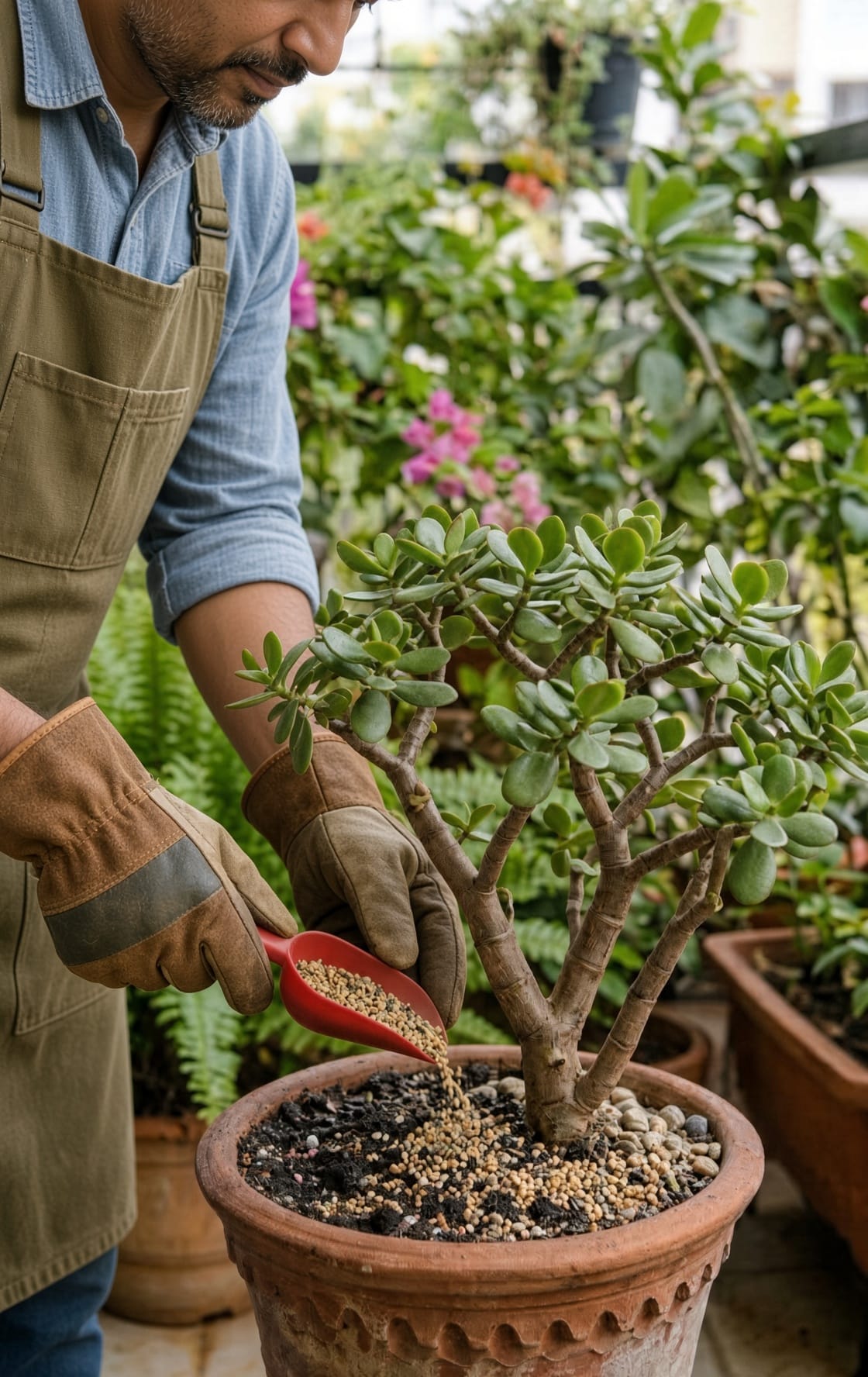
The image shows a healthy Jade Plant growing in a decorative terracotta container. A gardener is carefully applying small beige fertilizer granules around the base of the plant using a red scoop.
The Jade Plant has a substantial woody trunk, multiple established branches, and clusters of thick green leaves. The granular material is being distributed across the soil surface rather than directly onto the foliage.
This gardening scene raises an important question: Can granular fertilizer help a Jade Plant develop stronger roots, thicker branches, and a fuller, tree-like appearance?
The answer is yes—when the plant needs nutrients and the fertilizer is appropriate. However, the exact fertilizer in the photograph cannot be identified from appearance alone, and adding granules does not automatically make a Jade Plant grow faster.
Successful Jade Plant cultivation depends on the relationship between soil drainage, root health, sunlight, fertilizer, watering, container size, and pruning.
This complete guide explains how to fertilize a Jade Plant safely, choose premium succulent potting mixes, encourage a thicker trunk, maintain strong roots, prevent common diseases, and create a beautiful ornamental plant for indoor and outdoor spaces.
1. Understanding the Jade Plant: The Living Miniature Tree
The Jade Plant, botanically known as Crassula ovata, is a perennial succulent belonging to the Crassulaceae family.
Native to southern Africa, it is admired for its thick, water-storing leaves and ability to develop woody stems over many years.
Unlike fast-growing tropical houseplants, Jade Plants generally develop at a moderate pace.
Their attractive tree-like appearance results from gradual stem thickening, repeated branching, and the accumulation of healthy growth over time.
Main Characteristics of Jade Plant
- Thick, oval-shaped succulent leaves
- Green foliage that may develop reddish edges in strong light
- Woody trunks on mature specimens
- Naturally branching growth
- High tolerance for occasional dryness
- Sensitivity to prolonged waterlogging
- Long lifespan with proper care
- Suitability for indoor and protected outdoor cultivation
A mature Jade Plant can become an attractive focal point in a living room, sunroom, patio, conservatory, or professionally landscaped courtyard.
Why Jade Plants Are Popular
Jade Plants are valued for their architectural appearance.
Their stems gradually become thicker and more woody, creating the appearance of a small tree.
Because of this growth habit, they are frequently used in bonsai-inspired arrangements, premium ceramic planters, and contemporary interior landscaping.
2. What Is Being Applied to the Jade Plant in the Image?
The photograph shows a gardener adding small, light-colored granules to the potting medium.
These granules resemble commercially available granular fertilizers or mineral soil amendments.
However, their exact composition cannot be confirmed visually.
Possible materials include:
- Controlled-release fertilizer
- Organic granular plant fertilizer
- Mineral nutrient granules
- Slow-release succulent fertilizer
- Inorganic soil amendments
Each product has a different purpose.
Some supply nutrients over time, while others modify soil structure or chemistry.
Never identify or dose a fertilizer based only on the color and shape of its granules.
Always check the product label before applying it.
Why Granular Fertilizer Can Be Useful
Certain granular fertilizers release nutrients gradually.
This can provide a convenient feeding method for gardeners who prefer fewer fertilizer applications.
However, nutrient release depends on product formulation, moisture, temperature, and the condition of the potting medium.
A fertilizer designed for outdoor landscaping may not be appropriate for a small indoor succulent container.
3. Quick Answer: What Is the Best Fertilizer for Jade Plant?
For most healthy Jade Plants, a complete, balanced fertilizer used sparingly during active growth is sufficient.
A suitable fertilizer should provide essential nutrients without creating excessive salt accumulation.
The most important considerations are:
- A complete nutrient formulation
- Suitability for container-grown succulents
- Appropriate dosage
- Correct application timing
- Healthy root conditions
- Adequate sunlight
- Well-draining potting medium
Jade Plants are not heavy feeders.
Overfertilization can be more harmful than mild underfeeding.
A good fertilizer supports normal growth, but it cannot compensate for insufficient light or chronically wet soil.
4. How Fertilizer Supports Jade Plant Growth
Jade Plants need nutrients to maintain normal cellular processes, produce new leaves, and develop healthy stems and roots.
Three major nutrients appear prominently on fertilizer labels.
Nitrogen: Supporting Green Growth
Nitrogen contributes to the development of chlorophyll and new plant tissue.
Adequate nitrogen supports healthy foliage.
However, excessive nitrogen may encourage soft, weak growth, particularly when sunlight is inadequate.
Phosphorus: Supporting Normal Root Development
Phosphorus plays an essential role in energy transfer and root development.
It is important for plant health, but adding extra phosphorus does not automatically produce stronger roots when sufficient phosphorus is already available.
Potassium: Supporting Plant Function
Potassium contributes to water regulation, enzyme activity, and other important processes.
Adequate potassium supports overall plant health.
Secondary Nutrients
Calcium, magnesium, and sulfur also contribute to normal growth.
Micronutrients
Jade Plants require small amounts of iron, manganese, zinc, boron, copper, and other essential elements.
A complete fertilizer can provide these nutrients in appropriate proportions.
5. Granular Fertilizer vs. Liquid Fertilizer for Jade Plant
Both granular and liquid fertilizers can be suitable when applied correctly.
The best choice depends on the growing environment and the gardener’s preferences.
| Fertilizer type | Main advantage | Important consideration |
|---|---|---|
| Controlled-release granules | Gradual nutrient delivery | Release depends on conditions |
| Balanced liquid fertilizer | Easy concentration control | Requires periodic application |
| Organic granular fertilizer | Alternative nutrient source | Nutrient release may vary |
| Succulent-specific fertilizer | Convenient formulation | Follow product instructions |
| Water-soluble complete fertilizer | Flexible feeding schedule | Avoid excessive concentration |
When Granular Fertilizer Makes Sense
Controlled-release products may be convenient for mature Jade Plants in stable growing conditions.
When Liquid Fertilizer Is Better
Liquid fertilizer allows gardeners to adjust feeding more easily.
Which Is Best for Beginners?
A diluted complete liquid fertilizer can be a practical starting point because it provides control over concentration.
However, either approach can work.
6. How to Apply Granular Fertilizer to Jade Plant Safely
The gardener in the photograph is distributing granules over the soil surface.
This resembles a common top-dressing technique.
Before using this method, verify that the product is designed for surface application.
Step 1: Inspect the Jade Plant
Look for healthy leaves, firm branches, and signs of active growth.
Avoid fertilizing a plant with suspected root rot or severe stress.
Step 2: Check Soil Moisture
Determine whether the potting medium is excessively dry, saturated, or appropriately moist.
Step 3: Read the Fertilizer Label
Check the nutrient analysis, recommended dosage, application method, and duration of nutrient release.
Step 4: Measure the Correct Amount
Do not estimate the quantity from the photograph.
Different products have different concentrations.
Step 5: Distribute the Granules
If the label permits top-dressing, distribute the product evenly over the recommended soil area.
Avoid concentrating fertilizer directly against the trunk.
Step 6: Avoid Contact With Leaves
Keep fertilizer granules away from sensitive foliage.
Step 7: Water as Directed
Some products require watering after application.
Others have different instructions.
Step 8: Monitor the Plant
Observe new growth, leaf condition, and any signs of fertilizer stress.
Step 9: Respect the Reapplication Interval
Do not add more fertilizer before the recommended time.
7. Why Too Much Fertilizer Can Damage Jade Plant
Jade Plants are adapted to relatively lean growing conditions.
Excessive fertilizer can increase soluble salt concentrations in the potting medium.
This may interfere with water uptake and damage roots.
Warning Signs
- Brown leaf margins
- Unusual leaf drop
- Weak or distorted new growth
- White crust on the soil surface
- Poor root development
- Sudden decline after fertilization
These symptoms can also have other causes.
What to Do
Stop fertilizing.
Check the potting medium and drainage.
If salt buildup is suspected, use an appropriate corrective approach based on the severity of the problem.
For serious overfertilization, replacing contaminated potting medium may be necessary.
8. Best Soil for Jade Plant: The Foundation of Strong Roots
The quality of the potting medium is one of the most important factors in Jade Plant cultivation.
A suitable soil mix should drain freely while retaining enough moisture for root uptake.
Why Ordinary Garden Soil Is Often Unsuitable
Garden soil may compact inside containers.
Compaction reduces air spaces and can cause prolonged moisture retention.
Recommended Jade Plant Soil Mix
A practical starting mixture is:
- One part quality succulent potting mix
- One part pumice or perlite
- A modest amount of coarse mineral aggregate if additional drainage is needed
The exact proportions depend on the characteristics of the starting mix and local conditions.
Benefits of a Premium Succulent Potting Mix
A high-quality commercial succulent mix can provide:
- Consistent texture
- Better drainage
- Improved aeration
- Reduced compaction
- Easier moisture management
Premium soil products should be evaluated by their ingredients and performance rather than price alone.
9. Premium Succulent Soil Mix Comparison
| Material | Main function | Consideration |
|---|---|---|
| Succulent potting mix | General root support | Quality varies |
| Pumice | Drainage and aeration | Adds weight |
| Perlite | Improves air spaces | Lightweight |
| Coarse mineral grit | Improves structure | Use suitable particle size |
| Coco coir | Moisture retention | Avoid excessive amounts |
| Fine pine bark | Adds structure | Decomposes over time |
| Compost | Organic nutrient source | Use sparingly |
Why Pumice Is Popular
Pumice maintains structural air spaces and does not decompose quickly.
Why Perlite Works
Perlite improves aeration and helps prevent excessive compaction.
Why Organic Matter Matters
A modest amount of organic material can help retain moisture and nutrients.
The goal is balance, not complete dryness.
10. How Soil Drainage Affects Jade Plant Root Growth
Jade Plant roots require oxygen.
When soil remains saturated for extended periods, oxygen availability decreases.
This can create conditions favorable to root decay.
Healthy Root Conditions
Healthy roots develop in a medium that alternates between appropriate moisture and aeration.
Poor Root Conditions
Chronically wet soil can lead to:
- Root damage
- Weak growth
- Leaf drop
- Stem softening
- Reduced water uptake
- Root rot
How to Improve Drainage
Use a container with drainage holes.
Choose a suitable potting mix.
Avoid oversized containers.
Remove standing water from saucers.
Do not water according to a rigid calendar.
11. How to Water Jade Plant Correctly
Jade Plants store water in their thick leaves and stems.
This allows them to tolerate periods of dry soil.
However, drought tolerance does not mean they should never receive thorough watering.
Recommended Watering Method
Allow the potting medium to dry substantially between waterings.
When watering is needed, irrigate thoroughly until excess water exits the drainage holes.
Allow the pot to drain completely.
Summer Watering
Water requirements may increase during warm, bright growing conditions.
Winter Watering
Watering frequency often decreases when light and temperatures are lower.
Indoor Watering
Indoor plants may dry more slowly than plants growing outdoors.
Important Rule
Always assess the actual moisture conditions before watering.
12. How to Tell When Jade Plant Needs Water
Several observations can help determine watering needs.
Soil Moisture
Check below the surface rather than judging only the top layer.
Pot Weight
A dry container often feels noticeably lighter.
Leaf Firmness
Healthy Jade Plant leaves are generally firm and plump.
Slight Leaf Wrinkling
Some wrinkling may indicate water depletion, although root damage can produce similar symptoms.
Avoid Waiting for Severe Stress
Repeated extreme dehydration can weaken the plant.
13. Best Sunlight for a Thick Jade Plant Trunk
Light is essential for healthy Jade Plant growth.
A plant receiving adequate light is more likely to maintain compact, sturdy growth.
Bright Indoor Locations
A sunny window is often an excellent location.
Morning Sun
Morning sunlight can be beneficial.
Outdoor Sunlight
Established plants may tolerate substantial sunlight when gradually acclimated.
Strong Afternoon Sun
Sudden exposure to intense sunlight can scorch leaves.
Low Light
Insufficient light often causes elongated, weak growth.
The Connection Between Light and Trunk Development
A Jade Plant develops a thicker trunk gradually as it matures.
Good light supports healthy growth and helps prevent excessively elongated stems.
Fertilizer alone cannot create a thick trunk.
14. Why Jade Plant Becomes Tall and Thin
A Jade Plant that grows tall with widely spaced leaves may be experiencing insufficient light.
This condition is called etiolation.
Common Signs
- Long, weak stems
- Large spaces between leaves
- Leaning branches
- Reduced compactness
- Top-heavy growth
How to Correct It
Move the plant gradually to a brighter location.
Prune elongated branches when appropriate.
Avoid excessive fertilizer.
Provide stable growing conditions.
New growth can become more compact, but existing stretched stems will not shorten.
15. How to Grow a Thick Jade Plant Trunk
A thick trunk is one of the most desirable characteristics of a mature Jade Plant.
However, trunk development takes time.
Provide Adequate Light
Bright conditions support compact growth.
Allow Natural Maturity
Woody thickening occurs gradually over years.
Maintain Healthy Roots
A functioning root system supports sustained growth.
Avoid Excessive Watering
Root damage can slow development.
Use Balanced Nutrition
Fertilize moderately during active growth.
Prune Strategically
Pruning can encourage branching and improve the plant’s shape.
Choose a Stable Container
A mature Jade Plant can become top-heavy.
Use a pot that provides adequate stability.
16. How to Make Jade Plant Bushier
The Jade Plant in the image has an attractive branching structure.
Its canopy contains multiple stems supporting clusters of green leaves.
This appearance can be encouraged through selective pruning.
Why Pruning Helps
Removing a growing tip can encourage growth from buds below the cut.
When to Prune
Pruning is generally best during active growth.
How to Prune
Use clean, sharp pruning tools.
Identify an appropriate branch junction.
Make a clean cut.
Allow the wound to dry.
Avoid excessive watering immediately afterward.
What Happens Next?
New shoots may develop from nearby nodes.
Over time, this can produce a fuller canopy.
17. Jade Plant Pruning for a Bonsai-Like Appearance
Jade Plants are popular for bonsai-inspired styling because of their woody trunks and naturally compact leaves.
Step 1: Identify the Main Trunk
Choose the strongest central structure.
Step 2: Remove Unhealthy Branches
Eliminate dead or damaged growth.
Step 3: Improve the Silhouette
Trim overly long branches.
Step 4: Encourage Branching
Prune selectively to promote a balanced canopy.
Step 5: Maintain Light Exposure
Ensure the plant receives enough light from appropriate directions.
Step 6: Allow Recovery
Do not combine severe pruning with excessive fertilization.
Step 7: Repeat Gradually
Refine the shape over multiple growing seasons.
18. How to Repot a Mature Jade Plant
Mature Jade Plants do not require frequent repotting.
Repotting becomes necessary when the container is unsuitable, the soil deteriorates, or root problems develop.
Signs Repotting May Be Needed
- Severely compacted potting medium
- Poor drainage
- Root damage
- Unstable container
- Roots excessively crowding the pot
- Soil that remains wet too long
Repotting Method
- Prepare a suitable container with drainage holes.
- Use a fresh succulent potting mix.
- Carefully remove the plant.
- Inspect the roots.
- Remove dead or rotten roots with clean tools.
- Position the plant at its original planting depth.
- Fill around the root ball.
- Allow damaged roots to heal before watering heavily.
- Reintroduce normal care gradually.
Choosing Pot Size
Select a container only modestly larger than the root system when an increase is necessary.
An excessively large pot can retain unnecessary moisture.
19. Terracotta vs. Ceramic vs. Plastic Planters
The Jade Plant in the photograph grows in a decorative terracotta pot.
Terracotta is a popular choice for succulents because its porous structure can promote moisture evaporation.
| Container type | Advantages | Considerations |
|---|---|---|
| Terracotta | Porous, traditional appearance | Dries faster |
| Glazed ceramic | Decorative, stable | Moisture retention varies |
| Plastic | Lightweight, affordable | May dry more slowly |
| Concrete | Heavy and stable | Difficult to move |
| Premium resin | Lightweight and decorative | Drainage must be checked |
Best Choice for a Mature Jade Plant
A stable container with reliable drainage is essential.
Heavy ceramic or terracotta pots can be particularly useful for large, top-heavy specimens.
20. Can Decorative Stones Improve Jade Plant Care?
Decorative stones are often used around Jade Plants to create an attractive, finished appearance.
The photograph includes small pale stones around the trunk.
Benefits
- Attractive presentation
- Reduced soil disturbance
- Decorative contrast
- A clean surface appearance
Potential Problems
A thick layer of stones can make it harder to assess soil moisture.
Decorative stones do not replace drainage holes or a suitable potting mix.
Best Practice
Use a thin, loose layer if desired.
Keep the stem base visible.
Check moisture beneath the decorative surface.
21. Jade Plant Fertilizing Schedule
The correct feeding schedule depends on the fertilizer formulation and the growing environment.
| Season | Feeding approach |
|---|---|
| Spring | Light feeding as active growth begins |
| Summer | Continue moderate feeding if growing actively |
| Autumn | Reduce feeding as growth slows |
| Winter | Usually little or no feeding during slow growth |
Important Considerations
Indoor Jade Plants growing under supplemental light may follow a different growth pattern.
Always follow the fertilizer label.
Avoid combining several fertilizers without understanding their total nutrient contribution.
22. How Long Does Jade Plant Take to Grow?
Jade Plants are relatively slow-growing compared with many tropical foliage plants.
Growth depends on:
- Light intensity
- Temperature
- Root health
- Water availability
- Fertilizer
- Plant age
- Pot size
- Seasonal conditions
First Month After Fertilizing
Visible growth may be minimal.
Two to Three Months
Healthy plants may develop new leaves and shoots during active growth.
Six Months
The canopy may become fuller under suitable conditions.
One to Several Years
Trunk thickening and mature branching become more noticeable.
These are general observations, not guaranteed results from a single fertilizer application.
23. How to Propagate Jade Plant From Stem Cuttings
Jade Plant propagation is relatively straightforward.
Step 1: Choose a Healthy Branch
Select a firm, disease-free stem.
Step 2: Make a Clean Cut
Use sterilized pruning tools.
Step 3: Allow the Cut to Callus
Leave the cutting in a dry, shaded location until the cut surface has dried.
Step 4: Prepare the Growing Medium
Use a well-draining succulent mix.
Step 5: Plant the Cutting
Insert the base into the medium.
Step 6: Avoid Excessive Moisture
Keep the medium from becoming waterlogged.
Step 7: Provide Bright Indirect Light
Avoid intense sun while the cutting establishes.
Step 8: Monitor Root Development
Root formation generally takes several weeks, depending on conditions.
24. Rooting Powder vs. Natural Jade Plant Propagation
Some gardeners use commercial rooting products when propagating succulents.
However, Jade Plant cuttings often root successfully without rooting hormone.
| Method | Benefit | Consideration |
|---|---|---|
| Natural rooting | Simple and inexpensive | Requires suitable conditions |
| Commercial rooting powder | May assist some cuttings | Follow product label |
| Rooting gel | Convenient application | Not always necessary |
| Water propagation | Roots can be observed | Transfer to soil needs care |
Do Jade Plants Need Rooting Hormone?
Usually not.
Healthy cuttings, clean tools, proper callusing, and suitable soil are more important.
25. Why Jade Plant Leaves Turn Yellow
Yellow leaves can result from several causes.
Excessive Watering
Waterlogged roots may struggle to function.
Natural Leaf Aging
Older leaves eventually decline.
Poor Light
Insufficient light may contribute to weak growth.
Root Problems
Damaged roots can affect leaf health.
Fertilizer Stress
Excessive nutrient concentrations may damage tissues.
What to Do
Inspect the plant before making changes.
Avoid assuming that yellow leaves always indicate a fertilizer deficiency.
26. Why Jade Plant Leaves Fall Off
Occasional loss of older leaves is normal.
However, sudden widespread leaf drop can indicate stress.
Possible causes include:
- Excessive watering
- Severe drought
- Temperature changes
- Insufficient light
- Root damage
- Pest infestations
- Fertilizer injury
Recommended Approach
Check soil moisture.
Inspect the roots if necessary.
Evaluate temperature and light.
Avoid adding fertilizer until the cause is understood.
27. Why Jade Plant Leaves Become Soft
Healthy Jade Plant leaves are generally firm.
Soft leaves may indicate problems with water balance.
Underwatering
Leaves may wrinkle as stored water decreases.
Overwatering
Damaged roots may be unable to absorb water.
Root Rot
Root decay can cause widespread loss of firmness.
How to Distinguish the Causes
Check the moisture level and condition of the root system.
Do not automatically water a plant simply because its leaves are soft.
28. Common Jade Plant Pests
Jade Plants can be affected by several pests.
Mealybugs
These insects often appear as white cotton-like masses.
Scale Insects
Scale insects attach to stems and leaves.
Spider Mites
Spider mites can cause fine stippling and sometimes webbing.
Root Mealybugs
These pests may infest the root zone.
Pest Management
Inspect plants regularly.
Isolate affected specimens.
Remove visible pests when practical.
Use suitable insecticidal soap or horticultural treatments according to their labels.
Avoid applying products in intense heat or direct sunlight.
29. Jade Plant Root Rot: Causes and Prevention
Root rot is one of the most serious problems in Jade Plant cultivation.
Common Causes
- Prolonged waterlogging
- Poorly draining soil
- Containers without drainage holes
- Excessively large pots
- Low light combined with frequent watering
Warning Signs
- Soft stems
- Dark or mushy roots
- Rapid leaf decline
- Unpleasant odor
- Collapsing branches
Prevention
Use a suitable succulent potting mix.
Water according to soil dryness.
Provide adequate light.
Choose containers with drainage holes.
30. Can Jade Plant Grow Outdoors?
Jade Plants can grow outdoors in climates that remain warm enough.
Suitable Conditions
- Bright light
- Well-draining soil
- Protection from prolonged heavy rain
- Frost-free temperatures
- Gradual acclimation to direct sunlight
Cold Weather
Jade Plants are frost-sensitive.
Move container plants indoors or provide appropriate protection before freezing conditions.
Hot Weather
Strong sunlight combined with high temperatures can cause scorching, especially after sudden relocation.
31. Best Indoor Placement for Jade Plant
A mature Jade Plant can become an architectural feature in a room.
South-Facing Windows
Often provide excellent light in the Northern Hemisphere, although local conditions vary.
Bright Sunrooms
Can support compact growth.
Home Offices
A smaller Jade Plant can decorate a sunny desk or shelf.
Living Rooms
Large specimens work well near bright windows.
Entryways
A decorative Jade Plant can create a welcoming appearance if light is sufficient.
Conservatories
These spaces may provide ideal conditions when temperature and ventilation are controlled.
32. Professional LED Grow Lights for Indoor Jade Plants
Not every home has a sufficiently bright window.
Supplemental lighting can support healthy Jade Plant growth.
Benefits of LED Grow Lights
- Consistent light availability
- Greater placement flexibility
- Support for compact growth
- Useful during darker seasons
Choosing a Professional LED Grow Light
Consider:
- Light intensity
- Fixture efficiency
- Coverage area
- Adjustable positioning
- Timer compatibility
- Electrical safety
- Manufacturer specifications
Avoid Excessive Light
Even plants that prefer bright conditions can be damaged by poorly positioned high-intensity fixtures.
Introduce supplemental lighting gradually.
33. Luxury Jade Plant Decor and Premium Planters
A mature Jade Plant is especially suitable for high-end decorative arrangements.
Its thick trunk and sculptural branches complement modern interior design.
Minimalist Ceramic Planters
Neutral containers emphasize the natural shape of the plant.
Terracotta Pots
Terracotta provides a classic Mediterranean appearance.
Large Stone-Finish Planters
These can complement contemporary patios and conservatories.
Decorative Pebble Top-Dressing
A thin layer of natural stones can create a refined finish.
Wooden Plant Stands
Natural wood pairs beautifully with succulent foliage.
Modern Metal Stands
Metal stands can elevate smaller specimens and create a clean architectural appearance.
34. Where to Place This Indoor and Outdoor Plant: Advanced Interior Styling & Architectural Placement
Jade Plants are excellent candidates for architectural planting because of their tree-like form.
Contemporary Living Rooms
Place a mature Jade Plant in a premium ceramic pot near a bright window.
Mediterranean Patios
Combine terracotta planters with stone flooring and warm-toned outdoor furniture.
Modern Home Offices
Use a compact Jade Plant as a sculptural desk accessory.
Luxury Sunrooms
Arrange several mature Jade Plants at different heights.
Covered Balconies
Use stable containers that resist tipping.
Indoor Garden Corners
Combine Jade Plants with other succulents that have similar watering and light requirements.
Garden Courtyards
Large specimens can provide architectural interest in frost-free locations.
Professional Landscaping
In suitable climates, Jade Plants can contribute to low-water ornamental designs.
Boutique Hospitality Interiors
Mature Jade Plants can complement minimalist furniture, natural stone, and wood finishes where lighting is appropriate.
Premium Residential Plant Styling
A single well-shaped specimen may create a stronger visual impact than several crowded containers.
35. Jade Plant and Drought-Tolerant Landscaping
Jade Plants can contribute to water-conscious landscaping in suitable climates.
However, drought tolerance should not be confused with complete independence from water.
Advantages
- Attractive evergreen foliage
- Low watering frequency once established
- Architectural growth habit
- Compatibility with succulent gardens
- Long lifespan
Suitable Companion Plants
Consider other plants with similar light and moisture requirements.
Avoid combining Jade Plants in the same container with tropical species that require consistently moist soil.
36. How to Create a Premium Jade Plant Arrangement
A decorative Jade Plant arrangement can be created without complicated equipment.
Materials
- Healthy Jade Plant
- Stable decorative container
- Quality succulent potting mix
- Pumice or perlite
- Optional decorative stones
- Clean pruning tools
- Suitable fertilizer
- Moisture-checking tool if desired
Arrangement Method
Choose a container that complements the plant’s size.
Prepare a well-draining potting medium.
Position the plant securely.
Keep the root crown at an appropriate level.
Add a thin decorative top-dressing if desired.
Place the arrangement in bright light.
Water only when needed.
37. Choosing Premium Gardening Products for Jade Plant Care
Not every expensive gardening product is necessary.
However, selecting appropriate tools and materials can make long-term maintenance easier.
Premium Succulent Soil Mixes
Look for a stable, airy structure.
Controlled-Release Fertilizers
Choose products suitable for container-grown ornamentals.
Professional Pruning Tools
Clean, sharp tools allow precise cuts.
Decorative Ceramic Planters
Select stable containers with reliable drainage.
LED Grow Lights
Useful when indoor natural light is inadequate.
Moisture Meters
May provide supplementary information, although readings can be unreliable in very coarse succulent mixes.
Rooting Products
Optional for most Jade Plant cuttings.
Indoor Plant Care Kits
Convenient collections of basic tools can simplify routine maintenance.
38. Common Jade Plant Fertilizer Mistakes
Applying Too Much Fertilizer
Excess nutrients may damage roots.
Fertilizing During Severe Stress
A stressed plant should be evaluated before feeding.
Using the Wrong Product
Some fertilizers are too concentrated for small containers.
Ignoring the Label
Application rates vary considerably.
Applying Granules Against the Trunk
Concentrated fertilizer near the stem base may cause problems.
Fertilizing Without Adequate Light
Nutrients cannot compensate for insufficient sunlight.
Combining Multiple Fertilizers
Unnecessary combinations can increase salt accumulation.
Expecting Immediate Trunk Thickening
Woody growth develops gradually.
39. Jade Plant Care Calendar
| Season | Light | Water | Fertilizer | Maintenance |
|---|---|---|---|---|
| Spring | Bright | As needed | Light feeding | Prune and repot if necessary |
| Summer | Bright, acclimated | Monitor regularly | Moderate feeding if needed | Inspect for pests |
| Autumn | Bright | Reduce as growth slows | Reduce feeding | Prepare for cooler weather |
| Winter | Maximum suitable light | Less frequent | Usually pause | Protect from cold |
This schedule should be adjusted to the plant’s actual growing conditions.
40. How to Encourage Healthy New Jade Plant Branches
A full Jade Plant canopy develops through repeated branching.
Maintain Adequate Light
Light supports compact growth.
Prune at Appropriate Nodes
Selective pruning can encourage additional shoots.
Maintain Root Health
Strong roots support sustained growth.
Use Moderate Fertilizer
Balanced nutrition supports normal development.
Avoid Excessive Watering
Waterlogging can interrupt growth.
Allow Time
New branching takes weeks or months rather than days.
41. Can Jade Plant Produce Flowers?
Yes.
Mature Jade Plants can produce clusters of small, star-shaped flowers under suitable conditions.
Flowers are often white or pale pink.
Factors Influencing Flowering
- Plant maturity
- Adequate light
- Seasonal temperature changes
- Suitable environmental conditions
- Overall plant health
Does Fertilizer Guarantee Flowers?
No.
Flowering is influenced by multiple factors.
Excessive fertilizer does not guarantee blooming.
42. How to Keep Jade Plant Healthy for Many Years
Jade Plants can live for decades with suitable care.
Long-Term Maintenance
Provide bright light.
Use well-draining soil.
Water appropriately.
Feed sparingly.
Prune when necessary.
Inspect roots and stems.
Protect from freezing temperatures.
Repot only when needed.
Why Mature Jade Plants Are Valuable as Decorative Specimens
Large, established Jade Plants develop character through their woody trunks and branching patterns.
Their visual appeal often increases with age.
A carefully maintained specimen can become a long-lasting decorative feature.
43. Jade Plant Troubleshooting Table
| Symptom | Possible cause | Recommended action |
|---|---|---|
| Yellow leaves | Watering or root stress | Check soil and roots |
| Wrinkled leaves | Water depletion or root damage | Assess moisture and roots |
| Soft trunk | Possible rot | Inspect immediately |
| Long thin branches | Insufficient light | Increase light gradually |
| Brown leaf edges | Sun or fertilizer stress | Review conditions |
| White soil crust | Mineral or fertilizer salts | Investigate buildup |
| Leaf drop | Environmental stress | Check watering and temperature |
| Slow growth | Seasonal or environmental factors | Evaluate overall care |
| Weak branches | Low light | Improve light exposure |
| No flowers | Unsuitable flowering conditions | Review maturity and environment |
44. Frequently Asked Questions About Jade Plant Fertilizer
What Are the Beige Granules in the Photograph?
They resemble granular fertilizer or a soil amendment, but the exact material cannot be identified from the image.
Can Granular Fertilizer Make Jade Plant Grow Faster?
Appropriate fertilizer may improve growth when nutrients are limiting, but light, roots, water, and temperature remain essential.
What Is the Best Fertilizer for Jade Plant?
A complete, balanced fertilizer used sparingly is generally suitable.
Is Slow-Release Fertilizer Good for Jade Plant?
It can be useful when the product is appropriate for container succulents and applied according to the label.
How Often Should I Fertilize Jade Plant?
Feed lightly during active growth according to the product instructions.
Does Jade Plant Need Fertilizer in Winter?
Usually little or no fertilizer is needed when growth slows.
Can Fertilizer Make the Trunk Thicker?
Adequate nutrition supports growth, but trunk thickening primarily develops through healthy growth over time.
How Do I Make My Jade Plant Bushy?
Provide adequate light and use selective pruning to encourage branching.
What Soil Is Best for Jade Plant?
A well-draining succulent potting mix containing suitable mineral components.
Can Jade Plant Grow in Terracotta Pots?
Yes. Terracotta is often a good choice.
Can I Put Decorative Stones Around Jade Plant?
Yes, but avoid thick layers that interfere with moisture assessment.
Why Are My Jade Plant Leaves Falling Off?
Possible causes include watering problems, temperature stress, insufficient light, and root damage.
Can Jade Plant Recover From Root Rot?
Recovery may be possible if sufficient healthy tissue remains. Healthy cuttings can sometimes be used to preserve the plant.
Does Jade Plant Need Direct Sunlight?
Jade Plants generally prefer bright light and can tolerate direct sunlight when appropriately acclimated.
Can Jade Plant Live Indoors?
Yes, provided sufficient light and suitable growing conditions are available.
How Long Does Jade Plant Take to Develop a Thick Trunk?
It generally takes years, depending on growing conditions and plant maturity.
Can I Propagate Jade Plant Without Rooting Powder?
Yes. Stem cuttings often root successfully without additional rooting products.
Is Jade Plant Suitable for Bonsai?
Yes. It is commonly used for bonsai-inspired shaping.
Are Jade Plants Safe for Pets?
No. Jade Plants are toxic to cats and dogs if ingested. Keep them out of reach of pets.
Can Jade Plant Be Used in Luxury Interior Design?
Yes. Mature specimens can serve as attractive architectural houseplants in appropriately lit spaces.
45. Quick Jade Plant Care Notes
| Category | Recommendation |
|---|---|
| Common name | Jade Plant |
| Botanical name | Crassula ovata |
| Plant type | Succulent |
| Growth habit | Shrubby, tree-like |
| Light | Bright light |
| Water | Allow substantial drying between waterings |
| Soil | Well-draining succulent mix |
| Fertilizer | Balanced, complete fertilizer |
| Granular fertilizer | Use according to label |
| Root health | Excellent drainage essential |
| Pot type | Terracotta or other draining container |
| Trunk development | Gradual over years |
| Pruning | During active growth |
| Propagation | Stem or leaf cuttings |
| Flower color | White to pale pink |
| Outdoor placement | Suitable frost-free locations |
| Indoor placement | Bright window |
| Main risk | Root rot |
| Maintenance | Low to moderate |
| Decorative use | Indoor and outdoor |
| Pet safety | Toxic to cats and dogs |
46. Final Thoughts: Building a Beautiful Jade Plant With Strong Roots and a Thick Trunk
A mature Jade Plant is more than a simple houseplant. Its woody trunk, sculptural branches, and thick green leaves can make it a striking feature in both indoor and outdoor spaces.
The photograph demonstrates a common gardening technique: applying granular material to the potting medium around an established Jade Plant.
When the granules are a suitable fertilizer and applied correctly, they may help maintain adequate nutrition and support healthy growth.
However, successful Jade Plant cultivation requires more than fertilizer.
The most important factors are a well-draining succulent soil mix, sufficient sunlight, appropriate watering, healthy roots, and patient long-term maintenance.
Gardeners who want a thicker trunk and fuller canopy should focus on consistent growing conditions and selective pruning rather than excessive feeding.
Premium succulent potting mixes, quality ceramic planters, professional pruning tools, and suitable LED grow lights can make cultivation and decorative styling easier when chosen for a specific need.
For interior design enthusiasts, a mature Jade Plant offers a beautiful combination of natural greenery and architectural structure.
For outdoor gardeners in suitable climates, it can become an attractive component of drought-tolerant landscaping.
The most reliable way to grow a Jade Plant with strong roots, a thick woody trunk, healthy green leaves, and a beautifully balanced canopy is to combine appropriate nutrition with excellent drainage, sufficient light, careful watering, and time.
With proper care, a Jade Plant can develop into a remarkable miniature tree that remains attractive for many years.