A Christmas Cactus covered in cascading red flowers can become one of the most beautiful houseplants in your home. Its glossy green segments, graceful hanging stems, and colorful winter blooms make it especially attractive during the holiday season.
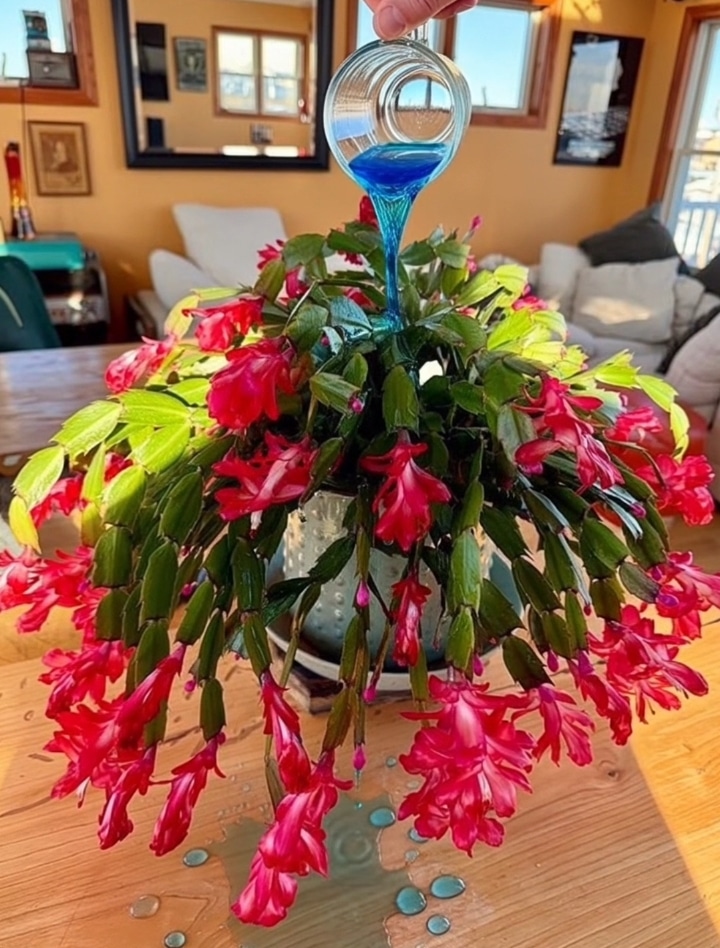
The image shows a mature Christmas Cactus (Schlumbergera) overflowing with bright red flowers while a vivid blue liquid is poured over the center of the plant.
But is blue liquid actually beneficial for Christmas Cactus? Can it encourage more flowers, strengthen roots, or help blooms last longer?
The answer depends on what the liquid contains. Some commercial fertilizers are blue because of added coloring or dissolved mineral nutrients, but color alone cannot identify a safe or effective plant treatment.
Here’s how to choose the right fertilizer, water your Christmas Cactus correctly, and encourage healthy seasonal flowering.
1. What Is the Blue Liquid Being Poured on the Christmas Cactus?
The bright blue solution resembles a colored liquid plant fertilizer or water-soluble fertilizer mixture.
However, its exact ingredients cannot be identified from the image.
Several gardening products can produce a blue solution, including:
- Water-soluble houseplant fertilizers.
- Certain balanced NPK fertilizer formulations.
- Commercial liquid plant nutrient concentrates.
- Some micronutrient supplements.
- Colored plant-care solutions.
Important: Never apply an unidentified blue liquid to a Christmas Cactus. Some blue household chemicals, pesticides, and cleaning products can seriously damage plants.
For reliable results, choose a fertilizer specifically labeled for houseplants or flowering plants and follow its dilution instructions.
2. Can Blue Fertilizer Help a Christmas Cactus Bloom?
A properly formulated fertilizer can support healthy foliage, root development, and flower production when the plant needs nutrients.
However, fertilizer alone does not trigger Christmas Cactus blooming.
Flower formation depends heavily on seasonal light exposure, temperature, and overall plant health.
What Christmas Cactus Fertilizer Provides
| Nutrient | Main Function | Why It Matters |
|---|---|---|
| Nitrogen (N) | Supports green growth | Maintains healthy stem segments |
| Phosphorus (P) | Supports energy transfer and roots | Contributes to normal flower development |
| Potassium (K) | Supports water regulation and plant function | Helps maintain overall vigor |
| Magnesium | Essential for chlorophyll | Supports healthy green tissue |
| Calcium | Supports cell structure | Important for new growth |
| Micronutrients | Support plant metabolism | Help prevent nutrient deficiencies |
A balanced fertilizer containing essential nutrients is usually sufficient. Excess phosphorus does not automatically produce more flowers.
3. Best Fertilizer for Christmas Cactus
Choosing the right fertilizer is more important than choosing one based on its color.
Christmas Cactus is a tropical forest cactus, not a desert cactus. It naturally grows in organic material and crevices where moisture drains away while roots receive oxygen.
Fertilizer Comparison
| Fertilizer Type | Advantages | Best Use |
|---|---|---|
| Balanced liquid houseplant fertilizer | Easy to dilute and apply | Regular growing-season feeding |
| Water-soluble NPK fertilizer | Provides measured nutrients | Established, actively growing plants |
| Organic liquid fertilizer | Can supply nutrients gradually | Soil-based plants, following label directions |
| Cactus and succulent fertilizer | Often formulated for moderate feeding | Suitable when label recommendations match |
| Slow-release fertilizer granules | Convenient controlled feeding | Well-drained potting mixes |
Recommended Feeding Schedule
During spring and summer, feed an actively growing Christmas Cactus with a diluted balanced liquid fertilizer approximately every 3–4 weeks, adjusting to the product label and plant response.
As autumn approaches and flower buds begin developing, reduce or pause fertilization.
Avoid heavy feeding while the plant is flowering.
Too much fertilizer can damage sensitive roots and contribute to stress.
4. How to Apply Liquid Fertilizer Safely
The image shows blue liquid being poured over the upper foliage and flowers.
For most Christmas Cactus fertilizers, application to the potting mix is preferable to pouring fertilizer directly over the flowers.
Step-by-Step Method
- Check the fertilizer label to confirm that it is appropriate for Christmas Cactus or flowering houseplants.
- Mix the recommended amount with clean water, using a weaker solution when appropriate.
- Check that the potting mix is not extremely dry before feeding.
- Slowly pour the diluted solution onto the soil around the base of the plant.
- Avoid soaking open flowers and delicate buds.
- Allow excess liquid to drain completely.
- Empty the saucer so the pot never sits in standing fertilizer solution.
Never pour concentrated fertilizer directly onto the roots.
Why You Should Avoid Wetting the Flowers
Repeatedly soaking flowers can encourage spotting and shorten their appearance, particularly in cool or poorly ventilated conditions.
Water and fertilizer should generally be directed toward the growing medium rather than the blossoms.
5. How to Encourage More Christmas Cactus Flowers
A Christmas Cactus needs more than fertilizer to produce an impressive holiday display.
Provide Bright, Indirect Light
Place the plant near an east-facing window or another location receiving bright, filtered daylight.
Avoid prolonged exposure to intense afternoon sun, which may discolor or scorch the segments.
Maintain Cooler Autumn Temperatures
Cooler temperatures help encourage bud formation.
Temperatures around 55–65°F (13–18°C) can be useful during the autumn bud-setting period, provided the plant is protected from frost and sudden extremes.
Provide Long, Uninterrupted Nights
Christmas Cactus can respond to approximately 12–14 hours of uninterrupted darkness each night for several weeks, although exact requirements vary by cultivar and temperature.
Avoid exposing the plant to bright artificial lighting during its dark period.
Keep Watering Consistent
Water when the upper portion of the potting mix begins to dry.
Do not allow the roots to remain constantly saturated.
Once buds appear, avoid major changes in temperature, watering, or location.
6. Best Potting Soil for Christmas Cactus
Christmas Cactus roots need a combination of moisture retention and excellent aeration.
A dense, compacted potting mix can increase the risk of root rot.
Recommended Potting Mix
A practical combination includes:
- 40% premium indoor potting mix.
- 30% fine orchid bark.
- 20% perlite or pumice.
- 10% coco coir or another moisture-retaining organic component.
Adjust the mixture according to your growing environment and the drainage characteristics of the ingredients.
Why Orchid Bark Helps
Orchid bark creates air spaces within the potting mix.
These spaces help prevent compaction and allow excess water to drain.
Perlite or pumice further improves aeration.
For mature Christmas Cactus plants, choose a pot with drainage holes rather than a decorative container that traps water.
7. Why Christmas Cactus Buds Fall Off Before Opening
One of the most frustrating problems for indoor gardeners is watching healthy-looking buds drop before they bloom.
Common causes include:
| Problem | Possible Explanation | Recommended Solution |
|---|---|---|
| Sudden temperature changes | Environmental stress | Maintain stable temperatures |
| Overwatering | Poor root oxygen and possible rot | Improve drainage |
| Underwatering | Moisture stress | Water consistently |
| Moving the plant repeatedly | Changes in light and temperature | Keep conditions stable |
| Excess fertilizer | Salt buildup and root injury | Reduce feeding |
| Dry indoor air | Can contribute to bud stress | Avoid heating vents and extreme dryness |
A flowering Christmas Cactus should not be subjected to sudden changes simply to encourage more blooms.
Stable conditions are usually more valuable than additional fertilizer.
8. How Often Should You Water a Christmas Cactus?
Unlike desert cacti, Christmas Cactus prefers moderate, consistent moisture during active growth.
However, it should never remain waterlogged.
General Watering Guidelines
Spring and summer: Water when the upper inch or so of the growing medium feels dry.
Autumn: Adjust watering to cooler temperatures and slower growth while avoiding severe dehydration.
Winter flowering: Maintain relatively consistent moisture without leaving the soil saturated.
Always check the actual potting mix rather than watering according to a rigid calendar.
Large pots, cool rooms, and dense soil may retain moisture much longer than small containers.
9. Troubleshooting Christmas Cactus Problems
Limp or Wrinkled Segments
Possible causes include underwatering, root damage, or excessive moisture.
Check the potting mix and roots before adding water.
Yellowing Stem Segments
Possible causes include excessive direct sunlight, nutrient imbalance, or root stress.
Move the plant to bright indirect light and review its watering routine.
No Flowers During Winter
Possible causes include excessive nighttime lighting, temperatures that are too warm during bud initiation, or inadequate seasonal conditions.
Provide a suitable autumn rest and consistent environmental conditions.
Brown or Mushy Roots
This may indicate root rot.
Remove damaged roots, repot in fresh, well-draining medium, and correct the watering problem.
White Residue on Soil
Mineral salts from fertilizer or hard water may accumulate on the surface.
Review fertilizer concentration and occasionally flush the potting mix with clean water, allowing complete drainage.
10. Best Indoor Planters and Grow Lights for Christmas Cactus
A mature Christmas Cactus with long cascading stems looks especially attractive in a decorative planter.
However, the container must support healthy root growth.
Ceramic Planters
Glazed ceramic planters offer an elegant appearance and are available in many interior design styles.
Choose one with drainage holes or keep the plant in a separate draining nursery pot inside a decorative outer container.
Hanging Planters
Hanging planters allow the segmented stems and flowers to cascade naturally.
They work particularly well near bright windows.
Full-Spectrum LED Grow Lights
If your home receives limited natural daylight, a full-spectrum LED grow light can support healthy vegetative growth.
Use a timer to maintain a consistent light schedule, and remember that uninterrupted darkness may be necessary during autumn bud initiation.
11. Luxury Home Decor With a Blooming Christmas Cactus
The rich red flowers and cascading green stems of Christmas Cactus make it a beautiful seasonal accent for upscale interiors.
Elegant Living Room Centerpiece
Display a mature Christmas Cactus in a textured ceramic planter on a wooden console table.
The red flowers create a striking contrast against neutral furniture and warm interior lighting.
Modern Holiday Styling
Pair a blooming Christmas Cactus with natural greenery, brass accents, and minimalist holiday decorations.
Its flowers provide seasonal color without requiring elaborate arrangements.
Premium Hanging Display
Use a high-quality hanging planter near a bright window to showcase the plant’s trailing growth.
Keep it away from cold drafts and heating vents.
Designer Ceramic Pots
Matte white, charcoal, deep green, and natural stone finishes complement the vivid red flowers.
A decorative outer pot can provide the desired appearance while allowing the inner growing pot to drain properly.
Frequently Asked Questions
Is blue liquid fertilizer safe for Christmas Cactus?
It can be safe if it is a properly diluted fertilizer specifically labeled for suitable plant use. The blue color alone does not establish safety.
Can blue fertilizer make Christmas Cactus bloom faster?
Fertilizer supports normal plant nutrition but does not guarantee faster blooming. Light and temperature conditions are essential for flower initiation.
Should I pour liquid fertilizer over Christmas Cactus flowers?
Generally, no. Apply fertilizer to the potting mix unless the product specifically instructs otherwise.
What is the best NPK fertilizer for Christmas Cactus?
A balanced houseplant fertilizer, such as a 10-10-10 or 20-20-20 formulation, can be suitable when diluted according to its instructions. The formulation and application rate matter more than a particular NPK number.
How often should I fertilize my Christmas Cactus?
Approximately every 3–4 weeks during active spring and summer growth is a reasonable starting point for diluted liquid feeding. Adjust according to the product and growing conditions.
Why does my Christmas Cactus have lots of leaves but no flowers?
The plant may not be receiving the cooler temperatures or uninterrupted nighttime darkness needed for bud formation.
Can too much fertilizer cause Christmas Cactus buds to fall?
Excess fertilizer can damage roots and create stress, potentially contributing to bud loss.
How long do Christmas Cactus flowers last?
Individual flowers often last several days, while the overall flowering display may continue for several weeks as different buds open.
Final Thoughts
A Christmas Cactus overflowing with brilliant red flowers is a beautiful addition to any home, especially during the holiday season.
Although the vivid blue liquid in the image creates an eye-catching gardening scene, its color does not prove that it is beneficial for the plant.
The safest approach is to use a clearly labeled, properly diluted houseplant fertilizer applied to the potting mix.
Combine sensible feeding with bright indirect light, well-draining soil, consistent moisture, and the right autumn temperatures.
With these conditions, your Christmas Cactus can develop healthy roots, attractive cascading stems, and a beautiful seasonal display of red flowers year after year.