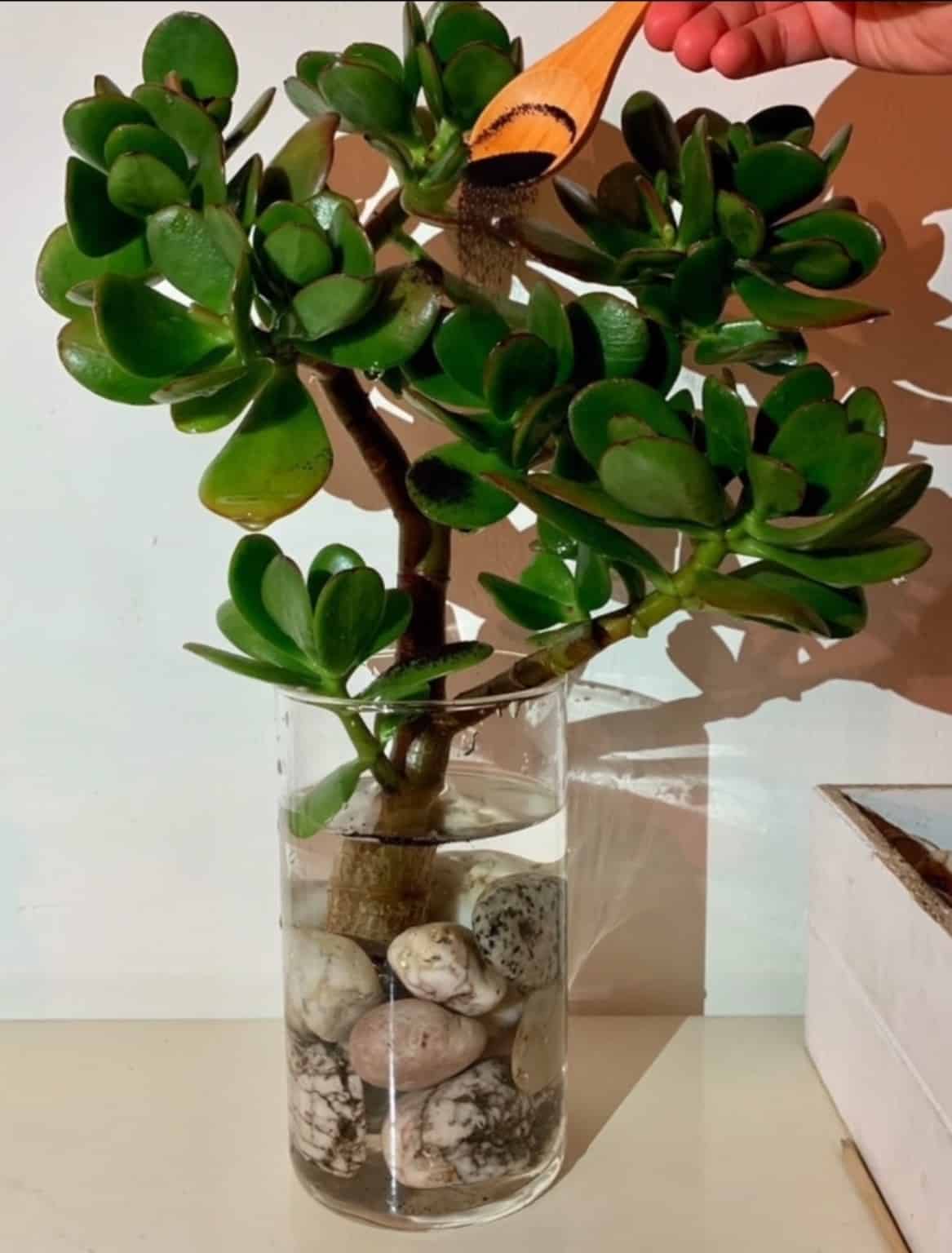
A beautiful Jade Plant growing in a clear glass vase filled with water and decorative stones can create an elegant indoor display. Its thick, glossy green leaves and woody stems make it an attractive choice for modern homes.
The image shows a mature Jade Plant (Crassula ovata) positioned in a tall glass container with water and smooth stones. A wooden spoon is sprinkling fine dark powder over the upper foliage.
But can dark powder help a Jade Plant grow stronger roots and healthier leaves? And is growing Jade Plants in water as effective as traditional potting soil?
The answer depends on the type of powder, how the plant is maintained, and whether its roots receive enough oxygen.
1. What Is the Dark Powder Being Added to the Jade Plant?
The dark material in the image resembles a fine powdered gardening product, but its exact composition cannot be determined from appearance alone.
Several plant-care products have a similar dark color.
These include:
- Fine horticultural charcoal.
- Powdered organic fertilizer.
- Humic acid powder.
- Seaweed-based plant supplements.
- Finely processed compost amendments.
- Mineral-based soil conditioners.
Each product serves a different purpose, and not all are appropriate for water-grown Jade Plants.
Important: Never add an unidentified powder directly to a Jade Plant, its leaves, or its water. Confirm the product’s ingredients and intended application before use.
Comparing Dark Plant-Care Powders
| Product | Primary Purpose | Suitable for Water Culture? |
|---|---|---|
| Horticultural charcoal | Used in some growing media | Not a complete fertilizer |
| Humic acid powder | Soil or nutrient supplement | Only if labeled for hydroponic use |
| Organic fertilizer powder | Provides nutrients as it decomposes | Usually better suited to soil |
| Seaweed extract powder | Supplementary plant nutrition | Only if water-soluble and appropriately labeled |
| Compost powder | Adds organic matter to soil | Not recommended in standing water |
| Hydroponic nutrient powder | Supplies dissolved mineral nutrients | Yes, when correctly formulated |
For Jade Plants grown in water, a properly diluted hydroponic fertilizer is generally a more predictable choice than an unidentified dark powder.
2. Can You Grow a Jade Plant in Water?
Yes. Jade Plant stem cuttings can develop roots in water, although this method requires careful maintenance.
Jade Plants are succulents that naturally prefer well-draining conditions. Their roots are vulnerable to rot when oxygen is limited or water remains stagnant.
Water propagation can be useful for establishing new cuttings, but long-term water culture is more demanding than growing Jade Plants in a succulent potting mix.
Benefits of Water Propagation
- Allows you to observe developing roots.
- Creates an attractive transparent display.
- Requires minimal equipment.
- Makes early root inspection easier.
Potential Disadvantages
- Greater risk of stem and root rot.
- Algae development in clear containers.
- Nutrient deficiencies without appropriate fertilizer.
- Root damage from stagnant water.
- Difficulty transitioning established soil roots into water.
A mature Jade Plant transferred directly from soil to water may experience considerable stress. Starting with a healthy stem cutting is usually safer.
3. How to Propagate a Jade Plant in a Glass Vase
The image features a tall transparent glass vase containing decorative stones.
You can create a similar arrangement using a healthy Jade Plant cutting.
Step 1: Select a Healthy Stem
Choose a firm, healthy branch approximately 4–6 inches long.
Use clean pruning shears to make a cut below a leaf node.
Remove the lowest leaves to expose a short section of stem.
Step 2: Allow the Cutting to Callus
Place the cutting in a dry, shaded location with good airflow.
Allow the cut end to dry and form a callus for several days before propagation.
This helps reduce the risk of decay.
Step 3: Prepare the Glass Container
Choose a clean glass vase with enough space to accommodate the cutting.
Add washed decorative stones if desired.
Avoid using stones collected from unknown locations without cleaning them thoroughly.
Step 4: Add Clean Water
Fill the vase with enough water to cover only the lower portion of the cutting.
Keep the leaves above the waterline.
Avoid submerging large sections of the stem.
Step 5: Position the Cutting
Use the stones to stabilize the stem without crushing or damaging it.
Place the vase in bright, indirect light.
Step 6: Monitor Root Development
Replace the water regularly and inspect the submerged stem.
Root development may take several weeks, depending on temperature, light, and the condition of the cutting.
If the stem becomes soft, dark, or unpleasant-smelling, remove it and inspect for rot.
Step 7: Decide on Long-Term Growing Conditions
Once roots develop, you can transfer the cutting into a well-draining succulent potting mix.
Alternatively, carefully maintained water culture is possible, but it requires suitable nutrients, clean water, and adequate root oxygen.
4. Best Fertilizer for Jade Plants Growing in Water
Jade Plants grown without soil cannot obtain nutrients from traditional potting media.
Over time, they may require a carefully formulated nutrient solution.
Recommended Fertilizer Options
| Fertilizer | Main Benefit | Recommended Use |
|---|---|---|
| Complete hydroponic fertilizer | Supplies essential mineral nutrients | Water-grown plants |
| Balanced liquid houseplant fertilizer | Provides basic nutrition | Only if suitable for water culture |
| Water-soluble succulent fertilizer | Supports controlled feeding | Follow product instructions |
| Hydroponic micronutrient formula | Supplies trace nutrients | When included in a complete feeding program |
| Organic compost fertilizer | Provides nutrients through decomposition | Better suited to soil |
A complete hydroponic fertilizer containing nitrogen, phosphorus, potassium, calcium, magnesium, and trace elements is preferable for sustained water culture.
Begin with a weak concentration appropriate for sensitive plants, following the product instructions.
Avoid adding fertilizer to freshly cut, unrooted stems.
How Often Should You Fertilize?
Established water-grown Jade Plants generally require much less fertilizer than fast-growing tropical houseplants.
During active growth, use a weak nutrient solution according to the fertilizer manufacturer’s recommendations.
Reduce feeding when growth slows.
Too much fertilizer can cause salt accumulation and root damage.
5. Is Dark Powder Good for Jade Plant Roots?
Some dark-colored gardening products contain compounds that can be useful in specific growing conditions.
However, the benefits depend entirely on their ingredients.
Horticultural Charcoal
Horticultural charcoal is sometimes included in potting media to modify physical properties.
It is not a substitute for complete plant nutrition and should not be assumed to prevent root rot in a glass vase.
Humic Acid
Humic acid products are commonly marketed as soil conditioners and nutrient supplements.
Some water-soluble formulations are compatible with hydroponic systems, but they should only be used according to their labels.
Organic Fertilizer Powder
Organic fertilizers may provide useful nutrients in soil, where microorganisms help break down organic matter.
Adding these products directly to standing water can encourage microbial growth and unpleasant odors.
Hydroponic Nutrient Powder
A properly formulated hydroponic nutrient powder can supply essential nutrients when dissolved at the recommended concentration.
This is a more appropriate choice for water-grown plants than unverified homemade mixtures.
6. Water vs. Soil: Which Is Better for Jade Plants?
| Feature | Water Culture | Succulent Potting Soil |
|---|---|---|
| Root development | Possible with careful maintenance | Generally more reliable |
| Drainage | Requires water and oxygen management | Controlled through soil structure |
| Fertilizer | Hydroponic nutrients may be needed | Succulent fertilizer during growth |
| Root rot risk | Higher if water becomes stagnant | Lower with proper drainage |
| Maintenance | Frequent monitoring | Moderate |
| Decorative appearance | Modern transparent display | Traditional or luxury planters |
| Long-term reliability | More demanding | Usually preferable |
For most indoor gardeners, growing Jade Plants in a high-quality succulent potting mix is the easier and more dependable option.
7. Best Potting Soil for Healthy Jade Plant Growth
If you decide to transfer your water-rooted Jade Plant into soil, choose a fast-draining growing medium.
A practical mixture includes:
- 50% premium cactus and succulent potting mix.
- 25% pumice or perlite.
- 25% coarse mineral grit or additional pumice.
The exact proportions can be adjusted based on the drainage characteristics of the original mix.
Choosing a Planter
Terracotta pots are especially useful because their porous walls allow moisture to evaporate.
Ceramic planters can also work well when they have adequate drainage holes.
Avoid oversized pots that retain unnecessary moisture around the roots.
8. Why Jade Plant Leaves Become Soft, Yellow, or Wrinkled
Healthy Jade Plant leaves are typically firm and fleshy.
Changes in their appearance may indicate growing problems.
| Symptom | Possible Cause | Solution |
|---|---|---|
| Soft, translucent leaves | Excess moisture or rot | Inspect roots and stem |
| Wrinkled leaves | Dehydration or damaged roots | Check root condition |
| Yellow leaves | Root stress or insufficient light | Review growing conditions |
| Brown leaf spots | Sun damage, injury, or disease | Inspect affected tissue |
| Black, mushy stem | Stem rot | Remove damaged tissue |
| Slow growth | Low light or seasonal dormancy | Improve conditions |
| White mineral deposits | Fertilizer or water salts | Refresh water and review dosage |
Avoid treating every leaf problem with additional fertilizer.
Root health, lighting, and moisture conditions should be checked first.
9. How Much Light Does a Jade Plant Need?
Jade Plants generally thrive in bright light.
Unlike many tropical foliage plants, they can tolerate several hours of direct sunlight when gradually acclimated.
For indoor growing, a bright south-facing or west-facing window is often suitable.
Growing Near a Window
Place the plant where it receives strong natural light without sudden exposure to intense sunlight.
Rotate soil-grown plants occasionally for balanced growth.
Using an LED Grow Light
A full-spectrum LED grow light can help maintain healthy growth in darker rooms.
Choose a fixture designed for houseplants and follow its recommended distance and daily lighting schedule.
Avoid leaving grow lights on continuously.
10. Can Jade Plants Grow Faster With Fertilizer?
Proper nutrition can support healthy growth, but Jade Plants are naturally moderate to slow growers.
Their growth rate depends on several factors:
- Adequate light.
- Healthy roots.
- Appropriate temperatures.
- Correct watering.
- Suitable nutrient availability.
- Seasonal growth patterns.
Adding extra fertilizer will not compensate for insufficient light or unhealthy roots.
For established soil-grown Jade Plants, a diluted balanced fertilizer during spring and summer is generally sufficient.
11. Luxury Indoor Styling With Jade Plants and Glass Vases
A Jade Plant displayed in a transparent glass vase can complement modern, minimalist, and luxury interiors.
The arrangement in the image combines glossy green leaves, a woody trunk, clear water, and smooth decorative stones.
Modern Glass Vase Centerpiece
Choose a tall, thick glass container with neutral-colored stones.
Position the plant on a marble or wooden console table where it receives suitable light.
Minimalist Living Room Display
Pair the Jade Plant with natural wood furniture, linen textures, and warm neutral colors.
The sculptural branches create an elegant focal point.
Premium Ceramic Planter Arrangement
For a more reliable long-term display, grow the Jade Plant in a premium ceramic planter with drainage.
Choose white, charcoal, or stone finishes to complement the deep green foliage.
Decorative Stone Styling
Smooth river stones can provide visual interest in glass arrangements.
However, decorative stones should not restrict root development or prevent proper cleaning.
Frequently Asked Questions
Can a Jade Plant live permanently in water?
It is possible to maintain some Jade Plants in water culture, but long-term success requires careful oxygen management, appropriate nutrients, and regular monitoring. Soil is generally more reliable.
What is the black powder sprinkled on the Jade Plant?
The powder cannot be identified from the image alone. It may resemble charcoal, humic acid, or a powdered fertilizer, but its composition must be verified before use.
Can I add charcoal powder to Jade Plant water?
Charcoal is not a complete fertilizer, and adding it to water does not guarantee protection against root rot.
What is the best fertilizer for Jade Plants in water?
A complete hydroponic nutrient formula used at an appropriate concentration is generally the most suitable option.
How long does a Jade Plant take to root in water?
Healthy stem cuttings may begin developing roots within several weeks, although timing varies with growing conditions.
Should I sprinkle fertilizer directly onto Jade Plant leaves?
No. Unless a product is specifically labeled for foliar application, apply fertilizer according to its soil or water-culture instructions.
Why is my Jade Plant turning yellow in water?
Possible causes include root stress, poor oxygen availability, nutrient imbalance, or unsuitable lighting.
Can I transfer a water-rooted Jade Plant into soil?
Yes. Use a well-draining succulent mix and monitor the plant carefully as its roots adapt to the new growing medium.
Final Thoughts
Growing a Jade Plant in a clear glass vase with decorative stones can create a striking indoor display, but maintaining healthy roots is more important than adding an attractive-looking powder.
The dark powder shown in the image should not be treated as a proven fertilizer without identifying its ingredients.
For water-grown Jade Plants, use clean water, maintain adequate root oxygen, and choose a properly formulated hydroponic nutrient solution when feeding becomes necessary.
For easier long-term care, a premium succulent potting mix, a well-draining planter, bright light, and moderate fertilization provide a reliable foundation.
With the right conditions, a Jade Plant can develop strong woody stems, glossy green leaves, and an attractive tree-like shape that enhances indoor spaces for many years.