12. Common Christmas Cactus Problems and Solutions
| Problem | Possible cause | Recommended solution |
|---|---|---|
| Wrinkled segments | Underwatering or root damage | Inspect soil and roots |
| Yellow segments | Moisture stress | Review watering |
| No flowers | Unsuitable light or temperature | Improve seasonal conditions |
| Bud drop | Sudden environmental changes | Stabilize care |
| Soft stems | Root or stem rot | Improve drainage |
| Slow growth | Low light or seasonal slowdown | Review growing conditions |
| Brown edges | Excess light or fertilizer stress | Adjust care |
Why Is My Christmas Cactus Not Blooming?
Insufficient dark periods, unsuitable temperatures, inadequate light during growth, or poor plant health may reduce flowering.
Why Are Christmas Cactus Buds Falling?
Bud drop may occur after sudden temperature changes, severe moisture stress, or abrupt changes in growing conditions.
13. How to Propagate Christmas Cactus
Christmas Cactus is relatively easy to propagate from healthy stem segments.
Step-by-Step Propagation
- Choose a healthy stem with two or three joined segments.
- Remove it carefully at a joint.
- Allow the cut end to dry briefly.
- Prepare a small container with airy potting mix.
- Insert the lower segment into the medium.
- Provide bright indirect light.
- Maintain light moisture without waterlogging.
- Wait for roots and new growth to develop.
Is Rooting Hormone Necessary?
Christmas Cactus cuttings can often root without rooting hormone.
A commercial rooting product is generally optional.
14. How to Repot Christmas Cactus
Christmas Cactus usually does not require frequent repotting.
Repot when the growing medium deteriorates or roots become excessively crowded.
Repotting Steps
- Choose a pot slightly larger than the root system.
- Prepare fresh, airy potting mix.
- Carefully remove the plant.
- Inspect the roots.
- Remove clearly rotten tissue using sanitized tools.
- Position the plant at its previous depth.
- Fill around the roots with fresh medium.
- Water appropriately.
Repotting after flowering is often convenient.
15. Common Christmas Cactus Pests and Treatments
Christmas Cactus may occasionally attract indoor plant pests.
Mealybugs
White cotton-like clusters may appear between stem segments.
Scale Insects
Scale insects may attach to stems as small bumps.
Fungus Gnats
Fungus gnats can become troublesome when potting mix stays excessively wet.
Recommended Pest Management
- Inspect plants regularly.
- Isolate affected specimens.
- Remove visible pests carefully.
- Use pest treatments labeled for holiday cacti when necessary.
- Avoid spraying delicate flowers unnecessarily.
- Maintain suitable watering and airflow.
16. Luxury Christmas Cactus Decorating Ideas
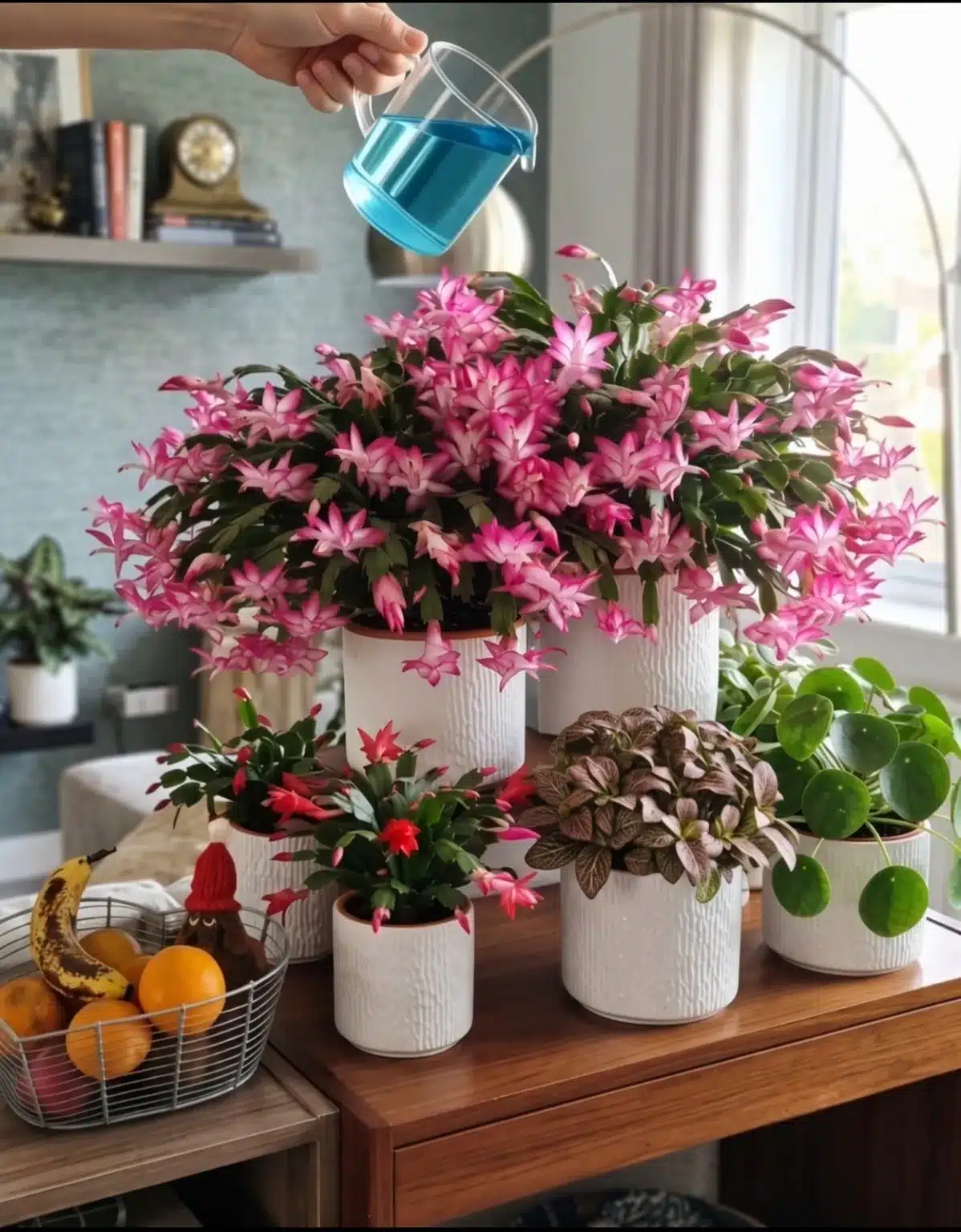
The image shows a beautifully coordinated indoor plant display with white ceramic planters, warm wooden furniture, and bright window light.
Elegant White Ceramic Collection
Display multiple pink Christmas Cactus plants in matching textured ceramic pots.
Luxury Living Room Centerpiece
Place a mature flowering Christmas Cactus on a wooden console or side table.
Holiday Window Display
Arrange red, pink, and white holiday cacti near a bright window.
Modern Indoor Plant Collection
Combine Christmas Cactus with separate pots of Pilea, Peperomia, and other attractive foliage plants.
Premium Hanging Planters
Use hanging ceramic or woven planters to highlight cascading stems.
Festive Seasonal Decoration
Pair blooming Christmas Cactus with subtle holiday lighting and neutral decorative accents.
Keep plants away from hot lamps and heating vents.
17. Frequently Asked Questions
Is blue liquid fertilizer good for Christmas Cactus?
A suitable fertilizer can support healthy growth when properly diluted and used according to its instructions.
Can blue liquid make Christmas Cactus bloom more?
Balanced nutrition may support flowering when nutrients are insufficient, but seasonal temperatures, dark periods, and plant health are also important.
Should blue liquid be poured directly onto Christmas Cactus flowers?
Generally, no. Most fertilizer solutions should be applied to the potting medium rather than directly over the flowers.
What is the best fertilizer for Christmas Cactus?
A complete balanced liquid fertilizer suitable for holiday cacti is generally appropriate during active growth.
How often should I fertilize Christmas Cactus?
Light feeding approximately every four weeks during active growth may be sufficient, depending on the product.
Why is my Christmas Cactus not flowering?
Insufficient dark periods, unsuitable temperatures, or poor growing conditions may prevent bud formation.
How do I make my Christmas Cactus fuller?
Provide suitable care and prune healthy stem segments lightly after flowering to encourage branching.
Can Christmas Cactus grow indoors?
Yes. Christmas Cactus is well suited to indoor growing conditions.
Can I propagate Christmas Cactus from cuttings?
Yes. Healthy stem segments can develop roots in an appropriate potting medium.
Is Christmas Cactus safe for pets?
Christmas Cactus (Schlumbergera) is generally considered non-toxic to cats and dogs, although consuming large quantities of plant material may still cause digestive upset.
Final Thoughts
Christmas Cactus is one of the most beautiful flowering houseplants, combining cascading green stems with colorful seasonal blossoms.
The blue liquid treatment shown in the image highlights the importance of selecting suitable fertilizers and applying them carefully.
For healthy long-term growth, prioritize complete holiday cactus fertilizer, premium airy potting mix, balanced watering, healthy roots, bright indirect light, and appropriate seasonal flowering conditions.
With thoughtful care and elegant white ceramic planters, Christmas Cactus can become a stunning centerpiece for a luxury living room, festive windowsill, or sophisticated indoor garden.