The Christmas Cactus (Schlumbergera) is one of the most beloved flowering houseplants, admired for its cascading green stems, delicate blossoms, and spectacular seasonal displays.
With proper care, Christmas Cactus plants can develop healthy roots, fuller branching stems, and beautiful flowers that brighten living rooms, windowsills, and elegant indoor gardens.
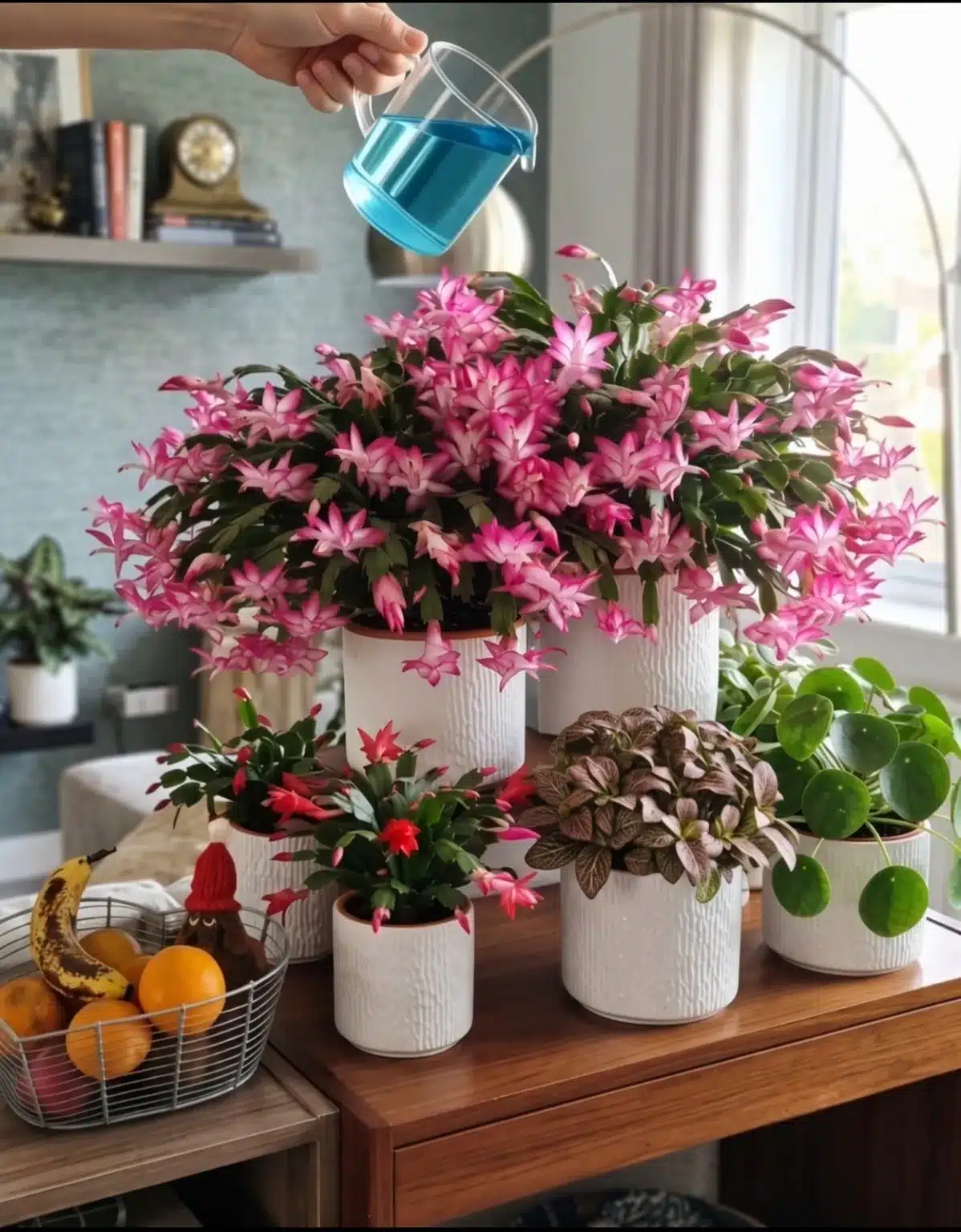
The image shows a stunning collection of pink-flowering holiday cacti growing in coordinated white ceramic planters. The two largest plants are covered with soft pink blossoms and cascading green segments. Smaller red-flowering cacti, a patterned foliage plant, and a Pilea complete the decorative display. Above the flowers, a gardener holds a transparent container filled with bright blue liquid.
Can blue liquid fertilizer help Christmas Cactus plants develop stronger roots, fuller green stems, and more beautiful flowers?
A properly formulated fertilizer can support healthy growth and flowering when nutrients are needed. However, the blue color does not identify the liquid’s ingredients, and excessive fertilization may damage sensitive roots.
This guide explains blue liquid fertilizer, premium Christmas Cactus potting mixes, correct watering, bloom stimulation, root care, and beautiful holiday cactus decorating ideas.
1. Understanding Christmas Cactus Growth
Christmas Cactus is a tropical forest cactus rather than a desert cactus.
Unlike drought-adapted desert species, it naturally grows in humid environments where its roots receive both moisture and airflow.
Holiday cacti are often confused with one another.
True Christmas Cactus (Schlumbergera × buckleyi) generally has more rounded stem segments, while Thanksgiving Cactus (Schlumbergera truncata) often has pointed projections along its segments.
The plants shown have flowering, segmented stems characteristic of the Schlumbergera group. Their exact species cannot be confirmed from the image alone.
Why Christmas Cactus Is Popular
- Beautiful pink, red, white, and purple flowers
- Attractive cascading growth
- Excellent indoor container plant
- Potential to live for many years
- Seasonal holiday flowering
- Easy propagation from stem segments
- Elegant decorative appearance
Ideal Growing Conditions
| Care factor | Recommended conditions |
|---|---|
| Light | Bright, indirect sunlight |
| Temperature | 60–75°F (16–24°C) during normal growth |
| Soil | Airy, well-draining organic potting mix |
| Watering | When the upper growing medium begins to dry |
| Humidity | Moderate humidity, around 40–60% |
| Fertilizer | Diluted complete houseplant fertilizer |
| Container | Pot with effective drainage |
| Flowering | Influenced by cooler nights and longer darkness |
2. What Is the Blue Liquid Being Used on Christmas Cactus?
The image shows a clear container filled with vivid blue liquid held above a flowering Christmas Cactus arrangement.
Some commercial water-soluble fertilizers and liquid plant nutrients are blue because of added coloring.
However, the liquid’s exact composition cannot be identified visually.
Common Blue Liquid Plant Treatments
| Treatment | Possible purpose | Important consideration |
|---|---|---|
| Complete liquid fertilizer | Supplies essential nutrients | Requires appropriate dilution |
| Water-soluble NPK fertilizer | Supports normal plant growth | Follow product instructions |
| Liquid cactus fertilizer | Provides formulated nutrition | Choose one suitable for holiday cacti |
| Micronutrient solution | Supplies trace elements | Use when needed |
| Seaweed-based supplement | Optional plant support | Not always complete nutrition |
| Unidentified blue liquid | Unknown composition | Do not apply until identified |
Can Blue Liquid Produce More Christmas Cactus Flowers?
Balanced nutrition can support normal growth and future flowering when nutrient levels are insufficient.
However, the number of flowers also depends on plant maturity, light exposure, seasonal temperatures, watering, and the development of healthy stem segments.
Fertilizer alone cannot guarantee additional flower buds.
3. Best Fertilizer for Christmas Cactus
Christmas Cactus benefits from moderate feeding during its active growing season.
A complete liquid houseplant fertilizer or suitable holiday cactus fertilizer is generally a practical choice.
Essential Nutrients
Nitrogen (N): Supports healthy green stem segments.
Phosphorus (P): Contributes to normal root function and energy transfer.
Potassium (K): Supports water regulation and normal flower development.
Magnesium and calcium: Help maintain healthy plant tissues and normal growth.
Fertilizer Comparison
| Fertilizer type | Main advantage | Suitable use |
|---|---|---|
| Complete liquid fertilizer | Easy dilution | Active growth |
| Water-soluble blue fertilizer | Measured nutrient application | Diluted feeding |
| Holiday cactus fertilizer | Convenient formulation | Seasonal care |
| Controlled-release fertilizer | Gradual nutrient supply | Established plants |
| Organic liquid fertilizer | Alternative nutrient source | Light feeding |
| Seaweed supplement | Optional supplemental care | Not complete nutrition |
What NPK Ratio Is Best?
A balanced complete fertilizer is generally suitable for Christmas Cactus.
High-phosphorus fertilizers are not automatically more effective for flowering when the plant already has adequate phosphorus.
Choose fertilizer based on the product label and plant condition.
4. How to Apply Blue Liquid Fertilizer Safely
The image shows blue liquid held above a flowering Christmas Cactus.
For most liquid fertilizers, the safest application method is to direct the diluted solution toward the potting medium rather than onto flowers or stem joints.
Step-by-Step Application
- Identify the product and check its ingredients.
- Confirm that it is suitable for Christmas Cactus.
- Read the manufacturer’s dilution instructions.
- Measure the recommended fertilizer amount.
- Mix with the specified volume of clean water.
- Check whether the potting medium requires watering.
- Apply the solution evenly around the root zone.
- Allow excess moisture to drain.
How Often Should You Fertilize?
During active stem growth in spring and summer, light feeding approximately every four weeks may be suitable for many fertilizer products.
Reduce or pause feeding as growth slows or while managing seasonal bud initiation.
Always follow the product’s instructions.
Signs of Excess Fertilizer
- Brown stem edges
- Yellowing segments
- White mineral buildup
- Root damage
- Drooping stems
- Premature segment drop
Avoid increasing fertilizer concentration to force extra blooms.
5. Can Blue Fertilizer Make Christmas Cactus Flowers Brighter?
The image features numerous beautiful pink flowers.
Flower color is primarily determined by the plant’s genetics.
Proper nutrition may help maintain normal flowering, but blue fertilizer cannot reliably change the plant’s natural flower color.
What Influences Flower Appearance?
- Cultivar genetics
- Flower maturity
- Temperature
- Light exposure
- Plant health
Some holiday cactus flowers may show slight color differences under changing temperature and environmental conditions.
Healthy Christmas Cactus flowers begin with strong roots and the right growing medium. Next, discover how premium potting mixes, proper watering, and balanced indoor conditions help support fuller stems and beautiful seasonal blooms.