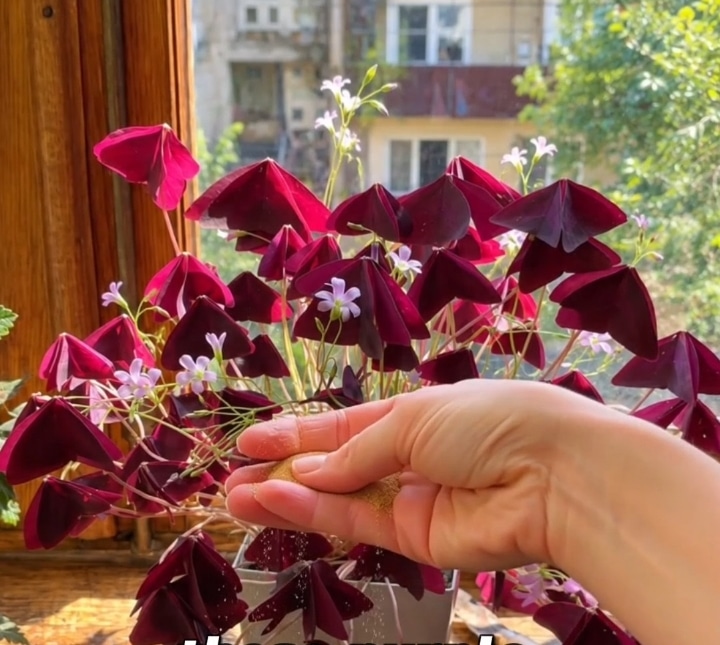
The Purple Shamrock is one of the most beautiful and unusual indoor plants, admired for its deep burgundy-purple leaves, delicate pinkish-white flowers, and remarkable butterfly-like appearance. Its triangular leaves open toward the light during the day and fold together at night, making the plant look almost alive with movement.
Known botanically as Oxalis triangularis, Purple Shamrock is a popular choice for sunny windowsills, decorative indoor planters, apartment gardens, and elegant living spaces.
The photograph shows a lush Purple Shamrock growing beside a bright wooden-framed window. Its rich purple leaves are surrounded by delicate pale flowers, while a hand holds a small amount of fine brown powder above the plant.
This raises an interesting gardening question: Can brown powder fertilizer help Purple Shamrock develop fuller foliage, stronger roots, and more flowers?
The answer depends on the powder’s ingredients, concentration, and how it is applied.
Some brown powders are suitable plant fertilizers or soil amendments. Others, including certain homemade treatments, may be ineffective or harmful when used incorrectly.
Understanding the difference is essential for keeping Purple Shamrock healthy.
1. Quick Answer: Is Brown Powder Good for Purple Shamrock?
A suitable brown granular or powdered fertilizer can support healthy Purple Shamrock growth when the plant needs additional nutrients.
However, the color of a powder does not establish whether it is safe or beneficial.
Brown powders used in gardening may include:
- Commercial organic fertilizer
- Worm castings
- Fine compost
- Ground plant-based fertilizer
- Cinnamon powder
- Coffee grounds
- Bone meal
- Other organic soil amendments
Each material behaves differently.
For Purple Shamrock, the safest approach is to use a properly formulated fertilizer intended for flowering houseplants.
Important: Never apply an unidentified powder directly to leaves, flowers, or soil without knowing what it contains.
Purple Shamrock has delicate foliage and relatively small underground storage structures. Excessive fertilizer or concentrated homemade treatments can damage its roots.
2. Understanding the Purple Shamrock Plant
Purple Shamrock belongs to the genus Oxalis.
Its distinctive triangular leaflets create the appearance of small purple butterflies.
Unlike many common foliage houseplants, Purple Shamrock grows from underground bulb-like storage structures, often called bulbs but botanically described as rhizomes.
These structures allow the plant to survive periods of dormancy and produce fresh growth when conditions become favorable.
Purple Shamrock Plant Profile
| Feature | Details |
|---|---|
| Botanical name | Oxalis triangularis |
| Common name | Purple Shamrock |
| Family | Oxalidaceae |
| Leaf color | Deep purple to burgundy |
| Flowers | Pale pink, lavender, or white |
| Light | Bright indirect light or gentle morning sun |
| Soil | Well-draining indoor potting mix |
| Water | Moderate during active growth |
| Fertilizer | Diluted balanced fertilizer |
| Temperature | Approximately 60–80°F (16–27°C) |
| Growth habit | Clumping |
| Propagation | Rhizome division |
| Dormancy | Possible under seasonal or environmental stress |
| Pet safety | Toxic if eaten due to soluble oxalates |
The plant’s beauty comes from its combination of richly colored foliage and delicate flowers.
3. What Is Happening in the Photograph?
The image features a mature Purple Shamrock growing in a white planter near a sunny window.
The leaves are dark burgundy-purple and folded into triangular shapes.
Several pale flowers rise above the foliage on slender stems.
A hand holds a fine brown powder close to the plant, apparently preparing to sprinkle it.
Visible Features
Deep purple foliage: The leaves have the characteristic triangular shape of Oxalis triangularis.
Delicate flowers: Small pale blossoms are visible among the leaves.
Bright natural light: The plant is positioned beside a window.
Brown powder: A fine brown material is being held in the hand, although its identity cannot be determined from appearance alone.
Decorative planter: The white pot creates a strong visual contrast with the purple foliage.
The photograph illustrates a possible top-dressing or fertilization practice.
However, it does not establish that the powder produced the plant’s healthy appearance or flowers.
4. What Could the Brown Powder Be?
Brown gardening powders can serve very different purposes.
Organic Fertilizer Powder
Commercial organic fertilizers may contain plant-derived or animal-derived nutrients.
They can support growth when applied according to the product instructions.
Worm Castings
Worm castings are a mild organic soil amendment.
They can contribute nutrients and organic matter to potting soil.
Fine Compost
Mature, screened compost may provide organic matter and small amounts of nutrients.
However, excessive compost can reduce drainage in small indoor containers.
Cinnamon Powder
Cinnamon is commonly discussed as a homemade gardening treatment.
It is not a complete fertilizer and should not be relied upon to stimulate roots or flowering.
Coffee Grounds
Used coffee grounds contain organic material and some nutrients, but they are not a balanced fertilizer.
Thick layers may interfere with aeration and moisture movement.
Bone Meal
Bone meal is a phosphorus-containing fertilizer.
It is not automatically necessary for Purple Shamrock and should only be used when appropriate.
Brown Powder Comparison
| Material | Potential purpose | Main concern |
|---|---|---|
| Balanced organic fertilizer | Nutrient supply | Overapplication |
| Worm castings | Mild soil amendment | Excessive top-dressing |
| Mature compost | Organic matter | Poor drainage |
| Cinnamon | Commonly used home treatment | Not a complete fertilizer |
| Coffee grounds | Organic material | Compaction and moisture issues |
| Bone meal | Phosphorus source | Unnecessary nutrient buildup |
| Unknown brown powder | Uncertain | Unpredictable effects |
For consistent results, choose a clearly labeled product.
5. Best Fertilizer for Purple Shamrock
Purple Shamrock is not an especially heavy feeder.
It can grow successfully in a quality potting mix with modest supplemental nutrition.
Balanced Liquid Fertilizer
A complete liquid houseplant fertilizer is usually a practical choice.
It provides measurable nutrients and is easy to dilute.
Fertilizer for Flowering Houseplants
A complete fertilizer suitable for flowering plants can support normal foliage and flower development.
Special high-phosphorus products are not automatically necessary.
Organic Fertilizer
A commercial organic fertilizer can be suitable when its nutrient analysis and application instructions are appropriate.
Controlled-Release Fertilizer
Slow-release granules can provide gradual nutrition.
Use cautiously in small containers.
Worm Castings
A thin layer can be incorporated into the surface of the potting medium.
However, worm castings should not replace complete fertilization when essential nutrients are deficient.
6. Understanding NPK Fertilizer
Fertilizer packaging commonly displays three numbers.
These represent nitrogen, phosphorus, and potassium.
Nitrogen
Supports healthy leaf development and chlorophyll production.
Phosphorus
Contributes to root function, energy transfer, and normal plant development.
Potassium
Supports water regulation and important metabolic processes.
Purple Shamrock benefits from balanced nutrition rather than excessive amounts of one nutrient.
A complete fertilizer with micronutrients is generally preferable to an improvised mixture.
7. How to Apply Brown Powder Fertilizer Safely
If the brown material is a suitable commercial powdered fertilizer, apply it according to the manufacturer’s instructions.
Step 1: Identify the Product
Read the fertilizer label.
Confirm that it is appropriate for container-grown flowering plants.
Step 2: Check the Plant’s Condition
Only fertilize actively growing, healthy plants.
Avoid feeding a dormant or severely stressed Purple Shamrock.
Step 3: Check Soil Moisture
Do not apply concentrated fertilizer to extremely dry roots.
Step 4: Measure the Powder
Use the manufacturer’s recommended quantity.
Do not estimate large amounts by hand.
Step 5: Apply to the Soil
Distribute the product as directed, keeping it away from delicate stems and leaves.
Step 6: Incorporate if Required
Some granular fertilizers should be gently mixed into the upper soil layer.
Avoid disturbing underground rhizomes.
Step 7: Water Appropriately
Follow the product’s watering instructions.
Step 8: Observe the Plant
Monitor foliage and flowering over the following weeks.
Do not expect immediate results.
8. Why You Should Avoid Sprinkling Powder Directly on Purple Shamrock Leaves
Purple Shamrock foliage is delicate.
Powder collecting on leaves and flowers may create unnecessary problems.
Possible concerns include:
- Leaf spotting
- Residue buildup
- Moisture retention
- Irritation from concentrated fertilizer
- Reduced ornamental appearance
Unless a product is specifically labeled for foliar use, apply it to the soil rather than the foliage.
9. Can Cinnamon Powder Help Purple Shamrock?
Cinnamon is frequently mentioned in homemade plant-care methods.
However, it is not a complete plant fertilizer.
Although certain cinnamon compounds have demonstrated antimicrobial properties under specific conditions, sprinkling kitchen cinnamon on potting soil is not a proven treatment for Purple Shamrock root diseases.
Cinnamon does not replace balanced fertilizer, proper watering, or healthy soil.
When Cinnamon Is Not Appropriate
Avoid applying thick layers around stems or rhizomes.
Do not use cinnamon as a substitute for treating serious root rot.
Do not assume it will increase flowering.
For healthy growth, focus on proven cultural care.
10. Can Coffee Grounds Improve Purple Shamrock Growth?
Used coffee grounds are sometimes recommended for houseplants.
However, their effectiveness depends on how they are processed and applied.
Potential Advantages
Coffee grounds contain organic matter and small amounts of plant nutrients.
Potential Problems
Excessive application can create a dense surface layer.
Organic residues may encourage unwanted fungal growth in persistently moist conditions.
Coffee grounds do not provide a predictable balance of essential nutrients.
Better Alternative
Compost used coffee grounds properly before incorporating them into a potting mix, or use a commercial balanced fertilizer.
11. Can Worm Castings Help Purple Shamrock?
Worm castings are among the more practical organic soil amendments for container plants.
They may contribute modest amounts of nutrients and organic matter.
How to Use Worm Castings
Apply a thin top-dressing to the soil surface.
Keep the material away from the central stems.
Avoid burying the plant’s crown.
Water normally.
Do not add so much material that drainage becomes compromised.
Important Note
Worm castings are not guaranteed to produce more flowers.
Flowering also depends on light, temperature, plant maturity, and overall health.
12. How Often Should Purple Shamrock Be Fertilized?
During active growth, Purple Shamrock may benefit from occasional light feeding.
A diluted complete liquid fertilizer approximately every four to six weeks can be a reasonable starting point when consistent with the product label.
Reduce or stop fertilization during dormancy.
Signs of Possible Overfertilization
- Brown leaf edges
- Yellowing foliage
- Wilting despite adequate moisture
- White fertilizer residue on the soil
- Damaged roots
More fertilizer does not necessarily produce more flowers.
13. Best Potting Soil for Purple Shamrock
Purple Shamrock prefers soil that holds some moisture while allowing excess water to drain.
Unlike drought-tolerant succulents, it should not remain completely dry for extended periods during active growth.
However, constantly saturated soil can damage its underground rhizomes.
Recommended Soil Components
Indoor potting mix: Provides a suitable growing foundation.
Perlite: Improves aeration.
Fine pine bark: Helps create structure.
Coco coir: Provides moisture retention.
Example Soil Blend
- 60% quality indoor potting mix
- 25% perlite
- 15% fine pine bark
Adjust the mixture based on indoor conditions.
The goal is a lightly moisture-retentive but well-draining medium.
14. Best Commercial Potting Mix Options
| Soil type | Suitability |
|---|---|
| Premium indoor potting mix | Very good |
| African violet potting mix | Often suitable |
| Perlite-amended houseplant mix | Very good |
| Dense garden soil | Poor |
| Heavy clay soil | Poor |
| Pure sand | Poor |
| Extremely coarse succulent mix | May dry too quickly |
Choose a container with functioning drainage holes.
15. How to Water Purple Shamrock Correctly
Purple Shamrock needs a different watering routine from ZZ plants or desert succulents.
During active growth, allow the upper portion of the potting medium to dry slightly before watering.
Step 1: Check the Soil
Feel the upper inch of the growing medium.
Step 2: Water When Needed
Water when the surface has begun drying but the plant has not become severely dehydrated.
Step 3: Water Evenly
Moisten the potting medium thoroughly.
Step 4: Allow Drainage
Let excess water escape.
Step 5: Empty the Saucer
Do not leave the container standing in water.
Step 6: Adjust During Dormancy
Reduce watering substantially when the foliage naturally dies back.
16. Why Purple Shamrock Leaves Fold at Night
One of the plant’s most fascinating features is its daily leaf movement.
Purple Shamrock leaves open during the day and fold at night.
This movement is called nyctinasty.
It is associated with changes in turgor pressure within specialized tissues.
Normal Leaf Movement
Leaves open in favorable light.
Leaves fold during darkness.
Flowers may also close.
When Folding May Indicate Stress
Persistent wilting during the day can indicate water stress, heat, or root problems.
Observe whether the plant reopens normally under suitable conditions.
17. Best Light for Deep Purple Leaves
Light strongly influences the plant’s appearance and growth.
Purple Shamrock generally performs best in bright indirect light with some gentle direct sunlight.
East-Facing Window
Often an excellent location.
Morning sunlight can support healthy growth.
South-Facing Window
Can work with filtering during intense periods.
West-Facing Window
Protect from excessive afternoon heat.
North-Facing Window
May be insufficient in some homes.
Signs of Too Much Sun
- Scorched leaves
- Dry edges
- Wilting during intense heat
Signs of Insufficient Light
- Weak elongated stems
- Reduced flowering
- Sparse growth
18. Can LED Grow Lights Help Purple Shamrock?
Yes.
LED grow lights can be useful in apartments with limited natural sunlight.
Full-Spectrum LED Lights
Support photosynthesis when natural light is insufficient.
Adjustable Desk Grow Lamps
Useful for small decorative pots.
Timer-Controlled Grow Lights
Provide consistent daily lighting.
What to Consider
- Light intensity
- Distance from foliage
- Coverage area
- Heat output
- Electricity consumption
- Manufacturer guidance
Avoid placing powerful grow lights too close to delicate foliage.
19. How to Encourage More Purple Shamrock Flowers
The photograph shows several pale flowers rising above the dark foliage.
Flowering is influenced by several conditions.
Provide Adequate Light
Bright indirect light and gentle morning sun can encourage healthy growth.
Maintain Suitable Temperatures
Avoid excessive heat and cold stress.
Use Balanced Nutrition
Feed lightly during active growth.
Water Consistently
Avoid prolonged drought and waterlogging.
Maintain Healthy Rhizomes
Use well-draining soil.
Respect Dormancy
Allow the plant to rest when it naturally enters dormancy.
Avoid Excess Nitrogen
Unnecessarily heavy nitrogen feeding can favor foliage growth without improving flowering.
20. Purple Shamrock Dormancy: What Every Grower Should Know
Purple Shamrock may enter a dormant period.
During dormancy, leaves can yellow, wilt, and die back.
This does not always mean the plant is dead.
The underground rhizomes may remain alive.
Signs of Dormancy
- Gradual leaf decline
- Reduced growth
- Fewer flowers
- Foliage dying back
What to Do
Reduce watering.
Stop fertilizing.
Remove dead foliage.
Keep the rhizomes in appropriate conditions.
Resume normal care when new growth appears.
Important Distinction
Sudden collapse accompanied by foul-smelling, mushy rhizomes suggests rot rather than healthy dormancy.
21. How to Repot Purple Shamrock
Repotting may be necessary when the plant becomes crowded or the potting medium deteriorates.
Step 1: Choose a Container
Select a pot with drainage holes.
Step 2: Prepare Fresh Soil
Use a light, well-draining potting mix.
Step 3: Remove the Plant
Handle the foliage and underground rhizomes gently.
Step 4: Inspect the Rhizomes
Healthy structures should feel firm.
Step 5: Separate if Desired
Divide healthy clusters carefully.
Step 6: Replant
Position rhizomes at an appropriate depth.
Step 7: Water Carefully
Avoid saturating damaged or dormant rhizomes.
Step 8: Provide Suitable Light
Place the container in bright indirect light.
22. How to Propagate Purple Shamrock
Purple Shamrock is commonly propagated by dividing its underground rhizomes.
Best Time
During repotting or when the plant is dormant or beginning active growth.
Propagation Method
Remove the plant from its container.
Identify healthy rhizome clusters.
Separate them gently.
Plant them in fresh potting medium.
Water lightly as appropriate.
Provide warmth and bright indirect light.
Wait for new shoots.
Important Note
Leaf cuttings are not the usual reliable propagation method for Oxalis triangularis.
Rhizome division is generally more effective.
23. Common Purple Shamrock Pests
Purple Shamrock may occasionally develop pest infestations.
Spider Mites
Can cause leaf stippling and fine webbing.
Aphids
May gather on tender shoots and flowers.
Mealybugs
Can appear as white cotton-like clusters.
Fungus Gnats
May become a problem when potting soil remains excessively wet.
Treatment
Isolate affected plants.
Inspect the foliage.
Remove visible pests where practical.
Use an appropriate pest-control product labeled for the plant and pest.
Test treatments on a small area first because Oxalis foliage can be sensitive.
24. Why Purple Shamrock Leaves Turn Brown
Brown foliage may result from several conditions.
Excessive Direct Sunlight
Strong sunlight can scorch leaves.
Underwatering
Severe dryness can cause wilting and crispy edges.
Overwatering
Saturated soil may damage roots.
Fertilizer Burn
Excess salts can injure plant tissues.
Dormancy
Natural seasonal decline can cause foliage to dry.
Low Humidity and Heat
Hot, dry conditions may increase moisture stress.
Correct the underlying problem rather than immediately adding more fertilizer.
25. Purple Shamrock Troubleshooting Table
| Problem | Possible cause | Recommended action |
|---|---|---|
| Leaves remain folded | Low light or stress | Check growing conditions |
| Brown edges | Heat, dryness, or fertilizer | Review care |
| Yellow leaves | Overwatering or dormancy | Inspect soil and rhizomes |
| Few flowers | Insufficient light | Improve lighting |
| Weak stems | Low light | Move to brighter location |
| Mushy rhizomes | Rot | Remove damaged tissue |
| Dry crispy leaves | Underwatering or sun | Adjust conditions |
| White insects | Mealybugs | Treat appropriately |
| Fine webbing | Spider mites | Isolate and inspect |
| No new growth | Dormancy or poor conditions | Check rhizomes |
| Powder residue | Excessive application | Remove carefully |
| Sparse foliage | Light, nutrition, or dormancy | Review overall care |
26. Best Products for Purple Shamrock Care
Premium Indoor Potting Mix
Supports healthy roots.
Balanced Liquid Fertilizer
Provides measurable nutrition.
Worm Castings
Useful as a mild organic amendment.
Perlite
Improves drainage.
Decorative Ceramic Planter
Enhances appearance.
LED Grow Light
Supports growth in dim interiors.
Moisture Meter
Can assist with soil monitoring.
Waterproof Plant Saucer
Protects furniture.
Small Pruning Scissors
Useful for removing spent flowers and damaged foliage.
Insecticidal Soap
Can help manage certain pests when labeled for use.
27. Purple Shamrock vs. Green Shamrock Plants
Purple Shamrock is often confused with other Oxalis species.
| Feature | Purple Shamrock | Green Shamrock Types |
|---|---|---|
| Leaf color | Purple or burgundy | Green |
| Leaf shape | Triangular leaflets | Varies by species |
| Flowers | Pale pink to white | Varies |
| Decorative effect | Dramatic contrast | Fresh green appearance |
| Light | Bright indirect | Species dependent |
| Dormancy | Possible | Species dependent |
Correct plant identification helps determine the best care routine.
Luxury Home Decor With Purple Shamrock
28. Why Purple Shamrock Is Perfect for Elegant Interiors
Purple Shamrock brings a distinctive combination of color, texture, and movement into interior spaces.
Its deep burgundy foliage contrasts beautifully with neutral walls, natural wood, white ceramics, and brass accents.
The delicate flowers soften its dramatic appearance.
Because the leaves move throughout the day, the plant also creates a dynamic visual element.
29. Purple Shamrock on a Sunny Windowsill
The photograph demonstrates one of the most attractive ways to display Purple Shamrock.
A wooden-framed window provides a warm natural backdrop.
Sunlight illuminates the leaves and emphasizes their rich color.
Styling Ideas
Choose a white ceramic planter.
Position the plant near bright filtered sunlight.
Allow the foliage room to spread.
Pair it with natural wood accessories.
Avoid overcrowding the windowsill.
30. Best Planter Colors for Purple Shamrock
| Planter color | Decorative effect |
|---|---|
| White | Strong purple contrast |
| Cream | Soft elegance |
| Matte black | Dramatic contemporary |
| Terracotta | Warm natural |
| Sage green | Botanical contrast |
| Brass-toned | Luxury accent |
| Light gray | Modern minimalist |
| Pale pink | Romantic styling |
A decorative planter should always accommodate proper drainage.
31. Purple Shamrock in Modern Living Rooms
Purple Shamrock works beautifully on side tables, plant shelves, and bright window ledges.
Its compact growth makes it suitable for smaller interiors.
A white or cream ceramic pot creates a refined appearance.
Pair it with natural textures such as oak, linen, or stone.
32. Purple Shamrock in Luxury Apartments
For apartment gardeners, Purple Shamrock offers dramatic color without requiring a large floor planter.
It can be displayed on a windowsill or elevated plant stand.
Bright indirect light is important.
A small LED grow light may help where natural light is insufficient.
33. Purple Shamrock in Home Offices
Purple Shamrock can add color to a home office without overwhelming the workspace.
Place it near a suitable window.
Use a stable container and waterproof saucer.
Avoid positioning the plant near heating vents or hot electronics.
34. Combining Purple Shamrock With Other Houseplants
Purple Shamrock can be visually paired with green foliage plants.
Pothos
Creates trailing green contrast.
Peace Lily
Provides broad leaves and pale spathes.
Spider Plant
Adds narrow, arching foliage.
Snake Plant
Creates upright architectural contrast.
Ferns
Add soft foliage texture.
Keep different species in separate pots so their watering requirements can be managed individually.
35. Creating a Burgundy and Green Indoor Garden
A burgundy-and-green plant display can create a sophisticated decorative effect.
Use Purple Shamrock as the colorful focal point.
Surround it with green foliage plants of different heights.
Choose coordinated planters.
Use natural wood or stone shelving.
Maintain sufficient space for airflow.
Avoid grouping plants so closely that their leaves remain wet or crowded.
36. Purple Shamrock Care Calendar
| Season | Main care focus |
|---|---|
| Spring | Active growth and light feeding |
| Summer | Moisture monitoring and heat protection |
| Fall | Adjust watering as growth changes |
| Winter | Monitor for dormancy and reduced growth |
Seasonal behavior depends on indoor conditions and the plant’s growth cycle.
37. Frequently Asked Questions
What Is the Brown Powder in the Photograph?
Its identity cannot be confirmed from appearance alone. It may be a fertilizer or soil amendment.
Can Brown Powder Make Purple Shamrock Grow Faster?
Appropriate fertilizer can support growth when nutrients are limited, but excessive application can cause damage.
What Is the Best Fertilizer for Purple Shamrock?
A complete, balanced houseplant fertilizer used conservatively.
Can I Sprinkle Cinnamon on Purple Shamrock?
Cinnamon is not a complete fertilizer or a proven general treatment for this plant.
Are Coffee Grounds Good for Purple Shamrock?
They are not a reliable replacement for balanced fertilizer and may cause problems when applied excessively.
Can Worm Castings Help?
They can provide a mild organic soil amendment when used sparingly.
How Often Should I Fertilize?
Occasionally during active growth, according to the fertilizer label.
Why Are Purple Shamrock Leaves Folding?
Daily folding is a normal response to changing light conditions.
Why Are the Leaves Turning Brown?
Possible causes include excessive sunlight, water stress, fertilizer damage, or dormancy.
Why Is My Purple Shamrock Not Flowering?
Insufficient light, dormancy, or unsuitable growing conditions may contribute.
Does Purple Shamrock Need Direct Sunlight?
Gentle morning sunlight can be beneficial, but harsh midday sunlight may cause damage.
Can Purple Shamrock Grow Indoors?
Yes, with adequate light and appropriate care.
What Is the Best Soil?
A moisture-retentive but well-draining indoor potting mix.
How Do I Propagate Purple Shamrock?
Divide healthy underground rhizomes.
Is Purple Shamrock Toxic to Cats?
Yes. Oxalis contains soluble oxalates and should be kept away from pets that may eat it.
Can Purple Shamrock Recover After Losing Its Leaves?
Yes, if the underground rhizomes remain healthy and the plant is dormant rather than rotting.
Does Purple Shamrock Need a Humidifier?
Usually not under normal household conditions.
Can I Use Slow-Release Fertilizer?
Yes, when the product is suitable and applied carefully.
Why Are the Flowers Closing?
Flowers may respond to changes in light and environmental conditions.
Can Purple Shamrock Grow Under LED Lights?
Yes, when the lighting provides sufficient intensity and duration.
38. Quick Care Notes
Q: What is the safest way to use brown powder on Purple Shamrock?
A: Identify the product first. If it is a suitable commercial fertilizer, measure and apply it to the soil according to the label. Avoid coating delicate leaves and flowers.
Q: What encourages fuller purple foliage and more flowers?
A: Bright indirect light, gentle morning sun, healthy rhizomes, consistent watering during active growth, and modest balanced fertilization.
39. Final Purple Shamrock Care Checklist
- Provide bright indirect light.
- Allow gentle morning sunlight when appropriate.
- Protect foliage from intense afternoon heat.
- Use well-draining potting soil.
- Keep the soil moderately moist during active growth without waterlogging.
- Reduce watering during dormancy.
- Use balanced fertilizer conservatively.
- Avoid unidentified brown powders.
- Keep fertilizer off delicate foliage unless labeled for foliar use.
- Inspect underground rhizomes when problems occur.
- Monitor for pests.
- Divide rhizomes when propagation is desired.
- Choose decorative containers with drainage.
- Remove dead flowers and foliage when appropriate.
- Keep the plant away from pets that may chew it.
Final Thoughts: The Secret to Beautiful Purple Shamrock Leaves and Flowers
The Purple Shamrock in the photograph is a beautiful example of how richly colored foliage and delicate flowers can transform an ordinary windowsill into an elegant indoor garden.
Its deep burgundy leaves, pale blossoms, and natural daily movements make it one of the most visually interesting small houseplants.
The brown powder shown in the photograph may represent a gardening treatment, but its identity and benefits cannot be established from the image.
A suitable fertilizer can support healthy growth, yet the plant’s success depends primarily on light, watering, healthy rhizomes, appropriate soil, and seasonal care.
Avoid excessive fertilizer, unidentified homemade mixtures, and thick layers of powder on delicate foliage.
With consistent care, Purple Shamrock can produce beautiful triangular leaves, fresh growth, and graceful flowers while adding a sophisticated touch to windowsills, living rooms, apartments, and home offices.
The real secret to a full, beautiful Purple Shamrock is healthy rhizomes, balanced nutrition, bright light, and careful watering—not an unidentified brown powder.